
Sustainable sports events have become a major priority for organizers, governing bodies, host cities, and sponsors worldwide. Climate commitments, ESG targets, and sustainability strategies are now common features of major championships and international competitions. Yet while the industry increasingly recognizes the importance of sustainability, implementation often proves far more challenging than ambition. The first part of this two-part series explores the operational realities behind sustainable sports events and the challenges of turning sustainability commitments into day-to-day event operations.
From sustainability claims to operational reality
For years, the sports industry treated sustainability primarily as a reputational issue. Today, the situation is very different. Sustainability strategies, climate commitments, legacy programmes, and ESG targets have become standard elements of major sporting events, from Formula 1 and Formula E to the Olympic Games, the FIFA World Cup, ATP tournaments, and NBA events.
The challenge is no longer convincing organisations that sustainability matters. The challenge is ensuring that sustainability changes how events are designed, procured, delivered, and measured.
A major sporting event involves a complex network of stakeholders, including host cities, venues, suppliers, logistics providers, broadcasters, contractors, mobility operators, and public authorities. Each operates under different priorities, timelines, financial pressures, and operational constraints. As a result, sustainability commitments made at leadership level do not always translate into operational decisions on the ground.
This problem is often reinforced by timing. Sustainability teams are frequently brought into projects after key decisions have already been made. By then, supplier contracts may be signed, scopes of work agreed, and performance indicators established, leaving limited room for meaningful change.
Importantly, sustainable event management extends beyond environmental performance. It also includes labour standards, accessibility, community engagement, supply chain responsibility, diversity, inclusion, and human rights considerations. These dimensions are increasingly interconnected, particularly in global events involving temporary workforces, international suppliers, and large-scale urban operations.
The industry has made significant progress over the past fifteen years. Sustainability is no longer viewed solely as a cost or compliance requirement. Many organisations now recognise that sustainability and operational efficiency can reinforce one another.
Ultimately, sustainable event management is not about symbolic initiatives or isolated environmental campaigns. It is about integrating sustainability into procurement, logistics, mobility, and infrastructure planning from the earliest stages of event development.
One of the most effective ways to accelerate this transition is to combine long-term transformation with short-term quick wins. Practical actions that deliver immediate operational, reputational, or commercial benefits can help build momentum for deeper changes in procurement, logistics, waste management, and supplier engagement.
The hidden environmental footprint of sustainable sports events
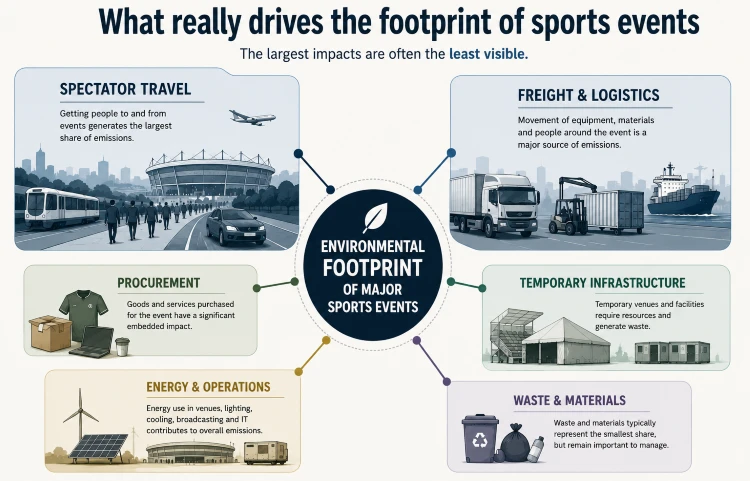
Public discussions around sustainability in sport often focus on highly visible actions: reusable cups, recycling campaigns, beach clean-ups, or carbon offsetting initiatives. While these activities can help raise awareness and engage audiences, they often represent only a small fraction of the actual environmental footprint generated by major events.
The largest impacts frequently come from systems that remain largely invisible to spectators. For globally deployed championships and tournaments, transport and supply chains represent some of the most significant sources of emissions. The movement of people, equipment, temporary infrastructure, freight, and services across multiple countries and continents creates an enormous operational footprint long before spectators even arrive at venues.
In fact, a substantial share of the environmental footprint of major international events is created before the event even begins. It comes from moving people, equipment, materials, services, and temporary infrastructure into place — often across multiple countries and continents. A significant proportion of emissions are therefore generated simply by bringing everything and everyone to the event.
This includes not only athlete and spectator travel, but also employee mobility, broadcasting equipment, catering infrastructure, hospitality operations, temporary structures, branding materials, and technical systems required to deliver modern sports events at a global scale.
Spectator travel is often one of the largest contributors to event-related emissions, particularly for international tournaments attracting large travelling audiences. This is why transport infrastructure and urban mobility planning are becoming increasingly central to sustainable event strategies.
Recent evidence confirms the scale of this challenge. Analysis of the Paris 2024 Olympic Games found that travel by spectators, athletes and officials accounted for approximately 53% of total event-related emissions. Similar findings have emerged across other major sporting events, where mobility consistently represents the largest single source of environmental impact.
In the United Kingdom, for example, major venue development is closely linked to public transport accessibility. New stadium projects are generally expected to have strong integration with underground or rail networks in order to reduce reliance on private vehicles. The O2 Arena in London is a good example of this approach. Access by car is intentionally limited, while public transport connectivity plays a central role in crowd management and mobility planning.
However, restrictions alone are not enough. Cities and organizers cannot simply discourage car use without providing credible alternatives. Sustainable mobility requires integrated transport systems capable of supporting large-scale urban events efficiently and reliably.
Research also shows how strongly transport choices influence overall event emissions. A study of professional football matches in Austria found that 42.4% of spectators arriving by car were responsible for 71.6% of transport-related greenhouse gas emissions, while more than half of spectators travelling by public transport generated only 27.1% of emissions. The findings illustrate how mobility choices can significantly influence the environmental footprint of sports events.
Freight and logistics present one of the greatest challenges for sustainable sports events.
Historically, international championships often followed calendars that required constant intercontinental travel, creating highly inefficient logistics patterns. In recent years, this has started to change. Several championships have begun redesigning race calendars around geographical clusters, organizing multiple events within the same region before moving equipment and operations elsewhere.
Formula E was among the early adopters of this approach, while Formula 1 has also introduced more geographically rationalized scheduling in recent seasons. These changes reduce unnecessary freight movement while simultaneously improving operational efficiency.
The impact of such operational decisions is becoming increasingly visible. In June 2025, Formula E became the first sport in the world to achieve third-party certified Net Zero Pathway status through the British Standards Institution (BSI). As part of this commitment, the championship has pledged to reduce Scope 1 and 2 emissions by 50% and Scope 3 emissions by 27.5% by 2030, compared with its 2018–19 baseline season. The pathway also prioritizes practical measures such as renewable electricity, smarter freight logistics, sustainable fuels, waste reduction, and more sustainable fan experiences. Formula E aims to achieve credible net-zero emissions by 2040, and no later than 2050, in line with the UNFCCC Sports for Climate Action Framework.
This is an important point that is often overlooked in sustainability discussions: sustainability and cost-efficiency frequently go hand in hand.
Optimizing transport routes, reducing unnecessary freight movement, minimizing duplicated operations, and improving logistics planning can reduce both operational costs and environmental impacts simultaneously.
One of the most practical examples of sustainability and efficiency working together is freight planning. In electric motorsport, organizers sought to prioritise sea and road freight over air freight wherever possible. While championships continued operating in one region, containers carrying non-critical infrastructure and technical equipment were already moving toward future destinations by sea.
Air freight was reserved for equipment that could not realistically move through slower transport systems. This approach reduced environmental impact while also improving cost-efficiency and operational resilience. It required early planning, calendar discipline, and close coordination between sporting, broadcast, logistics, and event operations teams.
This example illustrates a broader principle: sustainability becomes meaningful when it is integrated into the operational architecture of an event rather than treated as a separate communication exercise.
AI-supported logistics tools may increasingly help with route optimisation, freight consolidation and calendar planning, but their real value depends on the quality of operational data and whether planning teams act on the outputs early enough. Technology can support better decisions, but it cannot compensate for late planning or poor governance.
The sustainability conversation in sport is therefore shifting away from isolated symbolic actions toward much broader questions about operational systems, infrastructure, mobility, and supply chain management.
This shift is essential because the environmental impact of global sport is not primarily generated by what audiences see on television screens. It is generated by the complex logistical ecosystem required to make those events possible.
Why sustainable event management often fails in practice
One of the most persistent problems in sustainable event management is that sustainability is still too often treated as an additional layer rather than as a foundational operational principle.
In practice, operations teams working on major events operate under intense pressure. They face strict deadlines, budget constraints, security requirements, broadcasting obligations, crowd management responsibilities, and complex coordination challenges involving hundreds of suppliers and contractors.
Under these conditions, sustainability can easily become secondary unless it has already been embedded into the event design process from the very beginning.
A useful example comes from NBA events in Paris. Following preparations for the Paris 2024 Olympic Games, operational awareness around waste management and single-use plastics had already increased among venues, suppliers, and service providers. As a result, measures such as reducing or eliminating single-use plastics became significantly easier to implement. The lesson is broader than waste management alone: sustainability initiatives are far more likely to succeed when they are introduced into ecosystems that already possess the necessary operational readiness, supplier capacity, and stakeholder support.
The areas where the gap between ambition and operational reality most frequently emerges are often predictable. Energy systems, water usage, waste management, hospitality and catering, branding and signage, transport logistics, fan mobility, and temporary infrastructure all require careful pre-planning if sustainability objectives are to be implemented effectively. Waste performance is not achieved by placing recycling bins around a venue. It depends on whether back-of-house segregation has been designed properly, whether cleaning teams are trained, whether caterers use compatible materials, whether local recycling infrastructure exists, and whether waste contractors can provide reliable post-event data
Procurement remains one of the most critical areas. For sustainable sports events, procurement decisions often determine whether sustainability objectives can be translated into measurable operational outcomes.
If sustainability considerations are introduced only after procurement decisions have already been finalized, opportunities for meaningful intervention become extremely limited. Once suppliers are contracted and operational frameworks established, organizations are often reluctant to introduce changes that may affect timelines, budgets, or contractual obligations. The opportunity to reduce impact is highest before the procurement specification is issued. Once a supplier is appointed, materials are selected and delivery timelines are locked, sustainability becomes much harder to influence.
This is why sustainability experts must be involved during the concept and design stages of events rather than at the final implementation stage.
Sustainability cannot function effectively as a corrective mechanism added after operational systems are already fixed. It needs to shape the systems themselves.
Everything from material selection and temporary infrastructure planning to waste systems, energy sourcing, and logistics strategies should ideally be designed around principles of efficiency, circularity, and long-term operational impact from the outset.
At the same time, procurement teams themselves increasingly need sustainability literacy. Event professionals responsible for sourcing products and services must be able to identify technologies, materials, and operational solutions capable of delivering the same operational outcomes with lower environmental impact. Importantly, this does not always imply higher costs. In many cases, more efficient operational planning produces both environmental and financial benefits simultaneously.
However, transformation in the events industry inevitably takes time. Many supplier relationships operate through multi-year contracts, meaning that organizations may need to wait several years before introducing stronger sustainability criteria into new tenders and procurement frameworks.
Despite these limitations, awareness within the industry has changed significantly over the past decade. Sustainability is no longer viewed purely as a reputational exercise or a financial burden. Increasingly, organizations recognize that operational resilience, efficiency, stakeholder expectations, and sustainability performance are becoming deeply interconnected.
The challenge now is not whether sustainability should be integrated into sports events. The challenge is how early, how consistently, and how seriously that integration takes place across the operational life cycle of an event.
Conclusion: sustainability is an operational challenge
The sports industry has made remarkable progress in recognising sustainability as a strategic priority. Today, climate commitments, ESG frameworks, and sustainability strategies are no longer exceptions. They have become part of the standard language of major sporting events.
Yet recognition alone does not guarantee results.
As this first part has shown, the greatest environmental impacts often emerge from operational systems that remain largely invisible to spectators: transport, logistics, procurement, supply chains, and infrastructure planning. The difference between successful sustainability programmes and symbolic initiatives is often determined not by ambition, but by whether sustainability is integrated into decision-making from the earliest stages of event design.
Ultimately, sustainable sport is becoming less about communication and more about operations. The future of sustainable sports events will depend not only on ambitious commitments, but on the ability of organizations to integrate sustainability into everyday operational decisions.
Yet even the most efficient logistics system cannot guarantee a sustainable event. Sporting events are ultimately embedded within local communities, governance structures, cultures, and economies. Their long-term value depends not only on reducing negative impacts, but also on creating positive ones. Understanding these relationships, and the opportunities and risks they create, is the subject of Part II of this series. We will explore why local context matters, how meaningful legacy can be created beyond infrastructure, why greenwashing has become a growing risk for sports organizations, and what the future of sustainable sports events may look like.
About the author: Pierluigi Zacheo is the Founder of MyStadium, a strategic sustainability consulting company specializing in major sporting events, with expertise in environmental strategy, event operations, logistics, and ESG implementation.
Read about sustainable stadiums here