
Co-author: Isabel Why
The central question this article addresses is: If trees have a well-documented, measurable effect in lowering urban temperatures and reducing building cooling demand, why are they systematically excluded from the technical workflows, heat mapping, building energy modelling, and street-level environmental design that determine how cities invest in heat resilience?
In a recent article for New Polis Media, it was argued that smart city frameworks remain dangerously blind to living systems. Digital twins, Building Information Modelling (BIM), and Geographic Information Systems (GIS) overwhelmingly treat landscape as context rather than infrastructure. A tree appears as a generic object with a fixed cost, not as a dynamic system delivering quantifiable cooling, stormwater interception, or carbon sequestration. This argument can be examined through a single, urgent challenge: urban heat.
The heat mapping gap
Walk into any municipal planning department during a heat action plan update. You will see surface temperature maps derived from satellite imagery, albedo calculations for roofing materials, and solar radiation studies for street canyons. What you will rarely see is a high-resolution tree canopy model integrated into building energy compliance software or pedestrian thermal comfort standards.
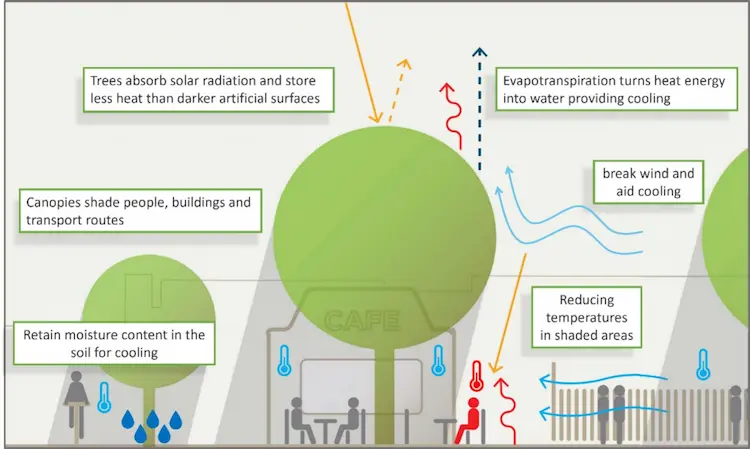
This is not a data availability problem. High-resolution LiDAR canopy data exists for most major cities. The problem is that building energy simulations, such as EnergyPlus or the tools embedded in green building rating systems, do not routinely accept tree shade or transpirational cooling as a calculable input. Consequently, a cool roof coating qualifies for efficiency credits. A mature street tree does not. A shading louvre counts toward passive cooling. A London plane tree, which can reduce peak surface temperatures by 10–25°C and lower adjacent building cooling demand by an estimated 20–30%, does not.
As Liu et al., 2024 documented in their systematic review of digital twin research from 2018 to 2024, the depth of research in the landscape domain remains significantly lower than for buildings and urban environments, despite growing recognition that this represents a critical gap. That gap has direct thermal consequences.
The albedo bias
Environmental design has developed a pronounced bias toward material solutions. Cool pavements, high-albedo roofs, and reflective cladding are legible to engineers. They have R-values, solar reflectance indices, and supply chains. Trees, by contrast, introduce what planners call “uncertainty”: maintenance costs, root interactions with underground utilities, and spatial competition with vehicle lanes or parking.
Yet the scientific literature is challenging this ‘uncertainty’. A 2024 study by Huang and Li demonstrated that parametric simulation can calculate vegetation coverage and ecological performance metrics, including cooling capacity, with sufficient precision to enable design efficacy evaluation. The LIM Arboris framework applied at the Hereford Station Transport Hub in the UK embedded species-level ecosystem service data, microclimate simulations, and cooling estimates into a multi-modal transport project.4 Where a standard BIM model specified a tree as a generic object, LIM Arboris modelled that same tree’s transpiration rate and shade geometry.
Trees demonstrably reduce solar gain, lower ambient air temperatures, and improve building energy performance, so why do standard compliance tools continue to exclude both existing and proposed canopy cover from their models?
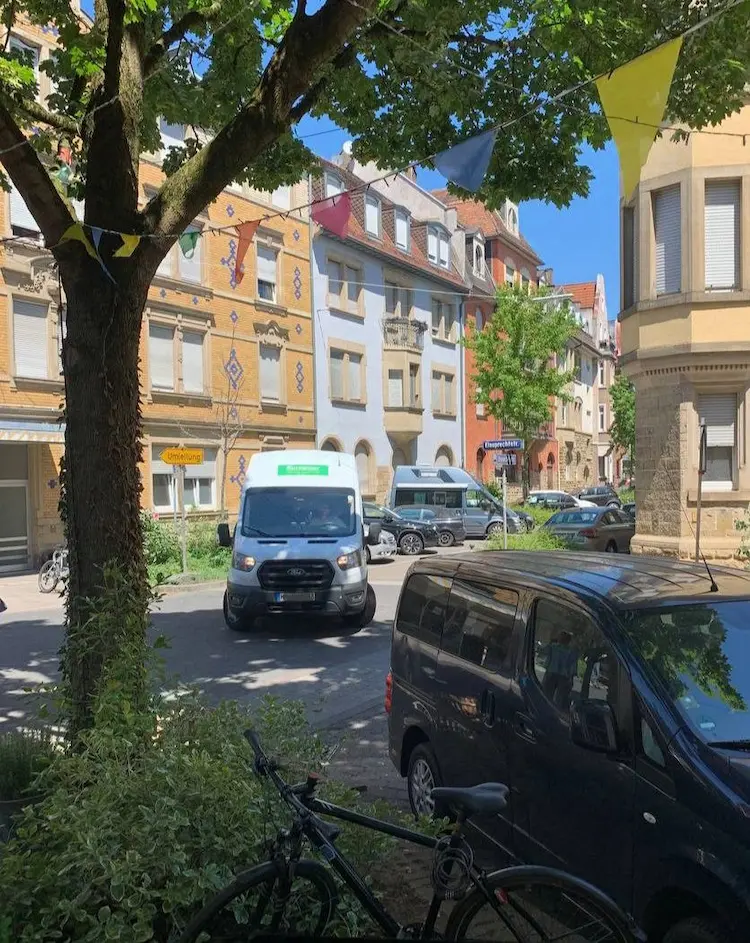
What urban heat resilience integration looks like
A genuinely smart heat strategy would embed a living data layer into every urban thermal model. That layer would include:
- Species-specific shading geometry, urban morphology suitability, and transpiration rates (drawing on databases such as i-Tree Eco, which quantifies cooling for individual taxa)
- Soil water balance and its effect on evaporative cooling
- Maintenance cost predictions alongside cooling benefit calculations
- Future climate scenario testing for alternative planting palettes
Gao and colleagues’ work on historic garden preservation using LIM technology has already validated that such frameworks can achieve high-precision interpretation of environments combining buildings, vegetation, and topography. The technological building blocks exist. What is missing is the governance rule that says: no heat resilience plan shall be approved without a canopy-integrated thermal model.
The exclusion of trees from compliance models is a distributional injustice. Older adults, whose impaired thermoregulation makes them four times more vulnerable to heatstroke, derive disproportionate protection from tree canopy. A study in The Lancet calculated that increasing tree canopy to 30% coverage in 93 European cities could prevent an estimated four in 10 premature heat-related deaths in adults. Children who can see trees from classroom windows exhibit fewer behavioural problems and stronger immune development.
Tree benefits are not distributed evenly by age, nor are they by gender. Women have been found to experience higher physiological thermal vulnerability than men under identical conditions; modelling that excludes trees therefore systematically undercounts cooling benefits for women during heatwaves. Even ‘tree deserts’, areas of critically low tree cover, which the Woodland Trust’s 2026 Tree Equity Survey found are overwhelmingly concentrated in poorer neighbourhoods, could be mitigated. A 2026 global study in Nature Communications covering 8,919 large urban areas found that current tree cover already mitigates 41–49% of the maximum potential urban heat island effect. If an effect of this magnitude can be measured across nearly 9,000 cities, it can certainly be modelled at the scale of a single building or street.
Hamburg offers a working alternative. Since 2019, the city has maintained a public digital tree registry mapping over 230,000 street trees, integrating species data, age, crown diameter, and condition monitoring into legally valid planning documentation. In 2025, Hamburg won the “European City of Trees” award.
Inclusion of trees in sustainability performance modelling is a pathway toward tree equity. Planting trees is not just a privilege for wealthy neighbourhoods; it is a necessity and an obligation to ensure sustainable and resilient development. Without considering trees in simulations, environmental performance predictions, and compliance models, we forfeit great natural benefits that could support all community groups.
The regulatory blind spot
Trees are excluded precisely where models are used for regulatory compliance and standardised certification is required. At the single building scale, Building Regulations compliance simulations emphasise repeatability, which, in practice, leads to them being driven by simplified assumptions embedded in a handful of accredited software packages. Trees are seen as non-permanent, changeable (growing), and unverifiable, placing them outside regulatory certainty boundaries.
When comments were invited on changes to the relevant parts of the Building Regulations, trees were grouped with curtains and blinds when respondents were asked to consider acceptable shading strategies.
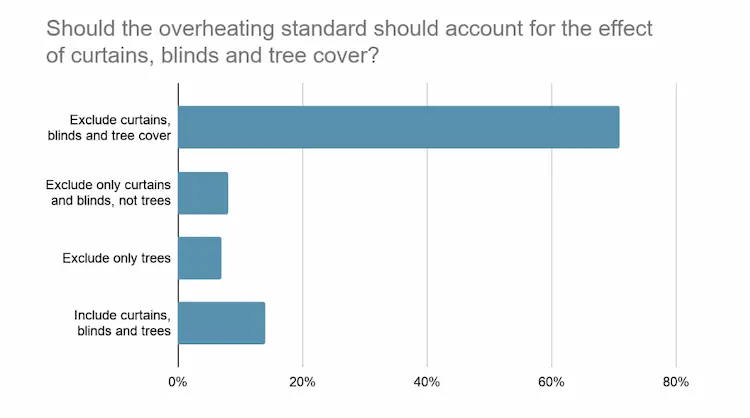
The consultation concluded that trees would be omitted from simulations because they can easily be removed, and building users may not have control over them.
There is a complex argument around ownership and property boundaries. It is at odds with the physical and non-physical effects of trees, which transcend property boundaries. The framework around building regulations compliance is for single buildings, but sometimes a simulation will include a neighbouring building – not a tree – for the shade it provides. The concept of modelling something that is in your neighbours’ possession is familiar. However, there is an inherent supposition that a neighbour will not tear down their building, but they might tear down their tree.
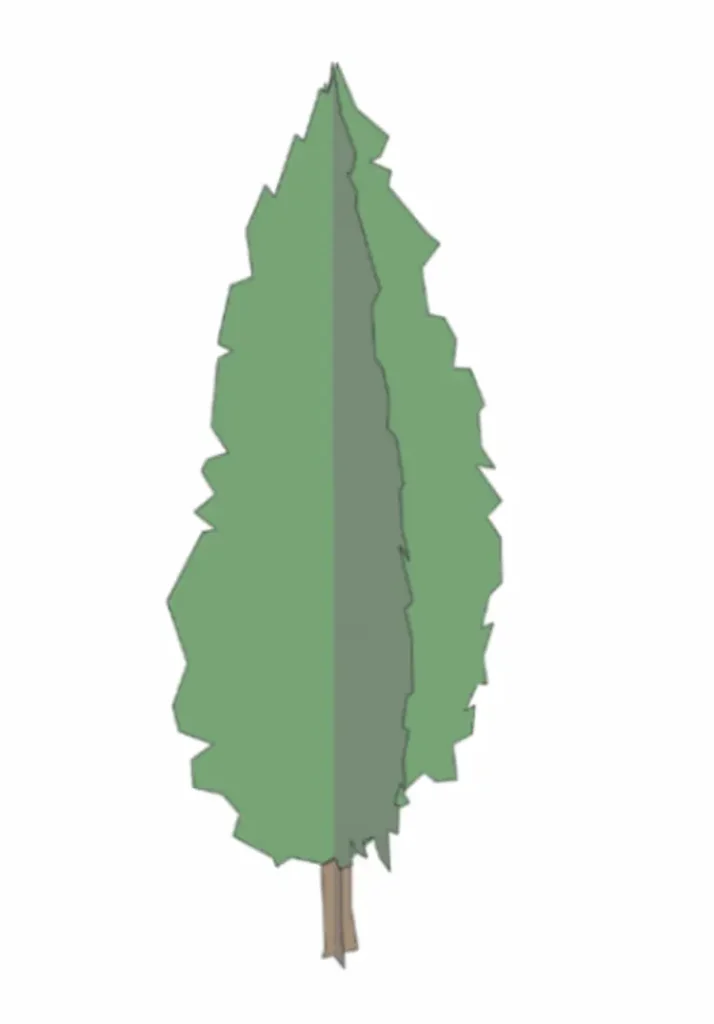
The Australian compliance system NatHERS, navigates this by including protected trees. It heads off another argument – trees are inhomogeneous – by deliberately simplifying trees to their bare essentials, distance from the building, height, canopy width, and percentage seasonal shading variation, and by doing so, facilitates their inclusion. Generally, when modelling trees in compliance software, the greater the detail, the longer the model takes to run, which can preclude lifelike representations from being useful to designers. Using two intersecting approximately tree-shaped planes is a popular, though unstandardised method, described by Hes et al. (see Fig 2). The barrier is not a technical impossibility; it is a procedural choice reinforced by culture and the ‘practice as usual’.
The omission is not neutral. It systematically biases design toward engineered, mechanical solutions. Where a mature tree canopy could reduce peak summer temperatures and lower cooling loads, the compliance model instead “discovers” an overheating risk that must be resolved through increased mechanical ventilation or active cooling systems.
The exclusion of trees creates a structural paradox within compliance simulation. A mechanical air-handling system with a defined lifespan, maintenance schedule, and associated embodied carbon cost is treated as a dependable compliance asset, while a living system that demonstrably improves microclimate is excluded on the grounds of hypothetical future removal.
The result is self-reinforcing. Because trees are excluded from compliance models, they are not credited in design; because they are not credited, they are not protected through design development, planning or value engineering. The regulatory framework privileges certainty over performance, even where that certainty produces poorer thermal outcomes. The tree, despite being one of the most efficient passive cooling technologies available, is rendered invisible by the very systems designed to optimise environmental performance.
The Paris Agreement’s global stocktake process requires nations to track adaptation progress, yet adaptation metrics for nature-based solutions in urban contexts remain underdeveloped. The Kunming-Montreal Global Biodiversity Framework commits signatories to spatial planning processes that address land-use change, a mandate that requires precisely the kind of high-resolution ecological data that current smart city platforms lack. The mandate exists. The tools exist.
But until a tree’s cooling effect appears in the same dashboard as a building’s albedo, we will continue to fund reflective paint over living canopy. We will continue to design streets that cook pedestrians because shade structures count, but trees do not. And we will continue to call this smart, right up until the next heatwave. Without integrating trees into urban heat resilience planning, cities will continue to overlook one of their most effective and equitable cooling assets.
FAQ
1. Why are trees often excluded from urban heat resilience planning models?
Most building compliance tools and heat resilience models prioritize engineered solutions such as reflective roofs, insulation, and mechanical cooling systems. Trees are frequently excluded because they are considered variable, difficult to standardize, and potentially removable, even though their cooling benefits are well documented.
2. Can trees really reduce urban heat and energy demand?
Yes. Trees provide shade, lower surface and air temperatures through evapotranspiration, and reduce solar heat gain in buildings. Research shows that urban tree canopy can significantly lower cooling demand and help reduce heat-related health risks during extreme heat events.
3. What needs to change for cities to use trees more effectively in climate adaptation?
Cities need to integrate tree canopy data into heat maps, building energy models, digital twins, and planning regulations. Trees should be treated as critical urban infrastructure rather than as decorative landscape elements, allowing their cooling benefits to be measured, valued, and protected.