
A decade after the adoption of the 2030 Agenda, the United Nations Sustainable Development Goals Report 2026 presents a picture that is neither a success nor a failure. Instead, it reflects what the UN itself describes as a “dual reality”: global cooperation and sustained investment have improved the lives of billions of people, yet progress remains too slow to deliver the Sustainable Development Goals (SDGs) by the end of the decade. With less than four years remaining until 2030, the report is more urgent in tone than its predecessor, shifting the discussion from optimism about acceleration toward concerns about implementation capacity, financing and even the credibility of development data itself.
Progress that should not be overlooked
Despite increasingly difficult geopolitical and economic conditions, the report documents a number of tangible achievements since 2015. Nearly one billion additional people have gained access to safely managed drinking water, while around 1.2 billion have obtained access to safe sanitation. Electricity now reaches 92% of the world’s population, and internet access has expanded dramatically from 40% to 74%, connecting billions to education, employment and public services. More than half of humanity is now covered by at least one form of social protection for the first time in history. New HIV infections and AIDS-related deaths have each fallen by roughly one third, disaster mortality has declined by 65% compared with the previous decade, and renewable energy continues to expand globally.
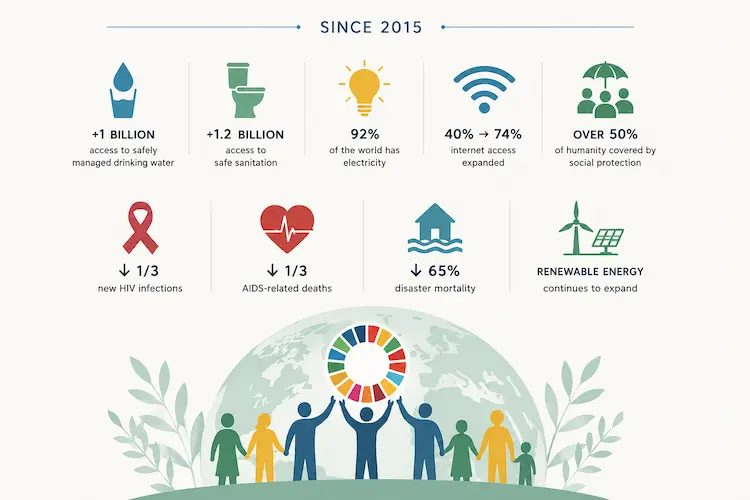
These figures demonstrate an important point often lost in public debate: when political commitment, investment and international cooperation align, the SDGs can produce measurable results. Contrary to frequent criticism, the framework has delivered real improvements in health, infrastructure and basic services across many regions.
A world still far from meeting its promises
Yet these successes are overshadowed by the overall trajectory. According to the 2026 assessment, only 36% of the 139 SDG targets with sufficient data are either on track or making moderate progress. Nearly half (49%) are advancing too slowly, while 15% have actually moved backwards compared with 2015. Although these figures represent a slight improvement over the 2025 report, when 35% of assessed targets showed adequate progress, and 18% were in regression, they remain far from sufficient to achieve the Agenda by 2030.
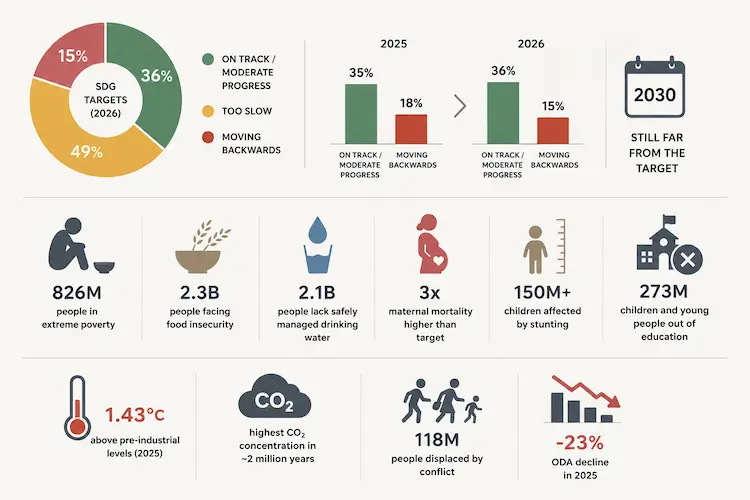
The statistics behind this assessment remain sobering. Around 826 million people continue to live in extreme poverty, while projections suggest that roughly 9% of the global population will still be extremely poor by 2030. More than 2.3 billion people experience moderate or severe food insecurity, and approximately 2.1 billion still lack safely managed drinking water services. Maternal mortality remains almost three times higher than the global target, over 150 million children suffer from stunting, and around 273 million children and young people remain outside education.
Climate indicators are equally alarming. Global average temperature reached 1.43°C above pre-industrial levels in 2025, while atmospheric carbon dioxide concentrations are the highest recorded in roughly two million years. At the same time, violent conflicts have displaced approximately 118 million people, and official development assistance (ODA) suffered a record 23% decline in 2025, directly undermining financing for sustainable development.
The financing gap is becoming the defining constraint
The report identifies familiar obstacles to implementation: armed conflicts, climate shocks, slowing economic growth, rising debt burdens and shrinking international assistance. However, financing now occupies an even more central place in the UN’s narrative.
Developing countries continue to face an estimated annual SDG financing gap of around US$4 trillion, while debt servicing increasingly limits public investment. The report argues that reforms of the international financial architecture, expanded lending by multilateral development banks and more effective debt relief mechanisms are no longer desirable policy options but necessary conditions for achieving the Goals.
This emphasis reflects an important shift. Earlier SDG discussions often focused on policy design and implementation. The 2026 report increasingly frames sustainable development as a financing challenge, suggesting that even well-designed national strategies cannot succeed without significantly larger financial resources.
UN SDG Report 2026 and artificial intelligence
Perhaps the most notable innovation in this year’s report is its entirely new chapter on SDG monitoring in the AI era. Unlike previous editions, which primarily discussed statistical capacity and funding, the 2026 report raises broader questions about trust, governance and digital sovereignty.
The UN warns that generative AI systems increasingly provide statistical information that may rely on outdated, incomplete or even synthetic data rather than official statistics. As AI-generated content becomes a primary source of information, unreliable figures can rapidly acquire the appearance of authority. This creates new risks for evidence-based policymaking and public trust.
The report therefore argues that future statistical systems must become not only more technologically advanced but also more transparent, people-centred and nationally governed. It also highlights growing inequalities in statistical capacity: while AI offers significant opportunities for data collection and analysis, many low-income countries lack both the financing and institutional capacity to govern these technologies effectively.
This represents an important conceptual evolution. For the first time, the discussion moves beyond measuring sustainable development to questioning whether progress itself can be measured reliably in an AI-driven information environment.
Beyond external crises
The report convincingly demonstrates how conflicts, climate change and declining development assistance have slowed implementation. Nevertheless, it is less persuasive in explaining why countries with similar economic constraints often achieve very different development outcomes.
Much of the analysis attributes slow progress to external shocks, wars, debt, inflation or climate impacts. While these factors are undoubtedly significant, the report devotes comparatively little attention to differences in governance quality, institutional effectiveness or policy implementation. Nor does it systematically examine why some countries have managed to maintain progress despite adverse conditions while others have stagnated.
Similarly, although the report repeatedly calls for increased financing, it provides less discussion of how existing resources could be used more effectively or how successful national experiences might be replicated elsewhere. This leaves an important analytical gap between identifying problems and explaining successful implementation.
Explore the UN SDG Report 2026 through the lens of urban development here.
From ambition to delivery
The 2026 report ultimately sends a more sober message than last year’s edition. The Sustainable Development Goals remain achievable in principle, but the margin for delay is rapidly disappearing. Progress continues in many areas, yet it is no longer sufficient to compensate for mounting geopolitical fragmentation, financial constraints and climate pressures.
Perhaps the report’s most important conclusion is implicit rather than explicit. The challenge facing the SDGs is no longer simply one of setting ambitious global objectives. It is increasingly about building institutions capable of implementing them, financing them and measuring progress with sufficient credibility in an increasingly complex technological and geopolitical landscape.
In that sense, the debate has begun to shift. The central question is no longer whether the Sustainable Development Goals represent the right vision for global development. Rather, it is whether the international system still possesses the political, financial and institutional capacity to deliver on that vision before 2030.