Five companies presented practical solutions for energy management, infrastructure and industrial processes at Energy & Investment Days 2026 in Novi Sad.
What if potential weaknesses in an electricity network could be identified before a new neighbourhood is built? Or if ageing water wells could be restored with less manual intervention? And what if a digital model could help operators better understand the behaviour of a hydropower plant?
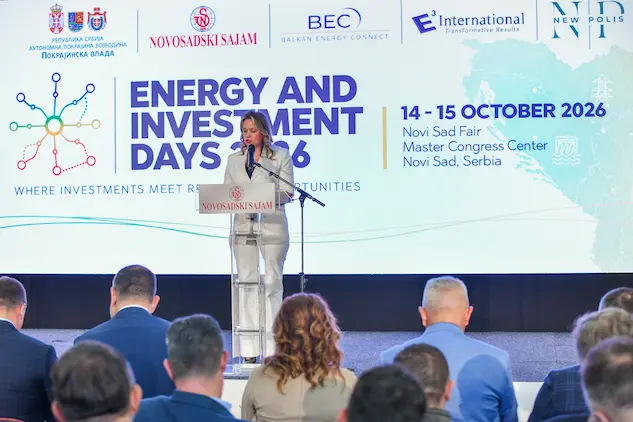
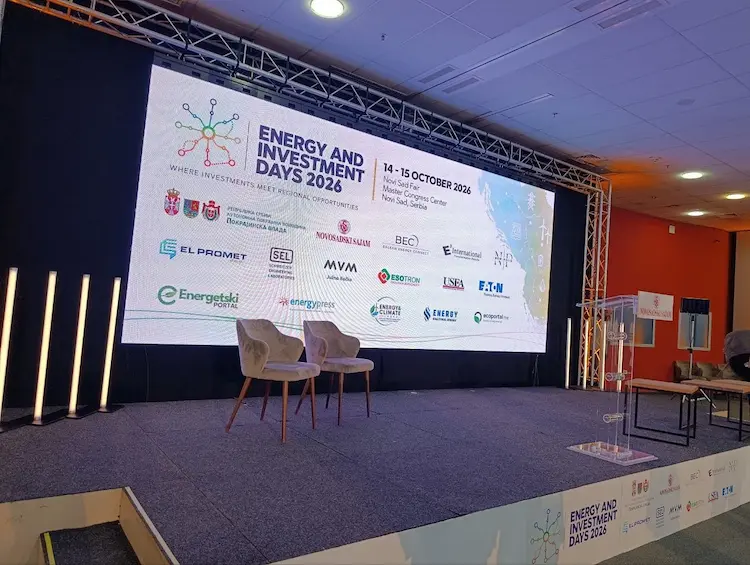
These questions point to some of the practical applications of energy innovation in Southeast Europe, as demonstrated at the Startup & Innovation Corner supported by MVM Južna Bačka during Energy & Investment Days 2026, held on 14–15 October at Novi Sad Fair in Serbia.
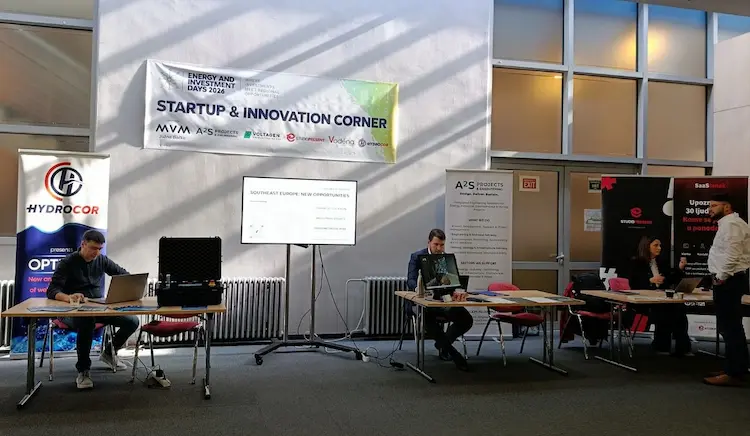
The participating companies represented different fields and stages of development. Some focused on physical infrastructure and industrial engineering, while others applied digital modelling, automation and artificial intelligence to existing operational and business challenges. New Polis spoke with representatives of five companies about the problems they are addressing, the technologies behind their solutions and their plans for further development.
Their presentations highlighted a common feature of applied innovation: the effort to solve specific operational problems that have challenged industries and organisations for years. Rather than focusing exclusively on new technologies, the companies demonstrated how engineering expertise, automation and digital tools can improve established processes.
Vodena: using digital models to improve energy management
Managing energy infrastructure increasingly requires the ability to understand how complex systems behave under changing conditions. Digital modelling offers one way to address this challenge, allowing operators to simulate processes, explore scenarios and improve planning. Vodena, established in 2015 as a university spin-off from the Faculty of Science at the University of Kragujevac, develops software for modelling, simulation and optimisation of physical systems, particularly in the water and energy sectors.
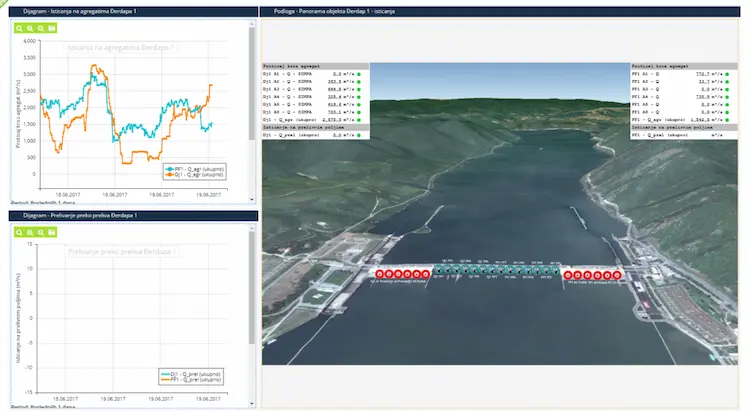
One of the company’s projects involves optimising hydropower production at the Iron Gate hydropower plant on the Danube. The company’s website confirms that its data analysis and optimisation solution is already used at the plant to support hydropower production. It combines data from the plant’s monitoring systems, hydrological forecasts and expected energy prices to help optimise operations within physical, environmental and legal constraints.
Vodena has also developed Smarticity, an energy management platform for facilities that combine renewable energy generation and energy storage. The platform is already available as a SaaS solution. It uses operational data to generate predictive models of energy production and consumption, simulate different operating scenarios and identify more cost-effective ways to manage electricity use. According to Nikola Bouchi, who represented the company at the event, users can connect their data sources without having to build complex models themselves. Vodena is also exploring the integration of an AI agent that would give users a more accessible way to interact with their energy systems.
The company’s work illustrates how modelling and optimisation can support the more efficient operation of existing energy assets. As electricity systems incorporate more renewable generation and storage, the ability to model their behaviour and anticipate changes becomes increasingly relevant.
Voltagen Grid Intelligence: identifying energy risks before they become problems
Energy infrastructure planning involves decisions whose consequences may last for decades. New residential developments, industrial facilities and other major projects can substantially change local electricity demand, making it important to understand potential constraints before construction begins.
Voltagen Grid Intelligence is developing a system that combines geographical information, digital twin modelling and AI-based analysis to examine energy infrastructure and identify potential vulnerabilities. Nikola Jovičić Petrović explained that the technology uses geographical and infrastructure data to estimate energy consumption across different areas, from individual parts of a city to larger urban territories.
The system can also model scenarios involving sudden increases in demand or the loss of an energy source. By analysing these situations, it aims to identify critical points in electricity infrastructure and help planners assess potential risks.
A particular challenge, according to Petrović, lies in combining different sources of information into a single analytical system. Geographical data, energy inputs and AI models may each provide useful insights, but integrating them into a coherent model is technically demanding.
The intended application is particularly relevant to urban development and infrastructure investment. By identifying possible constraints before a project moves into construction, planners and investors could make better-informed decisions about electricity supply and network capacity. The technology therefore seeks to connect energy-system analysis with the early stages of spatial and investment planning.
Hydrocor: making water-well regeneration more efficient
Not all technological innovation involves software or artificial intelligence. Some solutions focus on improving physical processes that remain labour-intensive, technically demanding or potentially hazardous. Belgrade-based Hydrocor has developed OPTIMUS, an automated system for water-well rehabilitation. According to Miloš Pavlović, the company’s approach combines mechanical and chemical treatment and can be applied to both horizontal and vertical wells.
Well regeneration is used to restore the performance of wells whose operation has deteriorated over time. Hydrocor’s technology aims to automate parts of this process, reducing reliance on manual intervention. Pavlović highlighted the safety aspect of the company’s approach. Some regeneration operations can expose workers to difficult or potentially dangerous conditions, while automated equipment can perform tasks with less direct human involvement. The system is also designed for continuous operation and remote monitoring. Information about the regeneration process can be transmitted to phones and tablets, allowing operators to follow its progress without remaining physically present throughout the operation.
Hydrocor’s OPTIMUS project has also received support from Serbia’s Innovation Fund under its early-development programme. The Fund describes the system as combining a proprietary treatment method with process automation and reports that it can reduce the regeneration cycle from seven days to three.
The example illustrates how automation can improve the efficiency and safety of specialised industrial processes. Its wider potential will depend on performance across different well conditions and on the ability to demonstrate operational and economic benefits to customers.
A²S Projects & Engineering: engineering solutions for water and industry
Water management remains a practical challenge for many industrial businesses, particularly those that require specialised treatment systems but may not have extensive in-house engineering resources. A²S Projects & Engineering is a multidisciplinary engineering and consulting company based in Novi Sad. Andrija Avramović explained that the company brings together expertise from several engineering disciplines to develop solutions for industrial clients.
The company works on wastewater treatment, drinking water systems, cooling and technical water infrastructure, as well as waste management and environmental projects. Its activities extend to engineering and project management in the energy, mining and geological sectors.
According to Avramović, the team consists of ten specialists covering process engineering, mechanical engineering and technical documentation. A²S is also a member of the Science and Technology Park in Novi Sad. The company’s multidisciplinary approach reflects the fact that industrial water problems often require more than a single technology. Treatment systems must be adapted to specific production processes, operating conditions and technical requirements.
For industrial clients, this combination of engineering disciplines can be particularly valuable when a project involves several interconnected technical requirements. A²S represents an approach in which technical expertise and project implementation are closely connected.
Studio Present: turning event contacts into business opportunities
For companies attending conferences and trade fairs, collecting business cards is often easier than turning new contacts into lasting business relationships. After several days of meetings, remembering individual conversations and organising follow-up communication can become a substantial administrative task.
Studio Present has developed a CRM platform intended to simplify this process. As Miloš Ćuković explained, the platform combines standard contact management functions with tools designed specifically for business networking at events. Users can scan business cards and transfer contact information directly into the system. They can also record conversations, which can then be transcribed and associated with individual contacts.
The platform supports automated follow-up messages. For example, a user can schedule an email to be sent two days after a trade fair, reconnecting with a potential partner and suggesting another meeting. Contacts can also be associated with particular events, making it easier to organise information and manage subsequent communication. Although its focus differs from the energy and industrial technologies presented by the other companies, Studio Present addresses a related challenge: how to make professional interactions more productive.
Its inclusion also reflects the business dimension of innovation events. Alongside technologies designed for infrastructure and industrial operations, digital tools can help companies make better use of the contacts and partnerships established at conferences and trade fairs.
From technology development to practical application
The five companies presented at Energy & Investment Days 2026 differ considerably in their technologies, target markets, and business models. Yet their approaches share an important characteristic: they begin with identifiable problems rather than technology for its own sake.
Some focus on improving established industrial processes, such as wastewater treatment and well regeneration. Others use digital modelling to support decisions about energy assets and infrastructure. Business software addresses another practical challenge, helping organisations manage information and professional contacts more efficiently. These examples also show that innovation can take different forms. It may involve patented equipment, the integration of existing technologies, specialised engineering expertise or new applications of digital tools.
However, developing a solution is only part of the challenge. For emerging technology companies, finding customers, demonstrating results and building partnerships can be equally important. Access to industrial clients, infrastructure operators and potential investors can help turn promising developments into commercially viable solutions.
The companies featured at Energy & Investment Days 2026 offer a snapshot of how energy innovation in Southeast Europe is taking shape across engineering, infrastructure and digital technology. Their experience also highlights the importance of connecting research and technical development with real market needs, practical implementation and long-term business partnerships.