
A New Polis white paper prepared in cooperation with Balkan Energy Connect (BEC)
Artificial intelligence is changing where data centres can be built. The greater the demands placed on power supply and other factors like electricity, connectivity, land, and construction, the more important the availability of these resources becomes in deciding where to build AI data centers.
This is beginning to change Europe’s traditional data centre geography. Projects are moving beyond established hubs as developers look for locations where power can be secured at the scale and speed required by new AI infrastructure.
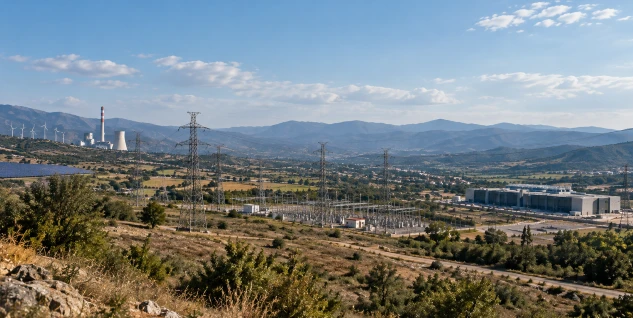
Southeast Europe presents a number of different opportunities. From Albania and Bosnia and Herzegovina to Bulgaria, Croatia, Greece, Montenegro, North Macedonia, and Serbia, the countries have quite varied energy, digital, and development landscapes. But in each of them, there exist transmission networks, energy assets, industrial land, fiber infrastructure, and existing digital facilities that could potentially support large new developments.
The key question is where these assets can come together at a specific location.
Our new white paper, Powering the AI Economy: Data Centres, Energy and the Emerging Digital Geography of Southeast Europe, builds on our previous research, Beyond Megawatts: Grid Readiness and Energy Competitiveness in the Balkans. It examines the conditions for large-scale data centre development through five dimensions: energy and grid, connectivity, land and development, water, and the institutional and regulatory environment.
About the white paper
The European data centre market is entering a new phase. AI is increasing the demand for large amounts of reliable electricity, while grid infrastructure often requires considerably more time to plan and develop.
This creates a different set of questions for investors. Where can a new data centre obtain firm power? How long will the connection take? Is there enough land for the initial campus and future expansion? Can the site obtain resilient fibre connectivity? Can cooling requirements be met? And can grid, planning and environmental approvals progress within the project timetable?
The white paper examines these questions across eight Southeast European countries and combines regional infrastructure data with evidence from existing projects and six locations selected for further site-level screening.
Key findings
The site matters more than the national average. National energy, connectivity and land indicators provide useful screening context, but investment readiness is determined at site level.
Southeast Europe has several infrastructure pathways. The region does not have a single development model. Energy assets, transmission networks, industrial land and digital infrastructure create different opportunities in different locations.
Power availability is a sequence. For a large data centre, the relevant chain is:
Available Power → Connectable Power → Contractable Power → Usable Power
Generation capacity alone does not establish whether firm power can be delivered to a specific site.
New possibilities exist outside the traditional data centre hotspots. The screening identifies six locations where different infrastructure assets converge. They represent potential development pathways, not investment ready sites.
Infrastructure convergence is the real investment test. A viable AI data centre requires power, grid capacity, connectivity, land, cooling and a workable development pathway to come together at the required scale and speed.
From regional potential to site readiness
The analysis shows that there are six additional areas where further screening should be conducted: Smederevo, Serbia; Spitallë/Durrës, Albania; Kozloduy Energy Zone, Bulgaria; Sisak, Croatia; TIDZ Štip, North Macedonia; and Podgorica 2/Mareza, Montenegro. These six places are examples of various infrastructure trajectories, including industrial land, high-voltage transmission, energy assets, fiber networks and utilities.
These locations are not being presented as ready-for-development locations. The key issue is the location where Southeast Europe will add its next 100 MW of data centres that are ready for artificial intelligence. To answer that, there is a need to go beyond just national level metrics, but also understand the characteristics at the site level, including how much power connection is possible, at what time, what grid improvements are necessary, what is available in terms of resilient connection and good land, and how quickly the project can be developed and permit-approved.
Publication details
Powering the AI Economy: Data Centres, Energy and the Emerging Digital Geography of Southeast Europe
White Paper | October 2026
Published by New Polis
Prepared in cooperation with Balkan Energy Connect (BEC)