The UNEP Emissions Gap Report 2026 finds that global greenhouse gas emissions have barely changed, despite the rapid expansion of clean energy. The challenge is increasingly one of infrastructure, investment and implementation.
The world is deploying renewable energy at record speed, clean technologies are becoming more competitive, and governments continue to announce climate commitments. Yet global greenhouse gas emissions remain close to their historical maximum. This is the central contradiction emerging from the UN Environment Programme’s Emissions Gap Report 2026.
According to UNEP, global emissions reached approximately 58.4 billion tonnes of CO₂ equivalent in 2025, virtually unchanged from the previous year. While emissions growth has slowed, it is too early to conclude that the world has reached a lasting peak. The report’s findings raise a broader question: why has substantial progress in clean energy not yet produced a sustained reduction in global emissions?
The gap between climate commitments and reality
The Emissions Gap Report 2026 presents a sobering assessment of the distance between national climate commitments and the reductions needed to meet the Paris Agreement’s temperature goals.
Under current policies, global warming is projected to reach approximately 2.8°C by 2100. Full implementation of countries’ nationally determined contributions (NDCs), including conditional commitments, would lower this projection to around 2.6°C. Both outcomes remain substantially above the Paris Agreement’s ambition to limit warming to 1.5°C.
The scale of the required adjustment is considerable. UNEP estimates that pathways offering the lowest feasible overshoot of 1.5°C would require global greenhouse gas emissions to fall by approximately 45% by 2035 compared with 2025 levels. Even if conditional national commitments are fully implemented, the projected emissions gap in 2035 remains around 16 billion tonnes of CO₂ equivalent.
These figures point to two distinct problems. Governments have not collectively committed to reductions sufficient to meet their stated temperature goals, and the policies already adopted are not delivering emissions cuts quickly enough.
Clean energy is advancing. Why are emissions not falling?
Evidence from other international organisations helps explain this apparent paradox.
According to the International Energy Agency’s Global Energy Review 2026, global energy demand increased by 1.3% in 2025, while energy-related CO₂ emissions rose by 0.4%. At the same time, the IEA estimates that clean energy technologies deployed since 2019 now avoid approximately 3 billion tonnes of CO₂ emissions annually.
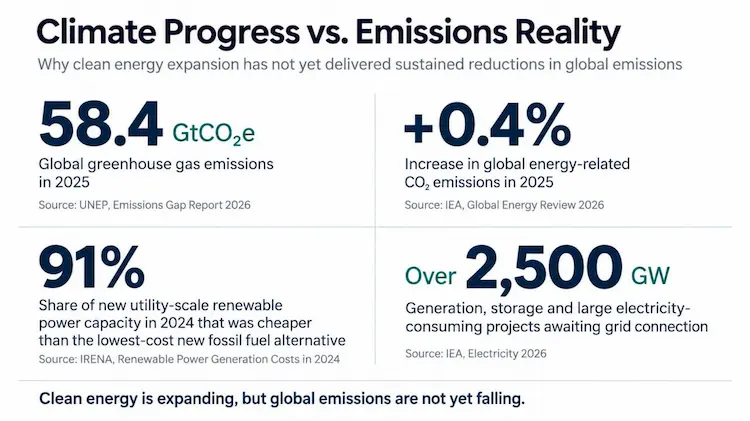
This suggests that the energy transition is already preventing emissions from rising more rapidly. However, expanding energy demand and continued fossil fuel consumption are offsetting much of that progress. Avoided emissions are not the same as an absolute reduction in emissions.
The economic conditions for accelerating the transition have improved. The International Renewable Energy Agency estimates that 91% of newly commissioned utility-scale renewable power capacity in 2024 produced electricity more cheaply than the least-cost new fossil fuel alternative.
The problem, therefore, cannot be explained simply by the high cost of clean generation. The speed of transition increasingly depends on whether energy systems can accommodate new technologies and whether investment decisions support the replacement, rather than merely the expansion, of existing supply.
Infrastructure is becoming a decisive constraint
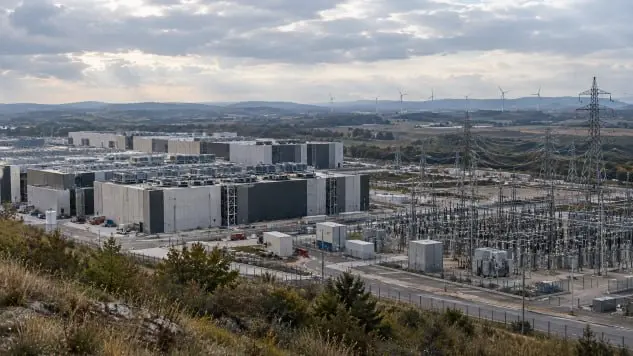
Electricity networks illustrate this challenge particularly clearly. The IEA’s Electricity 2026 analysis identifies more than 2,500 GW of generation, storage and large electricity-consuming projects waiting in grid connection queues worldwide.
Renewable power plants cannot contribute fully to decarbonisation if electricity networks lack capacity to connect them or deliver their output to consumers. Storage, system flexibility, permitting procedures and grid investment have therefore become central components of climate policy.
This also has implications for economic competitiveness. Countries that modernise their electricity systems may be better positioned to attract energy-intensive industries, data centres and other new investments. Those that fail to address infrastructure bottlenecks risk slowing both decarbonisation and economic development.
For the Western Balkans and other economies with ageing infrastructure, the lesson is particularly relevant. Expanding renewable generation is important, but its benefits depend on parallel investment in networks, flexibility and institutional capacity. Climate objectives and energy-sector modernisation increasingly need to be treated as part of the same investment agenda.
The growing cost of delay
The Emissions Gap Report 2026 also examines scenarios in which global temperatures temporarily exceed 1.5°C before potentially returning below that threshold later in the century.
Even the lowest feasible overshoot pathways considered by UNEP involve warming of approximately 1.7 – 1.8°C around mid-century. Returning to 1.5°C by 2100 would require rapid emissions reductions and substantial carbon dioxide removal, with significant uncertainties surrounding the feasibility of such an outcome.
Temporary overshoot should therefore not be interpreted as a harmless postponement of climate action. Higher temperatures increase exposure to climate risks, while delayed emissions reductions create greater dependence on future technological and institutional capabilities.
The financial implications extend beyond mitigation. UNEP’s Adaptation Gap Report 2025 estimates that developing countries could require between $310 billion and $365 billion annually for adaptation by 2035. These needs illustrate the growing economic significance of preparing infrastructure, settlements and public services for climate impacts.

From climate ambition to measurable results
The Emissions Gap Report 2026 does not suggest that climate policy has failed altogether. Its review of policy evaluations indicates that well-designed measures can deliver meaningful emissions reductions. The challenge lies in extending successful approaches, combining policies effectively and implementing them at sufficient scale.
A useful distinction emerges between indicators of transition activity and indicators of climate outcomes. Installed renewable capacity, investment announcements and national targets describe important developments, but they do not necessarily demonstrate that fossil fuel consumption or total emissions are declining.
This distinction should influence how progress is assessed. Governments and investors need to examine not only how much clean capacity is being added, but also whether infrastructure is enabling its use, which fossil fuel activities it replaces and what measurable reductions result.
The main message of the Emissions Gap Report 2026 is not that the energy transition is ineffective. It is that technological progress, falling costs and climate commitments have yet to combine into a sufficiently rapid decline in global emissions. Closing that gap will require less emphasis on announcements alone and greater attention to the practical conditions that turn climate ambition into results.