

Digital construction is shaping the physical foundation of future cities, yet it remains one of the slowest sectors to embrace digital transformation. According to the 2025 World Economic Forum report, the industry shows significant potential for digitalization, but adoption continues to lag behind most other sectors.
This contradiction is becoming increasingly difficult to ignore. Construction contributes an estimated 12–14% of global GDP and employs 7–10% of the world’s workforce, while cities themselves are rapidly evolving into data-driven systems shaped by AI, digital infrastructure and real-time information. Yet despite the speed of technological change across society, much of the construction sector still operates through fragmented processes, analogue documentation and disconnected data environments.
The gap between digital requirements and industry implementation
The demands placed on the industry are significant: EU regulations, early-stage simulation requirements, energy-efficient building standards, and CO2 reduction targets, alongside increasingly complex projects. Around 85% of existing buildings in the EU are expected to remain in use by 2050. Yet only around 1% currently has digital performance data. Experts suggest that by the mid-2030s, digital information will largely replace analogue documentation in construction, marking a shift toward a fully digital environment.
Despite this need, the sector remains largely unprepared, with most initiatives limited to pilot projects and isolated experiments.
Construction as one of the least digitized and productive sectors
One explanation lies in the traditional structure of the industry, which has experienced the slowest productivity growth since World War II. According to McKinsey, construction is among the least digitized sectors in developed economies—second to last in the US and last in Europe. It is also less productive today than in 1968.
Part of this challenge comes from a key characteristic of the industry: each project is unique. Unlike manufacturing, where processes are standardized and repeatable, construction projects are shaped by specific site conditions, regulations, and client requirements. This makes it harder to scale solutions and slows down the adoption of standardized digital processes.
In an era where AI is transforming all sectors, information has become a key resource, and physical buildings are increasingly defined as sets of data.
Digital construction, data, buildings, and the future city
We cannot optimize what we do not know. If we extend this perspective, each building becomes a source of structured data within the urban system. Consequently, smart cities rely significantly on the aggregation and integration of digital information generated at the building level. Buildings account for approximately 34% of global CO2 emissions and 32% of final energy consumption, with most emissions coming from operational energy use. Accordingly, smart city objectives aimed at reducing environmental impacts cannot be effectively achieved without access to digital building data.
Urban sustainability today is increasingly defined by the renovation of existing buildings. The EU’s Renovation Wave strategy reflects this shift, aiming to scale energy-efficient upgrades across millions of buildings by 2030. However, without reliable building data, these ambitions remain difficult to achieve. Simply put, we cannot optimize what we do not know.
Fragmentation and the need for process standardization
A key challenge is fragmentation across stakeholders from investors and designers to contractors and owners. Development has been largely ad hoc, with each actor focusing on isolated parts of the process.
Digital construction is further slowed by fragmented software ecosystems and different interpretations of BIM. To avoid parallel systems, the industry needs international standards that ensure interoperability and create a shared language across disciplines. The more universal the solution is, the greater its scalability potential.
Scandinavian countries have based their new classification systems on ISO 81346, a universal reference system intended for the entire industry and adapted for BIM environments. Sweden has implemented the CoClass system, which supports integrated digital workflows. Additionally, ISO 19650 provides a framework for managing information throughout the entire lifecycle of an asset.
The case for digital construction
In Sweden, municipalities are implementing coordinated digitalization frameworks based on shared data infrastructure, system integration, and standardized information models across public services.
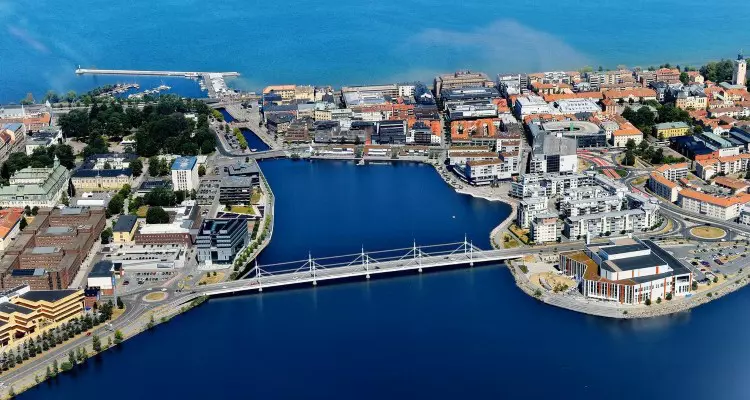
In the Jönköping region, this approach is further evolving as municipalities transition from fragmented digital initiatives toward shared data platforms and interoperable information structures. This reflects a broader shift toward treating data as a common infrastructure layer, aligned with emerging models in asset intelligence and smart city development.
The Norra Latin International School project in Stockholm represents a practical implementation of structured asset data through the development of an Asset Information Model (AIM) aligned with international standards.
The project demonstrates how existing buildings can be transformed into data-driven assets, enabling improved lifecycle management, operational transparency, and integration with facility management systems.

Towards holistic and scalable systems
Long-term scalability is difficult to achieve when digitalization depends on isolated tools, disconnected pilot projects, or proprietary systems that cannot communicate with one another. For this reason, development must move toward holistic, interoperable systems.
Investors must also recognize that digitalization is not merely a cost or a tool for increasing asset value. It represents an investment with fast returns through operational efficiency, improved decision-making, reduced risk, and optimized lifecycle management.
However, responsibility for this transition does not lie solely with investors. The broader ecosystem—including education, knowledge exchange, and collaboration across stakeholders—is equally important. Universities must prepare future professionals for data-driven environments, while governments must provide regulatory frameworks and incentives that encourage the adoption of standards.
Conclusion
For years, the industry has been discussing needs, requirements, and the importance of standards. While these challenges are well understood, the real barrier is no longer awareness but implementation. It is therefore becoming increasingly urgent for industry leaders to move beyond recognition of the problem and take decisive, coordinated action to accelerate the integration of digital technologies.
Organizations that understand this transition early are likely to play a major role in shaping the future direction of both the construction sector and data-driven urban development.
This transformation affects not only the construction industry, but urban development as a whole. It shifts construction away from one-off project delivery toward continuous, data-driven management of buildings throughout their lifecycle. Because buildings strongly influence the wider urban system, this transition also enables cities to base planning, operations, and decision-making on real-time building data.
In that sense, the future of construction may depend less on concrete and steel alone, and more on how information about buildings is generated, connected and used over time.
About the author: Viktorija Raonić is a Belgrade-based architect with international experience in complex architectural projects, focusing on construction digitalization and data-driven building management.