From quieter neighbourhoods in Zaragoza to cleaner heating in Poland and industrial transformation in Portugal, Europe’s 2028 green city winners and finalists reveal how environmental policy works beyond headline projects. A city can plant thousands of trees and still be an uncomfortable place to live. Traffic noise may disturb residential neighbourhoods, ageing pipes can waste precious water, and outdated heating systems continue to pollute the air. Addressing these less visible problems is an important part of making European green cities healthier and more liveable.
The European Green Capital and Green Leaf Awards 2028, announced on 8 October 2026, provide an opportunity to look at how municipalities are tackling such challenges. Zaragoza in Spain received the European Green Capital title, while Benidorm, also in Spain, and Portugal’s Estarreja were named European Green Leaf winners. Porto and Poland’s Bielsko-Biała were among the finalists.
A total of 27 cities competed for the awards, with applications assessed across seven environmental areas, including air quality, water management, biodiversity, waste, noise and climate action. The competition considers cities’ overall environmental performance and future commitments, rather than rewarding individual projects. The five examples examined here represent selected aspects of their policies, not a complete explanation of the jury’s decisions. They offer a closer look at how sustainable urban development takes shape in cities with very different economies, infrastructure and environmental challenges.
Zaragoza: Long-Term Planning, with an Ear for Noise
Zaragoza’s selection as European Green Capital 2028 reflects decades of environmental planning rather than the success of a single initiative. The European Commission highlighted the city’s long-term commitment and strong governance, particularly its ability to integrate environmental priorities into municipal policy.
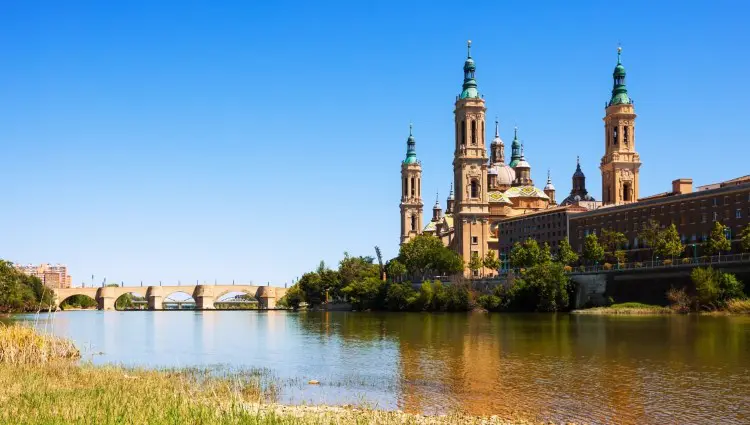
Its Green Infrastructure Master Plan, adopted in 2017, seeks to connect parks, natural areas and ecological corridors across the urban territory. Water conservation, biodiversity protection and climate adaptation have also become established parts of the city’s approach. Within this broader strategy, one relatively overlooked issue deserves attention: noise pollution.
Noise rarely attracts the same attention as air pollution or carbon emissions, although its effects on urban life can be substantial. Residents living near busy roads or in densely developed neighbourhoods may experience disturbed sleep, increased stress and higher risks of cardiovascular disease. Unlike a new park or tram line, a quieter neighbourhood is not necessarily something that photographs well.
Zaragoza has incorporated noise prevention into the planning of new residential areas. Its Technical Guide for the Integration of Noise Management in City Planning addresses acoustic conditions through land-use decisions, street layouts, building orientation and public-space design. One provision requires new residential areas to meet acoustic quality objectives 5 dB stricter than standard legal requirements. The rule applies to planning objectives for new developments, rather than establishing a universal noise limit for the entire city.
Developers must also consider indoor acoustic protection, particularly in bedrooms. The position of buildings relative to major roads, the orientation of residential spaces and the arrangement of streets can all influence the noise residents experience. These decisions are made long before construction is completed, when preventing acoustic problems is generally easier than correcting them afterwards.
Existing neighbourhoods present a different challenge. Zaragoza has designated five Special Acoustic Protection Zones, while its Noise Action Plan for 2025–2029 aims to reduce by 20% the number of residents exposed to noise above regulatory limits. This remains a policy target, not an achieved reduction.
Zaragoza has not eliminated urban noise, and its environmental programme extends far beyond acoustic comfort. What makes its approach noteworthy is the recognition that sound conditions should influence how neighbourhoods are designed, rather than being treated solely as a problem for later mitigation. For cities preparing new residential developments, this is a practical consideration with consequences for both public health and future infrastructure costs.
Benidorm: The Water System Behind the Tourist Skyline
Benidorm is hardly the conventional image of a green destination. Its high-rise buildings, crowded beaches and intensive tourism create substantial pressure on municipal infrastructure, particularly during the summer months. Yet the Mediterranean resort has spent years improving the management of one of the region’s most valuable resources: water.
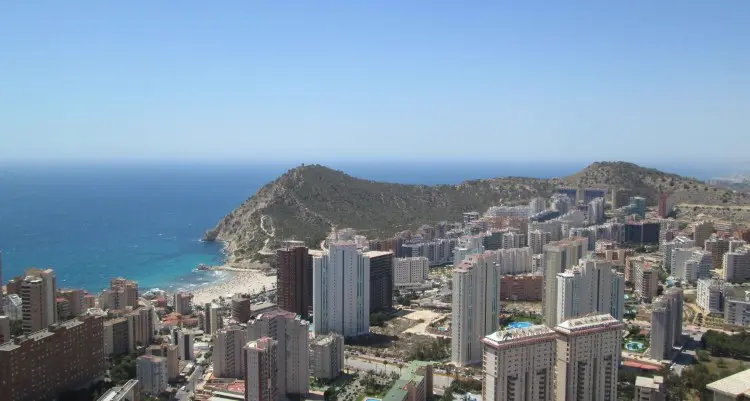
According to municipal information published in March 2026, Benidorm’s drinking water distribution network operates at approximately 96% hydraulic efficiency. The figure reflects long-term investment in maintenance, monitoring and leak detection, supported by cooperation between the municipality and its water services operator. In a city where seasonal demand can rise sharply, reliable infrastructure is as important as securing additional water supplies.
Water reuse forms another part of this strategy. According to Veolia, approximately 35% of treated wastewater is already reused. In April 2026, the company presented a €26 million plan to expand the reclaimed-water distribution network, making up to 2 million cubic metres of reclaimed water available annually once the new infrastructure is completed. That volume represents planned capacity, not water already saved.
The distinction between drinking water and reclaimed water is particularly important in tourist destinations. Irrigation and other uses that do not require potable water can place additional pressure on freshwater resources, especially during dry periods. Reuse allows municipalities to meet part of this demand without drawing exclusively on supplies intended for households and businesses.
Benidorm’s experience is relevant to coastal cities across the Mediterranean and Adriatic. Tourism remains an important economic activity, but its environmental pressures cannot be managed through additional supply infrastructure alone. Better monitoring, lower network losses and wider use of reclaimed water can help municipalities accommodate seasonal demand while reducing pressure on scarce freshwater resources.
Estarreja: Changing the Relationship Between Industry and the City
Estarreja’s environmental challenges are closely connected to its industrial history. Chemical production has long supported the local economy, providing employment and investment while leaving an environmental legacy that the municipality continues to address. Its European Green Leaf recognition draws attention to a transition involving industrial modernisation, nature conservation and cooperation with the local community.
One of the town’s most distinctive initiatives is PACOPAR, a platform established in 2001 to encourage dialogue between the chemical industry and the surrounding community. The partnership brings together companies, municipal representatives, schools, health institutions, civil protection services and local organisations. Its activities include discussions about industrial safety and environmental concerns, public information events and support for community projects.
The importance of PACOPAR lies partly in its continuity. For 25 years, it has provided a forum where industrial enterprises and local stakeholders can discuss issues affecting both economic activity and everyday life. Such cooperation does not automatically reduce emissions or resolve every conflict, but it offers a more structured relationship between businesses and the communities in which they operate.
Estarreja has also invested in restoring its natural environment. Launched in 2005, BioRia began with a nature trail in Salreu and developed into a network of routes through the wetlands and surrounding landscapes of the Ria de Aveiro lagoon. Today, the programme includes eight walking and cycling routes extending for approximately 50 kilometres, combining habitat conservation, environmental education and public access to natural areas.
BioRia has become an established destination for nature tourism. According to information published through Portugal’s ECOXXI environmental programme, it attracts approximately 32,500 domestic visits and 1,000 international visits annually, with visitor numbers stabilising around these levels after the pandemic. The programme also supports educational activities and birdwatching, bringing visitors into contact with natural habitats that were previously less accessible.
Visitor numbers do not measure the ecological recovery of the wetlands, but they demonstrate that the infrastructure is being used. BioRia has also developed partnerships with universities, environmental organisations and other institutions, linking conservation with education and local tourism. Its development illustrates how a former industrial landscape can acquire new public and environmental functions without abandoning its economic identity.
Industrial companies, meanwhile, are investing in cleaner production. In July 2026, chemical producer Bondalti completed its €76 million REPower Chemicals programme, comprising five decarbonisation projects. The investments include solar power plants with a combined capacity of 30 MWp, a 12 MWh battery storage system, new electrolysers and equipment to electrify industrial steam production.
According to Bondalti, the investments are expected to avoid more than 36,000 tonnes of CO₂ emissions annually, reducing Scope 1 and 2 emissions by nearly 28% compared with 2019. These are projected annual effects of completed investments, rather than independently verified long-term reductions.
PACOPAR, BioRia and Bondalti’s industrial programme are separate initiatives, developed by different organisations and serving different purposes. Together, they show the range of work involved in improving the environmental performance of an industrial municipality. Cleaner production matters, but so do the condition of surrounding natural areas and the relationship between industrial enterprises and local residents.
Bielsko-Biała: Cleaner Heating, but an Unfinished Air Quality Challeng
In many Central and Eastern European cities, improving air quality depends partly on decisions made inside private homes. Outdated heating systems, particularly those using solid fuels, remain important sources of pollution during winter. Replacing them can be expensive, especially when homeowners also need to improve insulation or undertake other energy efficiency measures.
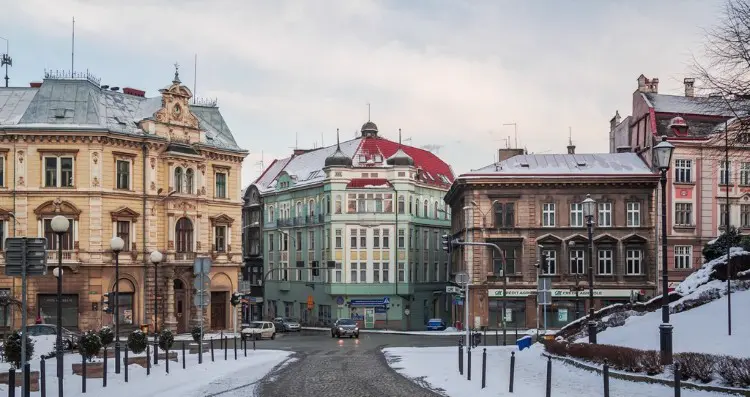
Bielsko-Biała, a Polish finalist for the European Green Capital 2028 title, has been working on this problem for nearly two decades. According to the municipal authorities, more than 8,500 outdated coal-fired heating installations have been replaced, with the city supporting cleaner heating systems since 2007. It has also modernised district heating infrastructure, introduced local air quality monitoring and supported improvements to residential buildings.
National funding has played an important role. Through Poland’s Czyste Powietrze (Clean Air) programme, homeowners can receive financial assistance to replace inefficient heating systems and improve the energy performance of their properties. By 30 June 2025, municipal statistics recorded 3,334 applications, 2,959 funding agreements and 2,157 completed projects, with approximately PLN 36.6 million in subsidies paid. The completed projects cover different types of eligible improvements and should not all be interpreted as comprehensive home renovations.
Bielsko-Biała has combined these measures with monitoring and public information initiatives. The city has developed a network of local air quality measurement and information points, while its broader environmental policies include district heating upgrades and measures to reduce emissions from buildings and other sources. These activities provide residents and local authorities with information needed to assess progress, although the number of completed projects alone cannot establish how much pollution has declined.
The scale of the remaining challenge is evident in Poland’s official 2025 air quality assessment. Areas exceeding the annual PM2.5 limit covered 22.7% of Bielsko-Biała’s territory, while exceedances of the target level for benzo(a)pyrene extended across 86.4%. These figures refer to the geographical extent of pollution exceedances, not the proportion of residents affected.
Benzo(a)pyrene is associated with combustion processes, including the burning of solid fuels for household heating. The Polish environmental authorities identify individual building heating during the colder months as a major source of this pollutant in the region. The figures therefore underline the importance of continued modernisation, even after thousands of older heating systems have been replaced.
For Western Balkan cities facing severe winter air pollution, Bielsko-Biała offers a useful comparison. Subsidies can help overcome the financial barriers that prevent households from replacing outdated equipment, but improvements take time and require reliable monitoring. The number of boilers replaced is an important measure of programme delivery; changes in the air residents breathe remain the more demanding test of its environmental impact.
Porto: The Water That Never Reaches the Customer
In Porto, one of the clearest environmental improvements has taken place largely out of sight. Between 2010 and 2024, the Portuguese city reduced its non-revenue water rate from 31% to 12%, a decline of 19 percentage points. The result reflects more than a decade of investment in monitoring, maintenance and the renewal of water distribution infrastructure.
Non-revenue water includes physical leaks, inaccurate metering and authorised consumption that is not billed. It is therefore a broader measure than leaking pipes alone, but it provides a useful indication of how efficiently a water network operates. According to a European Commission case study, Porto’s progress has been achieved through a combination of digital tools and conventional engineering work.
The municipal utility, Águas e Energia do Porto, has expanded smart metering, introduced detailed network monitoring and renewed ageing infrastructure. By 2024, 73% of customers had smart meters equipped with telemetry, while more than 55% of water meters had been replaced over the previous five years. The network included 347 monitoring points and more than 115 controlled supply zones, allowing operators to identify unusual consumption patterns and investigate potential losses.
Infrastructure renewal remains essential alongside digital monitoring. During 2024 alone, the utility replaced 11.43 kilometres of pipelines. The data generated by monitoring systems help maintenance teams identify where repairs are most urgently needed, rather than relying exclusively on visible failures or customer reports.
The published case study does not provide a separate cumulative investment figure for the entire programme, making it difficult to assess its full cost-effectiveness. Nevertheless, the reduction in non-revenue water is a substantial measured result. It also highlights the importance of routine infrastructure management, which rarely receives the attention given to major new construction projects.
Porto and Benidorm approach water management from different directions, although their performance indicators are not directly comparable. Benidorm combines network efficiency with expanding water reuse, while Porto has concentrated on reducing water that is lost or unaccounted for within its distribution system. Both experiences are relevant to municipalities facing growing demand, ageing infrastructure and increasingly uncertain water availability.
What European Green Cities Can Teach Others
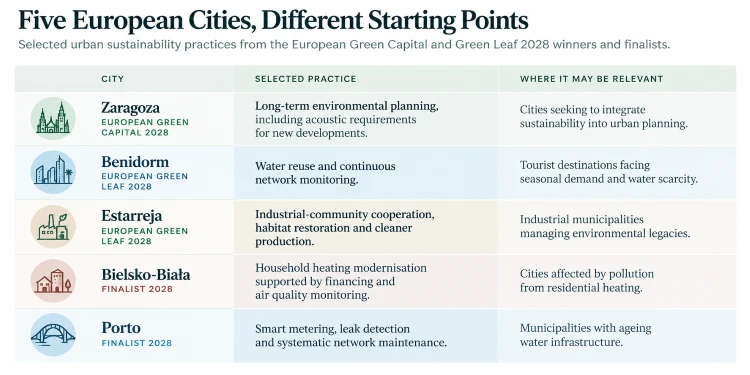
The five cities have followed different paths, and their environmental achievements cannot be measured by a single standard. Porto can demonstrate a substantial reduction in non-revenue water, while Zaragoza has introduced planning requirements whose full effects will emerge over time. Estarreja combines established cooperation and conservation programmes with recent industrial investments, and Bielsko-Biała shows how extensive heating modernisation can coexist with persistent air pollution.
Their experiences also reveal how much environmental progress depends on institutions and everyday decisions. Planning departments determine how new neighbourhoods are designed. Water utilities measure losses and organise repairs, while businesses invest in cleaner technologies and municipalities help households improve their homes. None of these activities is particularly glamorous, but together they shape the environmental conditions in which people live.
The European green city awards recognise broad environmental performance, not isolated projects. For municipalities elsewhere in Europe, including the Western Balkans, the most useful ideas may therefore be found not in copying another city’s entire strategy, but in examining how particular problems are managed. Better planning standards, reliable infrastructure data, accessible household financing and sustained cooperation between public institutions, businesses and residents can all become part of that work.