
Every year, from 1 November to 31 March, France enters what is known as the trêve hivernale, or winter eviction truce. During these five months, an eviction order generally cannot be enforced against a tenant, including in cases involving unpaid rent. The debt does not disappear and legal proceedings can continue, but the rule reflects a principle that also runs through the current debate over Paris housing policy: ownership comes with rights, but a home also has a social function.
The winter truce is a national rule, not a Parisian invention. But it provides a useful starting point for understanding what is now happening in the French capital. How far can a city go in regulating the use of privately owned housing when affordable homes are scarce?
In July 2026, the Paris City Council added another instrument to an already extensive housing policy. From January 2027, homes left vacant for at least a year will be subject to a tax equal to 30% of their cadastral rental value in the first taxable year and 60% thereafter. The default rates set by national legislation are 17% and 34%, but municipalities can raise them to the higher levels. Paris has chosen to do so. The city hopes the measure will help return around 20,000 vacant homes to the market.
The sharp increase made headlines. Yet the tax is only one part of a much broader experiment. Over more than two decades, Paris has assembled an unusually wide range of housing measures: social and affordable housing, public acquisition of private buildings, rent regulation, office-to-housing conversion, restrictions on tourist accommodation, taxation of underused homes and incentives for owners to return properties to long-term rental.
The real test is not whether one tax works. It is whether this combination can ease the housing crisis in Paris without pushing too much housing out of the conventional private rental market.
A city where one home in five is not a primary residence
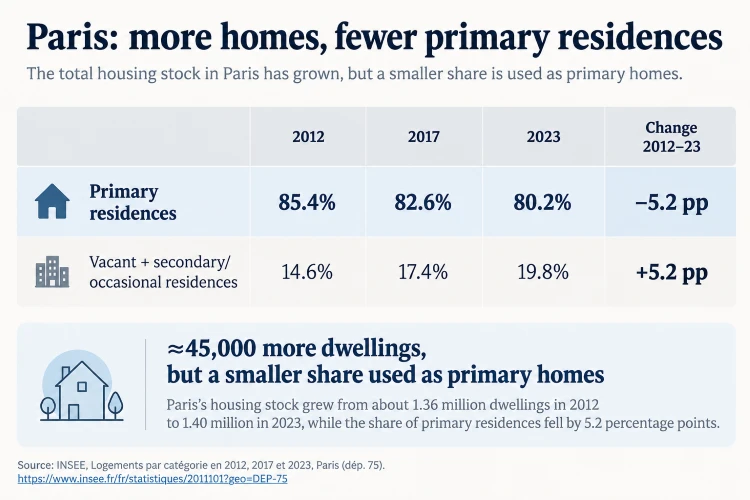
The numbers help explain why Paris is pushing so hard. According to the latest INSEE data, Paris had just over 1.4 million dwellings in 2023. Only 80.2% were primary residences. Another 9.9% were second or occasional residences and 9.9% were classified as vacant.
The change over the past decade is striking. In 2012, primary residences represented 85.4% of the housing stock. By 2017, their share had fallen to 82.6%, and by 2023 to 80.2%. Over the same period, the combined share of vacant, secondary and occasional homes rose from 14.6% to 19.8%. Almost one dwelling in five in Paris is therefore not someone’s primary home.
That does not mean that nearly 280,000 apartments are sitting unused and could simply be placed on the conventional rental market. The categories are very different. A second residence may be regularly used by its owner. A vacant property may be undergoing renovation, caught in inheritance proceedings or simply between occupants.
Paris itself makes this distinction. Under the new tax, exemptions remain for properties whose vacancy is beyond the owner’s control, including homes affected by legal or inheritance proceedings, properties requiring major renovation and homes offered for sale or rent at market prices without finding a buyer or tenant. Even with those qualifications, the trend is hard to ignore. The total housing stock has grown, but a smaller proportion of it is being used as permanent housing.
Vacant homes in Paris and a long queue for social housing
There is another striking comparison. At the beginning of 2025, Paris had 276,032 social homes, equivalent to 23.2% of its primary residences. Since 2001, more than 130,000 social housing units have been financed in the capital. Demand, however, remains exceptionally high. Around 327,000 households are registered as applicants for social housing in Paris, half of them already living in the city. Set beside the roughly 280,000 homes that are vacant, secondary or occasional, the two figures make a powerful contrast. They are not, however, matching measures of supply and demand.
A social-housing application represents a household, not necessarily a household without accommodation. Many applicants already occupy private or social housing but need something cheaper, larger or better suited to their circumstances. Nor can every non-primary residence realistically be converted into a long-term rental.
The comparison nevertheless captures one of the contradictions behind the housing crisis in Paris. The city has a severe shortage of affordable housing while a growing part of its housing stock is not used as permanent homes. That has gradually changed the policy debate. Building remains important, but so does the question of what happens to the homes that are already there.
How Paris housing policy moved beyond building more
The shift did not happen overnight. France’s 2000 Solidarity and Urban Renewal Act, commonly known by its French abbreviation SRU (loi relative à la solidarité et au renouvellement urbains), established minimum social-housing requirements for many municipalities. Under Article 55, municipalities covered by the law are generally required to ensure that social housing accounts for 25% of their primary-residence stock, with a 20% threshold applying in some less pressured housing markets.
Paris went beyond simply working towards the national requirement. Successive city administrations have used planning rules, public acquisition, pre-emption, conversion of existing buildings and direct support for social landlords to expand the regulated housing stock.
Two different figures are often used to describe the result, which can be confusing. APUR counts 276,032 social homes actually in service at the beginning of 2025, equal to 23.2% of primary residences. The City of Paris also refers to a share of around 25% of social housing financed, a broader measure that includes projects already funded but not necessarily completed. The comparable figure was around 13% at the beginning of the century.
Paris now wants to go considerably further. By 2035, the city aims for 40% of primary residences to be public housing: 30% social housing and another 10% affordable housing. The additional 10% is important because it targets a group often squeezed between the social and private markets: middle-income households who may earn too much to qualify for much of the traditional social sector but still struggle with Paris rents.
A publicly owned company, the Foncière du logement abordable, has been created to expand this intermediate segment. It plans to acquire entire buildings and offer homes at rents at least 25% below market levels. The city says the fund should acquire around 350 homes a year, backed by an annual acquisition budget of €120 million.
The city’s 2035 strategy estimated that reaching the 40% target would require producing more than 4,000 social homes and roughly the same number of other affordable homes every year. In Paris, however, “producing housing” does not necessarily mean constructing a new building.
When there is little space left to build
Paris is an exceptionally dense and mature city. Large sites for conventional residential development are scarce, while most of the urban fabric is already built. This has pushed the city towards other sources of supply. Existing buildings are acquired and renovated. Offices and other commercial premises become apartments. Private buildings are brought into regulated schemes.
Office conversion provides a useful example. Between 2013 and 2022, Paris accounted for 46% of all office floor space converted into housing across Greater Paris. Around 42% of the housing created through office conversions in the capital was social housing.
Conversions of all types of business premises produced around 900 homes a year over that period. Many were small projects carried out by private owners rather than large public redevelopment schemes.
For a city with little unused land, this matters. Increasing supply becomes partly a question of changing the function of buildings that already exist. The same reasoning has pushed vacant homes in Paris, second residences and tourist rentals much higher up the political agenda.
When homes move into the tourist market
Since January 2025, Parisians have been allowed to rent their primary residence as furnished tourist accommodation for no more than 90 days per year, down from 120. A primary residence is normally defined as a home occupied for at least eight months of the year. The rules are stricter for a property that is not the owner’s primary residence. Using such a dwelling for tourist accommodation requires a change-of-use authorisation and can involve compensation for residential floor space removed from permanent housing.
The scale of the sector explains the concern. At the end of September 2024, 95,344 furnished tourist rentals were registered in Paris, 78,301 of them declared as primary residences. More recent monitoring by APUR shows that short-term accommodation remains substantial across the metropolitan area. In October 2025, around 86,000 Airbnb listings were available across Greater Paris, almost 75,000 of them entire homes. About 65% of those entire-home listings were concentrated in Paris itself.
These figures need the same caution as the vacancy statistics. A listing is not automatically a home permanently removed from the residential market. Many primary residences are rented to visitors only occasionally. But short-term rentals now overlap with the housing market on a scale large enough that Paris no longer treats them simply as a tourism issue.
What makes the Paris approach different?
Vacancy taxes, rent controls, social-housing requirements and restrictions on short-term rentals all exist elsewhere. The distinctive feature of Paris housing policy is the way the city is trying to use them together. Some measures make it more costly or difficult to leave housing empty or divert it from permanent residential use. Others are designed to make long-term rental easier.
The Louez solidaire et sans risque programme is a good example. Private owners can lease their property through an approved organisation to households experiencing housing difficulties. In return, the scheme offers guaranteed payment of rent and charges, professional property management, coverage for restoring the apartment if necessary and, under certain conditions, tax advantages.
The city is therefore not relying on penalties alone. It is raising the cost of some choices while trying to reduce the risks associated with others. Public acquisition and office conversion add another layer. Where the private market does not produce enough affordable housing in Paris, the municipality increasingly intervenes in the stock itself.
Taken together, the approach covers several fronts: protecting tenants, regulating rents, recovering underused homes, converting non-residential property, acquiring buildings and continuing to build where space permits. That combination, rather than any single measure, is what makes Paris an interesting experiment.
Does taxing vacancy work?
There is some evidence that it can. France first introduced a tax on vacant housing in selected high-demand areas in 1999. Economist Mariona Segu later examined its effects in a study published in the Journal of Public Economics. She found that the tax reduced vacancy rates by around 13% in taxed municipalities relative to comparable untaxed areas, with a particularly strong effect on long-term vacancy. Most of the homes brought back into use became primary residences. That gives Paris some empirical basis for its latest move, but it does not tell us what the new rates will achieve in 2027.
Today’s housing market offers owners more alternative uses, including short-term rentals, and operates within a more complex regulatory system. Higher taxes may persuade some owners to rent or sell. Others may change the way a property is used or classified.
Then there is unavoidable vacancy. A habitable apartment deliberately kept empty is not the same as a property caught in a succession dispute or requiring major work. The exemptions built into the Paris system recognise that difference.
The city’s estimate that around 20,000 homes could return to the market is therefore better understood as a policy objective than a forecast.
Can regulation work without shrinking private supply?
This is where the Paris experiment becomes more difficult. Rent regulation limits landlords’ freedom to set prices. Restrictions on tourist accommodation reduce alternative uses. Vacancy taxes make keeping a home empty more expensive. At the same time, public acquisition expands the regulated sector.
Critics of this approach have a straightforward concern: if the cumulative burden becomes too high, some landlords may leave the conventional rental market, undermining the supply the city is trying to protect. Paris offers some evidence against the simplest version of that argument, although not yet a definitive answer.
Rent controls have been in force in the capital since July 2019. The latest APUR evaluation, conducted with researchers from CESAER and LéP using SeLoger listing data, estimates that by 2025 rents were around 5% lower than they would have been without the measure. The study found no lasting decline in rental supply that could be attributed to rent regulation itself.
There are limits to what this tells us. The study assesses rent regulation, not the combined impact of vacancy taxes, tourist-rental rules, public acquisition and other measures. Its estimate also depends on a counterfactual: what would have happened in Paris without rent controls.
And lower rents do not create additional apartments. For that reason, the next few years will be particularly informative. Paris is trying to regulate prices while also recovering, converting and acquiring housing. Whether those policies reinforce one another or begin to work against one another will be a more meaningful test than the performance of any single measure.

Paris is not alone
The dilemma extends well beyond France. Across major cities, housing policy is moving beyond the familiar question of how much new housing can be built. Vienna, Helsinki, Beijing, Tokyo, Singapore and New York are pursuing very different approaches to affordable urban housing, from public and subsidised housing to new rental models and more intensive use of limited urban land.
Barcelona and Amsterdam, meanwhile, have tightened rules governing tourist accommodation and the non-primary use of housing. Their policies differ from the Paris approach, but the underlying pressure is familiar: demand is strong, developable land is limited and some existing homes are moving away from permanent residential use.
This marks a broader shift in urban housing policy. For years, the central question was how many homes a city could build, where they could be built and at what density. Increasingly, cities also have to ask what happens to those homes after they have been built. For tourist and investment destinations with constrained housing markets, the two questions can no longer be separated.
What can other cities learn from Paris?
It is too early to call Paris a model to follow. The new vacancy-tax rates will not take effect until January 2027, and several parts of the strategy are still developing. But the experience already points to some useful principles.
Cities need to measure housing use as well as housing supply. Between 2012 and 2023, the total Paris housing stock increased from about 1.36 million to 1.40 million dwellings. Yet the share used as primary residences fell. More homes on paper did not translate into a larger share of homes occupied by permanent residents.
They also need to distinguish between different forms of non-use. A habitable apartment deliberately kept empty, a property awaiting renovation, an inherited home tied up in legal proceedings and an occasionally used second residence pose different problems. A tax designed without those distinctions risks being both unfair and ineffective.
Penalties work better when they are accompanied by incentives. Paris can make long-term vacancy more expensive, but programmes such as Louez solidaire also try to make renting less risky. The balance between the two may prove as important as the level of the tax itself.
Dense cities also need to look beyond new construction. Office conversions, rehabilitation and acquisition of existing buildings can all add to the usable housing stock, particularly where land for large new developments is scarce.
Above all, results matter more than the number of regulations adopted. Paris should eventually be judged against a fairly practical set of questions. Does long-term vacancy fall? Does the share of primary residences stabilise? Do more homes return to long-term rental? Does private rental supply remain viable? And does access to affordable housing in Paris actually improve?
More homes, but fewer of them primary residences
Perhaps the most telling figure in this story is not the new 60% vacancy-tax rate or the target of 40% public housing. Between 2012 and 2023, Paris added roughly 45,000 dwellings to its housing stock. Over the same period, the share used as primary residences fell by more than five percentage points, from 85.4% to 80.2%. For a mature, expensive and globally attractive city, that is an important warning against treating housing supply as a simple numbers game.
Paris still needs more housing. It also needs more of the housing it already has to remain available to people who live there. That does not justify unlimited intervention. Property rights, tourism, mobility, investment and legitimate second-home use are all part of an urban economy. Nor can bringing empty homes back into use solve structural scarcity in a city where hundreds of thousands of households are seeking affordable housing. But a city where almost one dwelling in five is not a primary residence cannot ignore how its existing housing stock is being used.
This is the real significance of the Paris experiment. The vacancy tax, rent regulation, tourist-rental rules, office conversions, public acquisitions and incentives for private landlords are different ways of testing the same proposition: in a city with little room left to expand, housing policy is not only about building more. It is also about keeping more of the existing city available for people to live in.
Whether Paris has found the right balance remains to be seen. The answer will not come from the ambition of its targets or the severity of its regulations, but from something much simpler: whether more homes actually become places where people live.