

he article about Vehicle-Road-Cloud Integration is provided by our media partner 7ITSNEWS.
Road traffic accidents remain one of the most persistent challenges facing modern transportation systems, despite significant advances in vehicle technology, infrastructure, and traffic management. As cities become more connected and mobility networks more complex, improving road safety requires moving beyond traditional approaches focused solely on drivers and vehicles. Increasing attention is therefore being given to integrated solutions that combine intelligent vehicles, smart infrastructure, and real-time data platforms. Against this backdrop, Vehicle-Road-Cloud Integration has emerged as a promising framework for reducing risks, enhancing traffic efficiency, and advancing the goal of intrinsically safer transportation systems.
Vehicle-Road-Cloud Integration refers to the coordinated interaction of intelligent vehicles, connected road infrastructure and cloud-based traffic management systems.
Road traffic and safety challenges
The core of traffic is the movement of people and goods from Point A to Point B, while transportation is organized movement. Society’s demand for traffic is growing, with safety, convenience, efficiency, green mobility, and economy becoming the five major goals of building a transportation powerhouse, among which safety ranks first.
According to WHO statistics, approximately 1.2 million people die in traffic accidents globally each year, and 50 million are injured or disabled. The mortality rate is 15 per 100,000 population, with 90% of accidents occurring in developing countries. China’s traffic safety situation remains severe. Although major accidents with 10 or more deaths have dropped from their high frequency in the 1990s to “zero” in 2025, the national motor vehicle fleet has reached 360 million vehicles. Safety awareness and infrastructure development lag behind.
Compared with developed countries, the concept of accident prevention has not yet taken root in China. The “zero fatality” vision has not been written into urban development plans. China’s traffic mortality rate per 100,000 population remains higher than that of Europe and the United States, and even higher than Brazil and Thailand. Safety is a matter of zero or one, while efficiency is a matter of one to ten. Safety is always the fundamental prerequisite for traffic operations.
What causes traffic accidents in China
First, highways are the high-incidence scenario, accounting for more than 60% of accidents, of which expressways account for 20-30%, national highways and rural roads account for 40%, and urban roads account for about 30%, with a gradually increasing trend.
Second, more than 70% of accidents occur on road segments, but special areas such as curves and intersections see concentrated accidents and should be the focus of prevention.
Third, human factors account for 97% of accident causes, far higher than in developed countries. Road-related factors account for about 20%, and vehicle-related factors also account for about 20%. The high proportion of human factors leaves significant room for technologies such as autonomous driving and vehicle-road coordination.
Fourth, adverse weather conditions can easily lead to major accidents. Fog, snow, and other conditions greatly increase the difficulty of traffic command.
Fifth, frontal collisions are relatively rare, while side collisions account for more than one-third of all accidents. Collisions between vehicles and stationary parked vehicles account for nearly 7%, which deserves attention. In addition, truck-related accidents account for a relatively high proportion, and issues such as airbags failing to deploy properly also require in-depth study.
Drivers often report “did not see,” “did not notice,” or “had no time to brake,” which requires vehicles and road systems to improve perception and response capabilities through technical means.
The core of accident prevention can be analyzed using the kinetic energy principle. The vast majority of accidents are contact accidents, and the essence of contact is collision. The core of prevention is to reduce the kinetic energy generated by collision. Kinetic energy is proportional to mass and the square of speed, providing a scientific basis for prevention and control.
Vehicle-Road-Cloud Integration and intrinsic safety
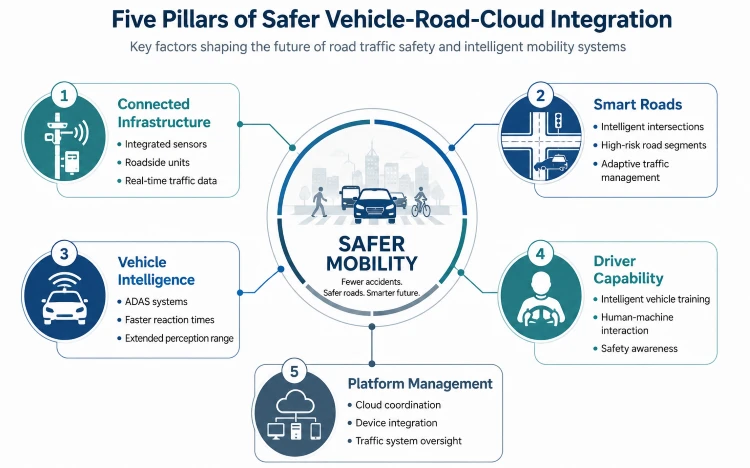
The development of the Vehicle-Road-Cloud system must first improve the intrinsic safety of vehicles.
Traditional vehicles should have longer perception distances, higher braking efficiency, and better overall performance. GB7258 and GB1589 are the core safety standards. In hundreds of years of automotive development, approximately 50 million people have died in traffic accidents. Safety needs have driven technological innovations such as ABS, EBS, ESP, pedestrian protection technologies, and night vision enhancement.
Second, the intelligence level of vehicles should be further improved. It is recommended to add “semi-open and semi-closed” test scenarios in addition to closed and open testing, forming a systematic and more complete vehicle testing system consisting of extreme testing, limited-risk testing, and adaptability testing. Intelligent vehicles should not learn the bad habits of human drivers. Displaying traffic light information directly on vehicle terminals may cause distracted driving and requires careful design.
Third, the intrinsic safety of roads must be improved. The United States and Europe have their own definitions of smart expressways. China has also released relevant group standards defining smart expressway levels. The core is to make roads more intelligent through technical means. A report released by the U.S. Department of Transportation in August 2024 emphasized that the core of vehicle-road coordination is to save lives. There is a certain deviation in China’s Vehicle-Road-Cloud development, with insufficient attention to traffic safety. Focus areas such as holographic intersections and variable lanes are essentially traffic management rather than safety improvement.
Vehicle-road coordination should focus on areas prone to collisions, such as sharp curves, continuous curves, long steep slopes, and unsignalized intersections, especially for side collisions, which are high-frequency accidents. Automakers hope that roads will adapt to vehicles, but from the user’s perspective, we hope that vehicle technology will continuously improve to better adapt to existing road environments.
Fourth, improving driver capability remains critical. Human factors currently account for 97% of accident causes, indicating significant room for improvement in driver training and examination systems. With the rapid development of intelligent vehicles, driver training should include content on intelligent vehicle cognition and the use of ADAS systems, helping drivers master the operational logic of new vehicles and their characteristics on the road.
Fifth, system safety of the Vehicle-Road-Cloud system requires platform support. Currently, 20 cities nationwide are piloting Vehicle-Road-Cloud control platforms. However, some platforms are being built blindly. The core value of a platform is not its “construction” but its ability to effectively manage and control various devices.
Recommendations for future development of Vehicle-Road-Cloud Integration
1. Upgrade and integrate existing intelligent equipment according to national standards
Existing standards such as GB 19056, GB 38892, and relevant Ministry of Transport standards are in urgent need of integration. More than 1 million heavy vehicles have been equipped with relevant devices, and ETC issuance has reached 220 million units. It is hoped that integration can be achieved in the new revision of GB 7258.
2. “Connectify” slow-speed key traffic individuals
Unmanned logistics vehicles and automatic cleaning vehicles have huge market potential and must be connected. It is recommended to integrate RFID technology for electric bicycles with the Internet of Vehicles system and promote the early application of Internet of Vehicles chips by students, the elderly, traffic police, and other special groups to achieve “being identified, being seen, and being detected early.”
3. Single-vehicle intelligence is key
Huawei, Tesla, and other companies are leaders in the field of single-vehicle intelligence. In the future, intelligent vehicles should be able to see farther, react faster, and make more accurate judgments than humans. Practices in Sichuan and elsewhere applying Vehicle-Road-Cloud technology to heavy truck operations are significant. Automotive innovation should focus on accident prevention, ride comfort, and traffic efficiency, rather than innovation for its own sake.
4. Expand the scale of smart roads and achieve intelligent key nodes
Efforts should focus on increasing the application of smart devices at key nodes such as signalized intersections, curves, roundabouts, interchange intersections, long straight sections, and transportation hubs. Standard development and improvement urgently need industry attention. The core value of smart expressway construction lies in reducing accident rates and improving efficiency, thereby bringing economic and social benefits.
5. Innovate mechanisms and deepen applications
The rights and responsibilities of the government and enterprises in Vehicle-Road-Cloud construction have not yet been clarified. It is necessary to clarify the user subjects, deepening application subjects, and beneficiary subjects of Vehicle-Road-Cloud. Ultimately, this is about clarifying the intrinsic relationship between traffic and transportation.
Finally, the industry must face the coming era of mixed traffic. On future roads, human-driven vehicles will coexist with unmanned vehicles, and non-motorized vehicles will also play an important role. The entire industry should work together to use new technologies to truly solve various problems in traffic development.
About the author: Pan Hanzhong, former Deputy Director and Researcher of the Road Traffic Management Research Institute of the Ministry of Public Security of China
Read more about smart mobility here