
Despite predictions that sustainable finance would see a downturn in its fortunes, ESG investment trends in 2026 have proven otherwise. After the anti-ESG reaction in the US and regulatory shifts in 2024-2025, many wondered whether sustainable investments had peaked. But it seems sustainable investments are far from declining; they have simply become more rigorous.
Investors are becoming more pragmatic
Rather than abandoning ESG, investors are changing how they use it. According to the 30th Annual Review of Sustainable Investing in the United States, around 70% of investment managers continue to use ESG integration as their primary investment strategy and have no plans to move away from it. At the same time, 88% of retail investors worldwide remain interested in sustainable investing, according to Morningstar.
The emphasis is shifting from broad sustainability claims to measurable business value. Investors increasingly evaluate companies based on climate resilience, governance quality, supply-chain security, and long-term financial performance instead of relying solely on ESG labels.
The ESG market continues to expand
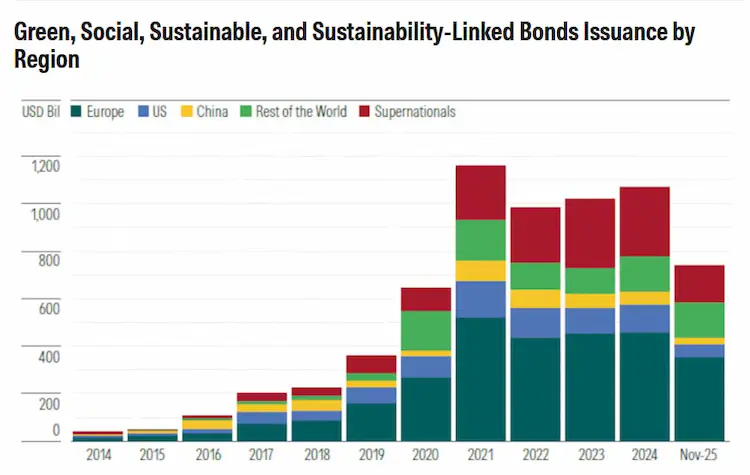
Market data suggest that sustainable finance continues to expand despite growing political debate around ESG. According to Mordor Intelligence, the global ESG finance market is expected to reach US$9.69 trillion in 2026 and grow to US$16.5 trillion by 2031, representing a compound annual growth rate (CAGR) of 11.24%. This pace significantly exceeds projected global GDP growth.
Asia-Pacific is expected to remain the fastest-growing regional market, with ESG finance expanding at 13.18% annually, supported by stronger regulatory frameworks, rising institutional demand, and rapid capital market development.
Read more about exploring ESG here.
Regulation is becoming simpler
One of the most significant developments in Europe is the European Commission’s Omnibus simplification package, which includes changes affecting sustainability reporting and sustainable finance disclosures. The initiative aims to reduce reporting and administrative burdens by 25% for large companies (and by 35% for SMEs) while making sustainability information more focused, comparable, and decision-useful for investors. Discussions on a possible reform of the Sustainable Finance Disclosure Regulation (SFDR) are continuing in parallel, with the objective of improving the clarity of product classifications and disclosures. Overall, the direction of travel is toward higher-quality, more practical sustainability reporting rather than a complete replacement of existing disclosure requirements.
The evidence suggests that ESG investment trends 2026 are defined by evolution rather than retreat. Sustainable investing is becoming more disciplined, with stronger attention to financial performance, material risks, and credible reporting. Capital continues to flow into companies that can demonstrate resilience and long-term value, indicating that ESG is moving from a marketing concept to a core element of modern investment strategy.