
Corporate sustainability is entering a more pragmatic phase. Business leaders still expect investment to continue, but fewer are looking to international agreements or public pressure to drive the next stage of the green transition.
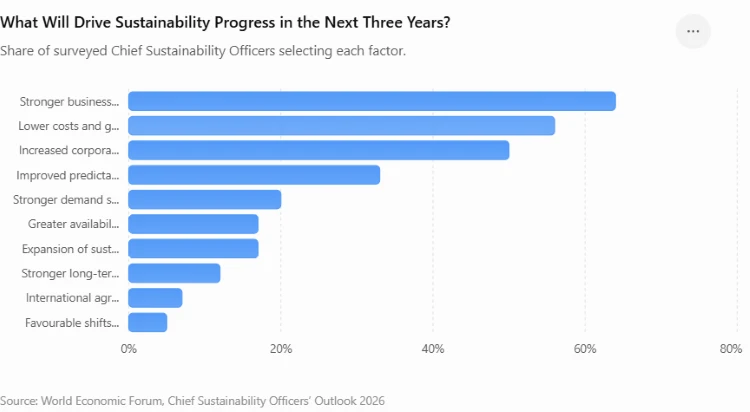
Only 7% of chief sustainability officers surveyed by the World Economic Forum expect international agreements to be among the strongest drivers of sustainability progress over the next three years. Even fewer, 5%, point to favourable shifts in public opinion.
The numbers look very different when money and technology enter the picture. A stronger business case for sustainability was chosen by 64% of respondents, lower costs and wider availability of sustainable technologies by 56%, and cooperation between companies within and across value chains by 50%.
These are some of the findings of the World Economic Forum’s Chief Sustainability Officers’ Outlook, published in September. The survey was conducted between February and March 2026 among 103 members of the Forum’s community of 189 sustainability executives from large companies. Respondents came from five continents, although the results are not broken down by region.
The timing matters. The survey was carried out amid geopolitical tensions, weaker economic growth and uncertainty over climate policy in several major economies. Still, 69% of respondents expect corporate sustainability strategies and investment either to remain broadly unchanged or to accelerate over the next 12 months.
The business case for corporate sustainability
There is a fairly practical explanation for this resilience. Sustainability measures increasingly have to show what they can do for costs, supply chains and competitiveness. A similar shift is visible in ESG investment trends, as investors move away from broad sustainability claims towards measurable business value, resilience and long-term financial performance.
A 2025 survey cited in the WEF report found that large companies had achieved average savings of 20% through waste reduction, 17% in supply-chain costs and 16% in energy consumption over the previous three years. CDP puts another number on the same trend: companies working with suppliers to reduce emissions have already identified $13.6 billion in savings, with a further $165 billion in potential financial benefits.
But this does not mean sustainability has fully moved from the ESG department into the centre of corporate strategy. Asked how senior executives currently see it, 65% of CSOs chose “compliance obligation”. Half chose “social licence to operate”. Only 41% said it was seen as a source of business growth or value. Customer demand came in at 15% and workforce expectations at 8%.
Investors, boards and regulators now appear to matter more for corporate action than consumers or employees. This is also visible in ESG reporting trends, where the regulatory landscape is becoming more fragmented even as sustainability disclosure becomes more embedded in corporate practice. In the WEF survey, 58% of respondents expect climate- and nature-related reporting to continue expanding globally. The report points to the adoption or adaptation of ISSB standards in the UK, Japan, Türkiye, Brazil and Australia, with China and India also moving towards related requirements for listed companies.
One green transition is becoming many
One of the more useful ideas in the report is “green divergence”. The term describes a world in which countries continue with the green transition, but increasingly for different reasons and along different routes.
The differences are already visible. WEF points to clean-energy manufacturing and critical minerals in Southeast Asia; water security, resilient infrastructure and sustainable finance in the Middle East and North Africa; and growing cooling and adaptation needs in parts of Africa. Around two-thirds of surveyed CSOs expect emerging markets to play a larger leadership role in global environmental sustainability.
This makes the transition harder to describe as a single global project. Energy security, industrial policy, access to raw materials, water, infrastructure and competitiveness are increasingly mixed with climate objectives. The destination may overlap, but the economic arguments for getting there can be very different.
Adaptation becomes a business issue
The same pragmatism is visible in climate adaptation. Eighty-five percent of respondents expect adaptation to receive more attention over the next three years, and 77% believe private investment will be decisive in scaling it up. Companies are particularly concerned about distribution and logistics, operations and insurance: 42% identify the cost and availability of insurance among the areas most vulnerable to climate and nature risks.
Money itself is not the biggest obstacle. Only 14% cite the high cost or limited availability of finance as a major constraint on adaptation investment. Far more, 62%, struggle with uncertain cost-benefit calculations. Another 42% point to a lack of leadership support and 31% to short budgeting cycles.
That is particularly important given the scale of the problem. UNEP estimates that developing countries will need around $310–365 billion a year for adaptation by 2035, while international public adaptation finance amounted to only $26 billion in 2023.
AI adds another complication. Almost three-quarters of surveyed CSOs expect AI and other digital technologies to support sustainability progress. Risk forecasting, resource and energy efficiency, and environmental measurement are seen as the most promising applications. But 77% also identify the energy and resource demands of AI infrastructure as its main environmental downside.
This concern is hardly theoretical. The International Energy Agency expects electricity consumption by data centres worldwide to more than double to around 945 TWh by 2030, with AI the main driver of that growth.
The WEF survey does not show companies turning away from sustainability. It shows something less dramatic but probably more consequential: sustainability strategy is being tested against ordinary business questions. What does it cost? What does it save? Which risks does it reduce? And where does it create an advantage?