

This article is provided by our media partner 7ITSNEWS.
The shared two-wheeled mobility industry has developed over the past decade, now comprising two main sectors: bicycles and e-bikes. Only three major players remain in the bicycle sector, while the e-bike sector has over 200 competing companies. The industry has deployed approximately 20 million vehicles across 1,000 cities and counties, generating 50 million daily orders, equivalent to 50% of urban rail transit volume, thereby making it a vital supplement to urban transport systems and a key part of the reconstruction of the governance of two-wheeled mobility.
From a technical perspective, shared mobility integrates AI, IoT, and big data. AI enables parking tests, helmet detection, and facial recognition. IoT uses high-precision positioning and vehicle status alerts to regulate parking. Big data leverages massive order, trajectory, and heatmap data for enterprise dispatch and government decision-making.
The industry faces four core challenges: order management, safety, conflict between old and new mobility formats, and replacement of private e-bikes.
Order Management
Leading companies have built vehicle status control platforms for full-process management. Combining geofencing with physical parking markings effectively guides standardized parking. For example, downtown Hangzhou has no shared e-bikes; they are only deployed in suburbs with geofencing that automatically cuts power when leaving designated areas. Daily order data is actively shared with government agencies to support efficient dispatch and parking control.
Safety Management
For traffic safety, shared e-bikes strictly follow national standards, speed limits, helmet use, etc., which have driven industry-wide improvements in private e-bikes. Helmets are critical: 80% of e-bike fatalities involve head injuries. Shared e-bikes commonly adopt a “no helmet, no start” technical measure to ensure basic safety.
For battery safety, private e-bikes often have hazards like indoor or improvised charging. Shared e-bikes use centralized or distributed charging modes, effectively avoiding such risks. Data shows shared e-bikes have a significantly lower average accident rate per million kilometers than private e-bikes.
Synergy Between Old and New Mobility Formats
Central government think tank research shows that in typical cities, 75% of shared e-bike orders are complementary to buses and subways. In Kunming, Nanning, and other southern cities, 5-8% of rail transit passengers use shared e-bikes for first/last-mile connections. However, bus ridership continues to decline, with multiple studies indicating private e-bikes as a major factor.
The 2-7 km range is the core service distance for buses. Within this range, 40% of trips use private e-bikes, 30% use walking or cars, leaving public transit to compete for the remaining share. Cost difference is key: average monthly travel cost for private e-bikes is 94 RMB, compared to about 225 RMB for bus/subway and 236 RMB for shared e-bikes. This cost advantage significantly diverts passengers from public transit.
Reconstructing the Governance of Two-Wheeled Mobility Through Substitution
Private e-bike ownership has reached approximately 400 million vehicles nationwide, becoming the most basic motorized travel mode. Pilots on campuses and in industrial parks show that shared mobility can effectively replace private e-bikes, with an ideal substitution ratio of 1:3.
The efficiency advantage of the shared model is clear: near a rail transit station in one city, the average parking duration for a shared e-bike is about 100 minutes, compared to 300 minutes for a private e-bike. Shared models significantly outperform private vehicles in parking space utilization and efficiency.
Recommendations and Outlook
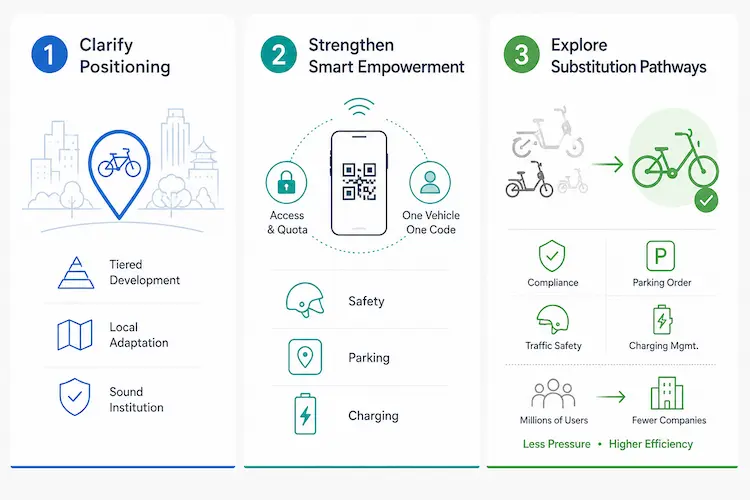
First, clarify the industry’s positioning. After more than a decade, the role of shared mobility in transport planning remains unclear, lacking tiered development guidance. Differentiated development models should be explored, with policies adapted to local conditions to create a sound institutional environment.
Second, strengthen smart empowerment. Deepen smart access control, quota management, and “one vehicle, one code” systems, and explore extending these management models to private e-bikes. On safety, continue promoting helmet and seatbelt use and intervention against risky riding. On parking, optimize high-precision positioning and geo-fencing-based payment settlement. On charging, apply shared e-bike centralized charging models to private e-bike governance.
Third, explore substitution pathways. Shared e-bikes have clear advantages in vehicle compliance, parking order, traffic safety, and charging management. Centralized charging turns dispersed risks into manageable ones. By shifting management targets from millions of private users to a few companies, shared models create an efficient leverage effect. Implementing shared-to-private substitution in selected cities or areas can reduce management pressure, improve governance efficiency, and contribute to reconstructing the governance of two-wheeled mobility.