

The density of official air quality monitoring stations in Serbia and the wider region remains insufficient to provide a complete picture of how pollution is distributed across space. As major Western Balkan cities continue to face chronically high concentrations of PM2.5 and PM10 particles, with Skopje, Sarajevo and Belgrade recording levels two to four times above World Health Organization recommendations, the need for precise and spatially dense monitoring becomes a matter of public health.
In this context, low-cost sensors are increasingly emerging as an accessible complement to expensive reference stations. The key question, however, is how reliable they really are.
Before assessing the sensors themselves, it is important to understand why their role matters. According to the World Health Organization, air pollution is responsible for millions of premature deaths worldwide each year. Among the most harmful pollutants are particulate matter, especially PM2.5 and PM10. Their danger lies in their ability to penetrate deep into the respiratory system, causing respiratory and cardiovascular diseases, including asthma, bronchitis, heart attacks, strokes, or even mental diseases.
Vulnerable groups such as children, the elderly and people with chronic conditions are particularly at risk. This is precisely why accurate and sufficiently dense monitoring is not a luxury, but a fundamental prerequisite for protecting public health.


How low-cost sensors are changing air quality monitoring
Air quality is now widely recognized as one of the key public health challenges, especially in urban environments where traffic, industry and individual heating sources intersect. Although air pollution is systematically monitored, existing measurement approaches often fail to provide sufficiently detailed insight into local variations.
In this context, so-called low-cost sensors are attracting increasing attention, as they enable more affordable and denser monitoring networks.
Reference monitoring stations remain the standard of highest reliability. These systems, often costing more than €100,000 per unit, rely on highly precise methods such as gravimetric and optical measurements, fully aligned with European regulations. However, their wider deployment is limited by high installation and maintenance costs. As a result, monitoring networks cover a relatively small number of locations, leading to insufficient coverage, particularly in areas with heavy traffic or dominant individual heating systems.
Low-cost sensors, by contrast, offer a significantly more accessible solution. These devices are compact, often wireless, and considerably cheaper, ranging from a few hundred to several thousand euros. Their key advantage lies in the ability to create dense sensor networks that provide more detailed spatial and temporal resolution of data. This allows for a more realistic picture of pollution distribution at the micro level, such as along busy streets or within industrial zones.
How do these sensors work?
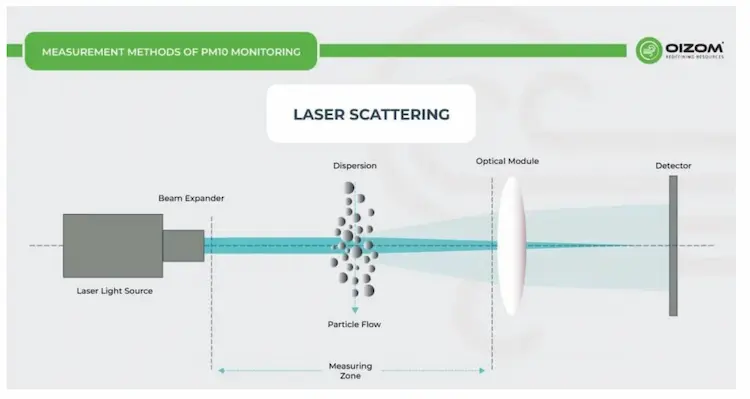
The most commonly used sensors for particulate matter (PM2.5 and PM10) operate on the principle of optical light scattering. When particles pass through a laser beam inside the sensor, they alter the intensity of the light, which is then used to estimate their concentration. This technology enables rapid response to changes in air quality, which is particularly important during short-term pollution episodes.
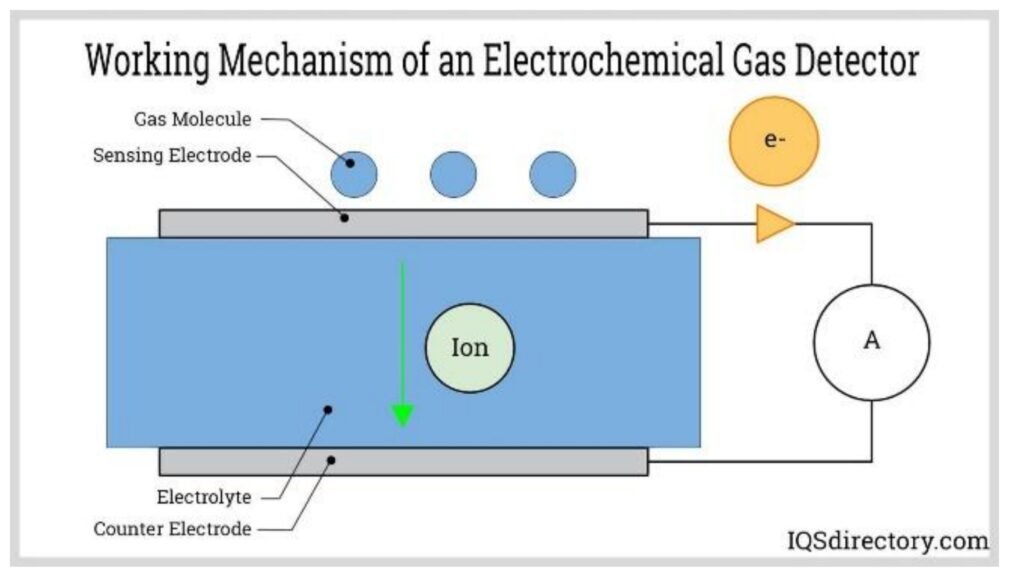
For gaseous pollutants, electrochemical sensors are used. These detect chemical reactions between gases and electrodes, generating an electrical signal proportional to pollutant concentration. Such sensors are especially useful for monitoring pollution from traffic and industrial sources.
How reliable are the results?
In contemporary air quality research, increasing attention is being given to comparative analysis of low-cost sensors and reference monitoring stations, with the aim of optimizing existing monitoring systems. Reference stations remain the methodological and regulatory “gold standard” due to their high precision, reliability and compliance with European directives.
However, their high investment cost and maintenance complexity significantly limit the possibility of establishing dense monitoring networks, especially in urban environments characterized by strong spatial variability of pollution sources.
By contrast, low-cost sensors enable a far more flexible approach to monitoring, primarily through the possibility of deploying a large number of measurement points at relatively low cost. This opens the way for a more detailed understanding of the spatial distribution of pollutants, which is particularly important in areas with heavy traffic, industrial activity or widespread use of individual heating systems.
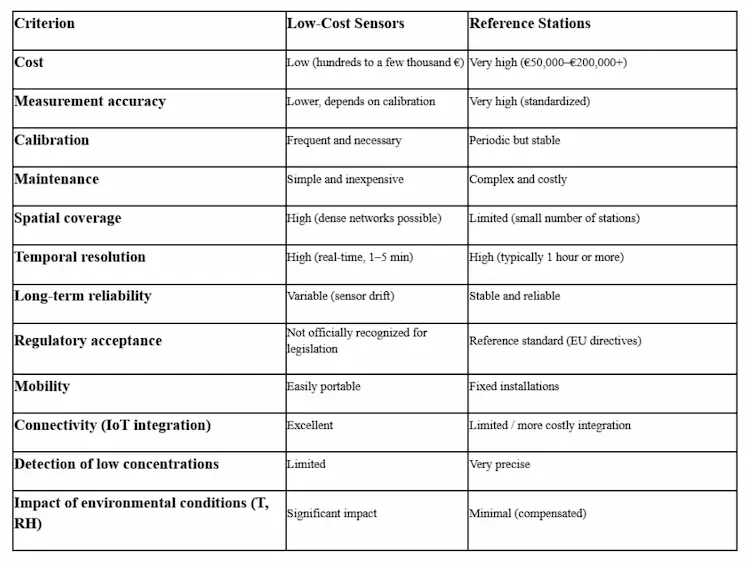
At the same time, their application is not without challenges. The key issue is the stability of calibration over longer periods, as well as pronounced sensitivity to external influences such as temperature and relative humidity, which can lead to variability in data quality.
Despite these limitations, the scientific and professional community increasingly recognizes the potential of integrated monitoring systems, in which the high accuracy of reference stations is combined with the spatial resolution of low-cost sensors. Such an approach not only improves data quality but also supports the development of advanced models for assessing population exposure to air pollution, which is essential for designing effective public health policies.
Case study: comparing sensors in real conditions
As noted, the key question regarding low-cost sensors is their accuracy. To demonstrate their potential as a complementary tool, a study was conducted in Pirot, comparing a reference monitoring station with low-cost sensors.
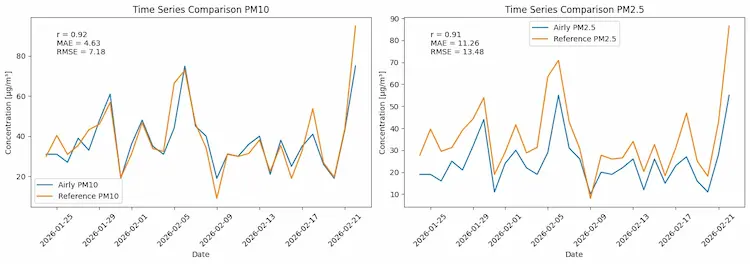
An Airly Pure low-cost sensor was installed in close proximity to the reference station, with a distance of only a few meters between the devices, ensuring comparable measurement conditions. Monitoring was carried out over a continuous 30-day period, from January to February 2026, providing a sufficient number of data points for statistical analysis and correlation assessment.
For PM10 particles, a high correlation with reference measurements was observed (r ≈ 0.92), with relatively small deviations. This indicates that these sensors can reliably track changes in particulate concentrations under real-world conditions.
For finer particles (PM2.5), although the correlation was also high (r ≈ 0.91), larger deviations in absolute values were observed, particularly at higher concentration levels.
Meteorological conditions have a significant impact on measurement accuracy. High relative humidity can lead to increased optical signals due to the hygroscopic growth of particles, while temperature and aerosol composition further influence the results. For this reason, calibration against reference stations is a critical step in the practical application of these sensors.
What does this mean for cities and citizens?
Modern air quality monitoring increasingly relies on integrating reference stations with low-cost sensors. This hybrid model offers an effective compromise between high accuracy and detailed spatial coverage. It makes it possible to assess the spatial distribution of pollution more precisely, identify dominant local emission sources, and respond more quickly when pollutant concentrations rise. At the same time, wider public access to data improves transparency and helps raise awareness of air quality issues.
Examples from practice, such as projects in London and Łódź, show that these systems can have a direct impact on the design and improvement of public policy. Their use has supported concrete measures, including the introduction of low-emission zones and the protection of sensitive sites such as schools and healthcare facilities from the harmful effects of traffic and other pollution sources.
Read more about air pollution in Serbia here.
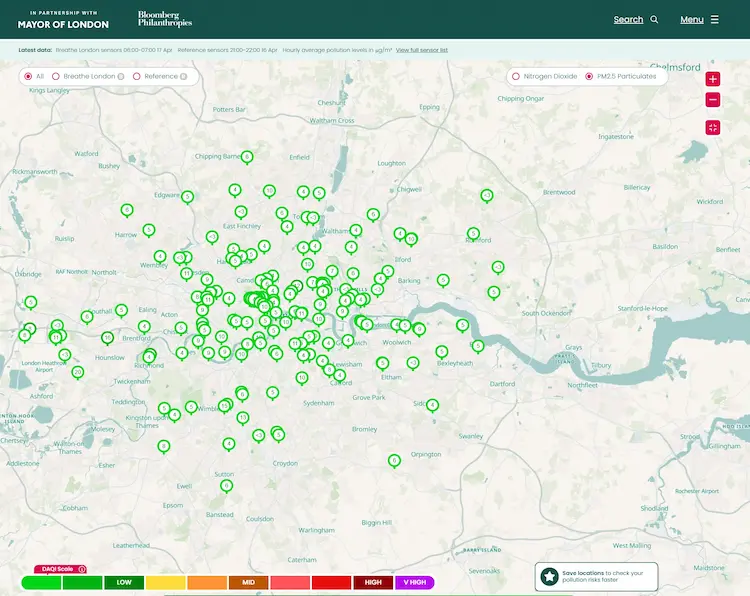
The Breathe London project is one of the most representative examples of how dense sensor networks can be used in an urban setting. Launched in 2019 as a pilot project with around 100 sensors, it quickly demonstrated its operational value, and the network was later expanded to more than 400 devices. This kind of infrastructure enables continuous real-time air quality monitoring while significantly improving the spatial resolution and reliability of data. In London, the data collected through this system is used to support decision-making in air quality management, including the optimization of low-emission zones and the identification of critical pollution hotspots.
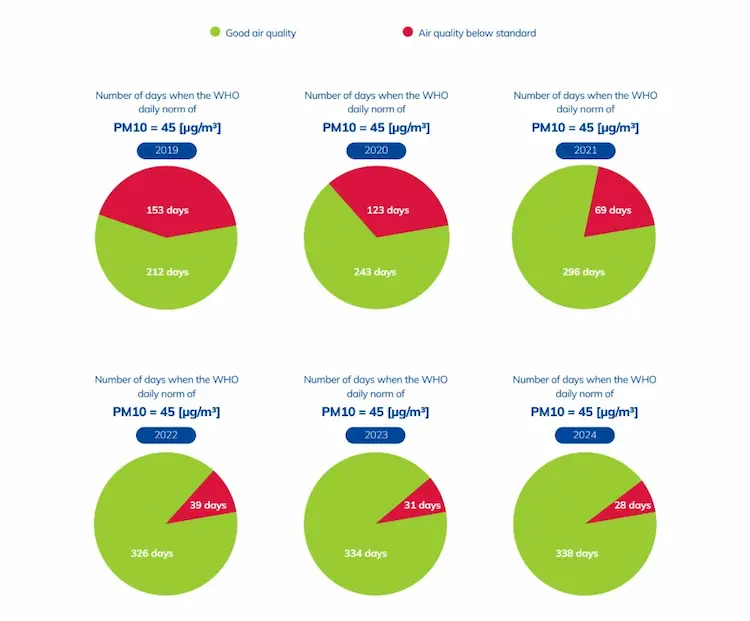
The Łódź region, by contrast, has long faced air quality problems linked to outdated heating systems and intensive traffic. The introduction of an expanded sensor network significantly improved the spatial representativeness of the data. This, in turn, made it possible to plan and implement measures more effectively, while the resulting improvements reflected a broader set of regulatory and technological interventions.
Conclusion
Based on the analysis presented, it can be concluded that in the context of air quality monitoring, low-cost sensors do not represent a replacement for reference monitoring stations, but rather their essential complement in modern systems. Their use enables a significant increase in spatial and temporal data resolution, which is crucial for understanding local pollution patterns and identifying critical zones in urban environments.
By integrating these two approaches, it is possible to develop a reliable and operationally efficient system capable of responding to increasingly complex environmental challenges .
At the same time, the development of such systems aligns with the European Union’s legislative framework, particularly Directive 2008/50/EC on ambient air quality and cleaner air for Europe. This directive defines limit and target values for key pollutants such as PM10, PM2.5 and NO₂, and requires countries to ensure adequate monitoring networks and public access to information.
Examples from London and Łódź clearly show that such systems can directly influence policymaking and the implementation of concrete measures to reduce air pollution. By enabling the identification of pollution hotspots, supporting the introduction of low-emission zones, and protecting vulnerable population groups, monitoring is evolving from a passive measurement system into an active tool for managing air quality.
Looking ahead, further development of these systems should focus on standardization, continuous calibration and integration of data into broader models for assessing population exposure. Only through such an approach can reliable foundations for decision-making be ensured and long-term improvements in air quality achieved, which remains one of the key priorities of sustainable urban development.
Uroš Pantelić – ecologist, assistant professor at the University of Belgrade.
Read more about air quality here.