
Over the past few years, the concept of the “15-minute city” has become one of the most widely discussed ideas in global urbanism. First introduced by urbanist and Sorbonne University professor Carlos Moreno, the concept has influenced debates on sustainability, mobility, quality of life, and urban regeneration far beyond Paris, where it first gained political visibility.
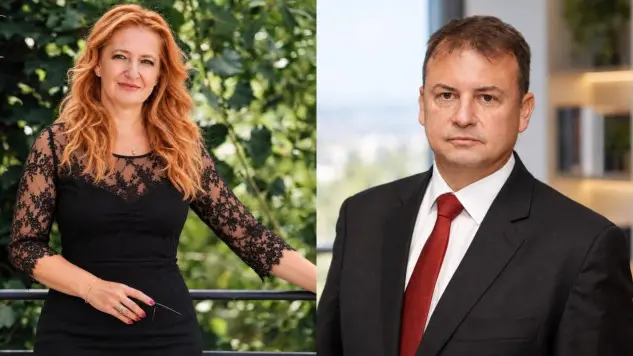
In this interview with New Polis, Moreno reflects on the evolution of the 15-minute city, the criticism surrounding the concept, social fragmentation and urban inequality, and why the future of cities may depend less on technological “smartness” and more on human-centred urbanism, resilience, and proximity.
The 15-minute city: beyond the slogan
Over the last few years, you seem to have moved away from the 15-minute city as a strict urban concept toward broader ideas like proximity, chrono-urbanism, and topophilia. Do you feel that the original concept has been oversimplified by public debate?
For the first time in modern urbanism, we had a concept — the 15-minute city — that generated a truly worldwide impact. One of the main reasons was the strong collaboration between the mayor of Paris, Anne Hidalgo, and me, a scientist at Paris Sorbonne University.
The 15-minute city is a scientific concept with significant complexity. The mayor of Paris embraced this concept to present a new urban model that people could easily understand during the Paris electoral campaign.
I would not necessarily say the concept was oversimplified. Rather, we needed to take a complex scientific framework and make it understandable and accessible to the public.
You often say that modern cities suffer not only from a spatial crisis, but from a crisis of time. What does that mean in practice? How should urban planners think differently if time becomes the central category?
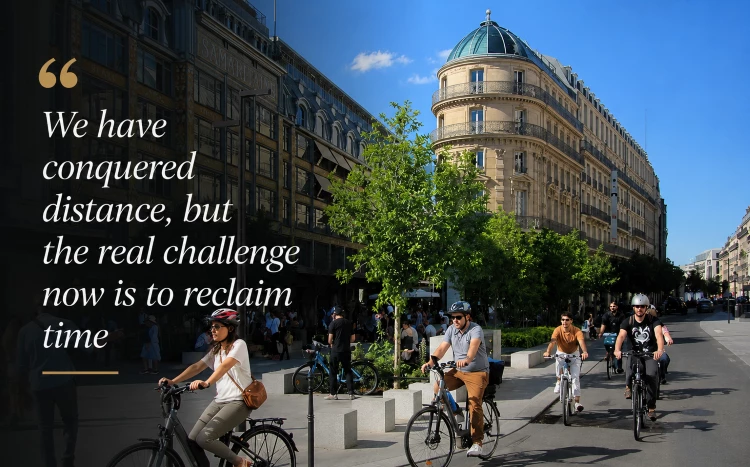
The essential question today is how to build a new relationship between urban space and useful time. For a long period, during the second half of the 20th century and the beginning of the 21st century, we conquered long distances, but we lost useful time.
With the 15-minute city, the least important element is actually the number itself. We should avoid becoming obsessed with the number 15. The essential point is to propose a more polycentric city based on shorter, decarbonised distances and low-carbon mobility, especially walking, and cycling, to reclaim more useful time and improve quality of life.
If we can offer more services close to where people live — commerce, restaurants, cafés, cultural activities, cinemas, theatres, schools, libraries, green spaces, outdoor activities, sports facilities — we automatically create more opportunities to improve quality of life while reducing dependence on private cars and overcrowded public transportation.
The real challenge is to recreate a new relationship in our cities. Today, many people live far away from services. We need more compact, polycentric cities with more services in closer proximity.
Universality and freedom of choice
Some critics say the 15-minute city works better in dense cities like Paris or Barcelona than in more fragmented or post-socialist cities. Do you think the idea can really work everywhere?
The best response to this criticism is reality itself. The concept was first proposed in Paris, but within just a few months to a few years, it spread worldwide across all five continents, regardless of city density or size.
Of course, we see implementation in cities such as Paris, Rome, or Milan. But we also see the concept applied in medium-sized cities, small towns, and even rural areas. For example, in Tunisia, in the city of Sousse, with 400,000 inhabitants. In Poland, near Poznań, in towns of around 15,000 inhabitants. In rural France, in small communities with 5,000 inhabitants.
For this reason, we created the Global Observatory of Sustainable Proximity, a new NGO established together with UN-Habitat, UCLG, and my team at IAE Paris Sorbonne University. Its purpose is to connect projects around the world and demonstrate that this concept has become universal, while adapting differently to each local context.
The 15-minute city is not a checklist or a list of constraints. It is a framework for reimagining cities and territories through the mix of six essential urban functions: where we live, work, learn, access healthcare, enjoy public spaces, and access commerce and services in proximity.
Through this mix, many forms of implementation become possible. Today, Scotland has implemented the “20-minute territory” approach. In Spain, the “30-minute territory” model is adapted for medium-sized and smaller cities.
We now have many examples around the world showing that the 15-minute city, the 30-minute city, or the X-minute city is no longer really about a number. It is an adaptive framework for improving quality of life in different contexts.
Today, I can confidently say that this concept has become universal.
People do not always choose the closest school, job, or cultural space. They often choose what they think is better. Can the idea of proximity work together with freedom of choice?
Of course it does. The question is how to improve the quality of life on a daily basis. Most people would prefer to have a school close to home rather than cross the city for an hour with their children every morning.
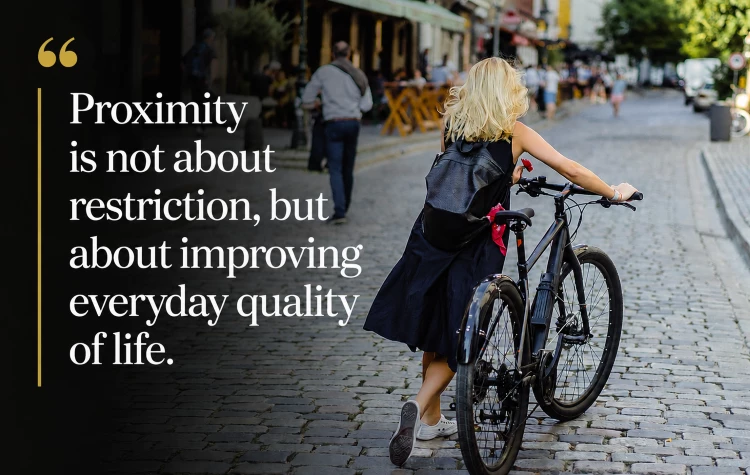
People appreciate having local commerce, cafés, restaurants, sports facilities, and cultural spaces nearby. Nobody refuses the possibility of improving the quality of life through proximity to services. So proximity is not about restriction, but about improving everday quality of life.
This is also positive for the economy. More local activities create employment, added value, local production, and local knowledge. They help create more vibrant neighbourhoods and can also help fight loneliness in dormitory neighbourhoods.
At the same time, people remain completely free to move around the city. If I prefer to go to a cinema far away from my home, that is my right. Nobody wants to create restrictions. The idea is simply to offer another urban and economic model, another lifestyle, in which people have easier access to more services closer to where they live.
Of course, cities may reduce car access in highly dense central areas due to traffic congestion and public health concerns. But people remain free to move around the city and make their own choices.
Beyond the 15-minute city
The term “15-minute city” has become politically controversial in some countries. If you were introducing the idea today, would you use the same language?
I first proposed this concept in 2010, sixteen years ago. But I am a scientist. My work is to continue exploring new possibilities to improve quality of life.
From the beginning, I proposed two concepts: the 15-minute city for high-density zones and the 30-minute territory for medium- and low-density areas. The 15-minute city became especially visible as many major city networks, including C40 Cities and UCLG, embraced the concept during the post-COVID period to rethink urban quality of life.
At the same time, with my team at Sorbonne University, we continued to develop the concept and build a global research community around it.
Today, scientists around the world are working on the X-minute city and the X-minute territory. The 15-minute city was the spark that launched a broader global discussion.
Since then, we have seen many adaptations:
- the 10-minute city in Utrecht,
- the 20-minute city in Melbourne,
- the 30-minute territory in Spain,
- “vital neighbourhoods” in Bogotá,
- “green thriving neighbourhoods” promoted through C40 Cities.
There are now many different names because the concept is alive. It is not static. It is not a doctrine. Scientific concepts must continue evolving. Today, my books have been translated into 15 languages, including Chinese, Polish, Hungarian, Latvian, German, Portuguese, Spanish, and many others. In Mongolia, in Ulaanbaatar, they even created a 15-minute city department.
For the first time in the history of urbanism, we have a single global concept deployed under many different names.
The goal is not to reproduce the exact same “15-minute city” everywhere. The goal is to promote the underlying principles: more compact, more liveable, low-carbon cities, shorter distances, and cities with more services and a better quality of life.
In your recent work, you increasingly connect urban planning with issues like ageing, loneliness, and social isolation. Why are these topics becoming so important for cities today?
The essential point of the 15-minute city, the X-minute city, and the X-minute territory is to improve quality of life. We need to identify social vulnerabilities and inequalities in cities and develop systemic proposals that connect climate challenges with economic and social challenges.
The legacy of the 20th century is the fragmented, zoned city. This urban fragmentation has generated deep social segregation. We have seen strong gentrification processes in cities at the end of the 20th century and the beginning of the 21st century. Today, this is clearly visible.
One of the key issues linked to ageing, loneliness, and dormitory neighbourhoods is social housing. This is particularly visible in former communist countries after the massive privatisation of social housing. In many places, social housing disappeared, and access to housing increasingly depended on income levels. Historic city centres and attractive urban areas became accessible primarily to higher-income people.
We need to recreate more social housing opportunities across the entire city through a distributed geographic approach. But it is not enough simply to provide housing. We also need to provide services.
This is essential because social housing is often located on the outskirts, far away from services and opportunities.
This creates a double punishment:
- spatial segregation,
- and temporal segregation.
People without nearby services may spend one, two, or even three hours each day just to access work, healthcare, or other basic needs.
To fight gentrification, we need a strong presence of distributed social housing integrated into the city itself. This is how we rebalance fragmented and segregated cities.
Social issues are also linked to economic issues. We have to transform the economic model of cities by creating more local activities, more local employment, more coworking spaces, and more local added value. Instead of forcing people to commute daily to corporate towers, we need proximity-based work models and more local economic opportunities.
When we connect social and economic issues through proximity, we also create concrete ways to reduce CO2 emissions by shifting from constrained mobility toward active mobility: walking, cycling, and public transportation.
Chronotopia and the multi-purpose city
You have written about the idea that urban spaces can change functions during the day. Which cities are experimenting with this most successfully today?
Chronotopia is one of the essential elements of this approach. There are three important dimensions:
- reducing long distances,
- topophilia, meaning developing a sense of belonging and attachment to places,
- and chronotopia, meaning the multi-purpose use of buildings and urban spaces.
One square metre can serve many different functions during the day, at night, or on the weekend.
One of the most important examples was introduced by Anne Hidalgo in Paris at the end of 2020, when schoolyards were opened during weekends. Traditionally in France, schoolyards were closed on weekends, even though they are public spaces under the city’s authority. Under the motto “The school is the capital of my district,” Paris decided to open schoolyards to neighbours and local communities for cultural activities, sports, drawing, and many other activities. This became an iconic example of chronotopia because the schoolyard ceased to be merely a schoolyard. It became a public space for the neighbourhood.
The same principle can apply to many other urban spaces. For example, a nightclub may be used only on weekend nights, but during the daytime it could serve as a gym or community facility. Corporate office towers, instead of being used only during office hours and remaining empty after 6 PM, could integrate cultural activities, green spaces, or mixed-use functions.
Chronotopia represents a shift away from the single-use urbanism and architecture of the 20th century toward a multi-purpose urban model for the 21st century.
Beyond the smart city
If we look beyond the smart city discussion, what do you think will matter most for successful cities over the next 15–20 years: technology, resilience, social cohesion, proximity, or something else?
This is a very important question. We need to move beyond the techno-centred discourse of the smart city. One of my contributions has been to promote a more humanistic urbanism inspired by traditions such as:
- the Garden City,
- Clarence Perry’s neighbourhood unit,
- Jane Jacobs’ living city,
- Christopher Alexander’s pattern language,
- and Jan Gehl’s cities for people.
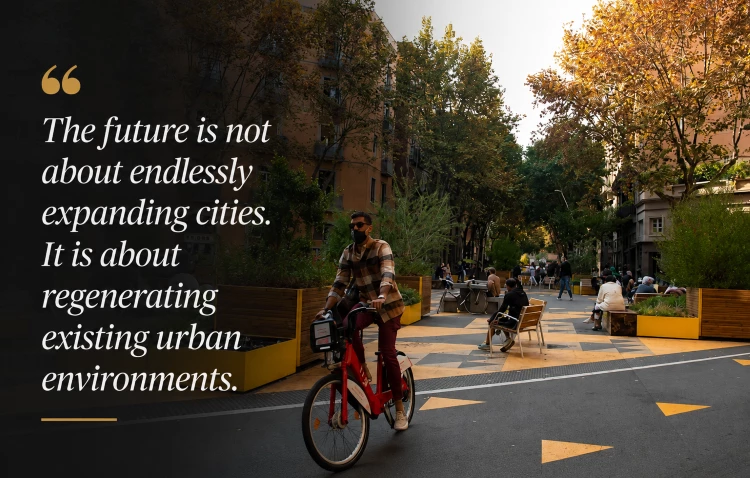
Over the next 15 to 20 years, I believe the main challenge will be urban regeneration. The future is not about endlessly expanding cities. It is about regenerating existing urban environments.
Beyond the “smart city” discourse, successful cities over the next 15–20 years will not be defined by a single factor, such as technology or resilience alone, but by their ability to synthesise these factors through a new urban grammar grounded in time, proximity, and quality of life.
In this context, I speak about the convergence of three forms of AI. The first “AI” is Artificial Intelligence as a technology. Today, artificial intelligence is one of the most important technological vectors. But we need technology that improves the quality of life. The second “AI” is Adaptive Intelligence — the capacity of cities to transform in response to climate, social, and economic disruptions. The third “AI” is Ancestral Intelligence. It means local solutions and locally rooted sustainable knowledge, grounded in communities, territories, cultures, and human rhythms.
Technology alone is not enough. We need resilient proximity and local knowledge as well. In this convergence, two key concepts emerge.
The first is the “X-minute city” — a flexible and evolving model of proximity that ensures essential urban functions are accessible within a short time radius, adapted to each context.
The second is “proxilience,” a fusion of proximity and resilience, where local living systems reduce vulnerabilities while strengthening social cohesion and everyday well-being.
The cities that will lead in the future are those capable of aligning these three forms of intelligence to create proximate, resilient, and human-centred urban environments. Because we have conquered distance, but the real challenge now is to reclaim time.
Read and watch more interviews here