Ask people about the quality of life in Serbian cities, and the answer is close to unanimous: they want to be safe and healthy, to breathe clean air and to make a decent living. Ask them how their city performs, and only the first of those three wishes is near to being met.
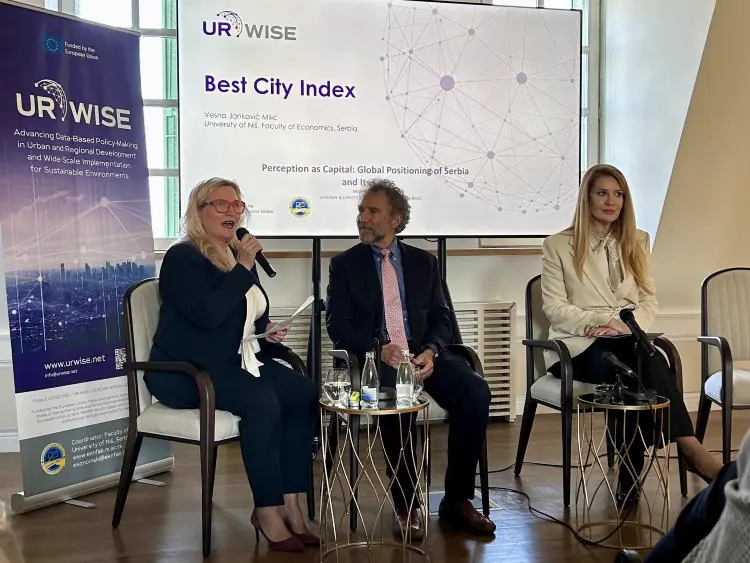
That is the central finding of the Best City Report, prepared by the Faculty of Economics at the University of Niš within the EU-funded Horizon Europe project UR-WISE (GA 101187119). Between September 2025 and February 2026, researchers surveyed 2,221 residents of 28 cities, alongside 621 business decision makers and 200 professionals with expertise in urban issues. Residents rated their own city from 1 to 5 across ten dimensions, from safety and housing to digital services and social inclusion.
About 65% of residents answered through online panels, mainly those aged 18 to 55, and 35% by telephone, mainly those over 55. The sample was designed to mirror each city’s population structure, with controls for gender and education. Even so, the authors note that it describes the people surveyed, rather than a statistically representative sample of all residents. With roughly 80 respondents per city on average, the national results are the most robust, while city-level figures are indicative.
A national score of 3.10
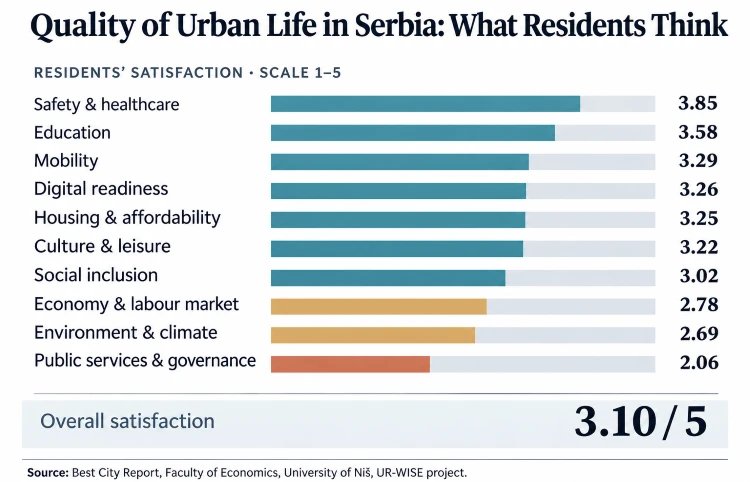
Taken together, residents give their cities 3.10 out of 5: not a failing grade, but not an endorsement either. No dimension reaches the report’s “high” tier of 4.50, and the ten scores fall into three bands.
At the top are the basics. Safety and healthcare scores 3.85 and education 3.58. People generally feel secure in their neighbourhoods and can reach a doctor and a school.
In the middle sit the things that make daily life easier or more pleasant: mobility (3.29), digital readiness (3.26), housing and affordability (3.25), culture and leisure (3.22) and social inclusion (3.02).
At the bottom are the economy and labour market (2.78), environment and climate (2.69) and, far behind, public services and governance (2.06). According to the report, these three areas account for most of the dissatisfaction recorded across Serbian cities.
What matters most is where cities fall short
The survey measured two different things on separate five-point scales: how important each dimension is to residents, and how satisfied they are with it in their own city. The two are not strictly comparable, but read side by side they show where cities fall short of what people value.
Importance is high across the board. All ten dimensions scored above 4, and three stood out: safety and health (4.82), environment and climate (4.75) and economy and labour market (4.73). Two of the three things residents value most are therefore among the three they are least satisfied with.
The contrast is sharpest for governance, with importance at 4.59 and satisfaction at 2.06. It is narrowest for digital readiness (4.19 and 3.26), safety and education, yet even there importance is rated almost a full point above satisfaction. In no dimension does satisfaction come close to matching what residents say matters to them.
Why governance scores so low
For residents, this dimension covers four things: the efficiency of city administration, trust in local institutions, the availability of information on city projects and budgets, and opportunities to take part in decisions. It is the lowest-rated dimension in every one of the 28 cities. Even the best result, Sombor’s 2.63, falls in the report’s “low” tier, and nine cities score below 2.0.
The report does not break the residents’ score down item by item, but the assessments of the 200 professionals point to where the problems lie. They rate citizen participation at 2.19, transparency and open data at 2.27 and administrative efficiency at 2.30. More than half of their ratings in this dimension (53%) were poor and only 15% good. Asked to choose, 79.5% would prefer better administration over more digital services.
Business decision makers are less critical: they rate governance at 2.88, which the authors read as a sign that existing systems serve enterprises better than households.
Quality of life in Serbian cities: three groups
City-level results rest on small samples, and many cities are separated by only a few hundredths of a point. They are best read as indicative patterns, not as a league table. With that caution, three groups can be distinguished.
The highest scores come from mid-sized cities. Seven score 3.30 or higher: Sombor, Subotica, Kikinda, Vršac, Šabac, Kruševac and Sremska Mitrovica. None has more than 125,000 inhabitants and five are in Vojvodina. Sombor, at 3.53, is the only city above 3.50 and the only one where all ten dimensions beat the national average, with standout scores for safety (4.19), housing (3.81) and environment (3.71).
The four largest cities fall in the middle of the range: Novi Sad (3.24), Belgrade (3.17), Kragujevac (3.14) and Niš (3.07). Belgrade and Novi Sad post the highest scores for culture and the highest average salaries in the sample, but all four score around 2.0 on governance, and Belgrade and Niš are close to the bottom on environment.
At the other end, five cities fall below 3.00: Valjevo, Smederevo, Kraljevo, Zaječar and Novi Pazar. What they share is a governance score under 2.0 combined with some of the lowest environment ratings in the country.
Whether mid-sized cities really offer a better quality of life in Serbia than the largest ones cannot be settled by this survey; residents may also judge their cities against different expectations. As New Polis explored in its analysis of the Happy City Index 2026, measurable urban conditions and residents’ perceptions of quality of life do not always tell the same story. The results of the survey give no support to the assumption that the biggest and best-paid cities are the most satisfying to live in. Average net pay in Belgrade is about 50% higher than in Sombor; perceived quality of life is not.
Some findings hold across all three groups. Safety never drops below 3.66. Only four cities reach 3.00 on the economy. And the environment is where cities differ most, from 3.71 in Sombor to 2.10 in Novi Pazar.
What cities can take from this
The national picture is of cities whose foundations hold, while the things that persuade people to stay (good jobs, clean air and an administration they trust) lag behind. Even the highest-scoring city is not exempt: the report warns that Sombor’s combination of high liveability and limited economic opportunity encourages skilled residents to leave, which could erode its scores over time.
For local governments, the most uncomfortable message is also the most actionable one. Clean air and new jobs take years and capital. Publishing budget information, explaining decisions and giving residents a real say depend far more on will than on money, and that is exactly where residents say their cities are failing them most.
About the author: Jelena Stanković, professor at the Faculty of Economics, University of Niš, Serbia.
Disclaimer: The research was funded by the European Union under the Horizon Europe programme, Grant Agreement No. 101187119 (UR-WISE). Views and opinions expressed are however those of the author(s) only and do not necessarily reflect those of the European Union or the European Research Executive Agency (REA). Neither the European Union nor the granting authority can be held responsible for them.