From Sofia’s cultural spaces to major developments in Belgrade and Athens, four projects reveal how investment transforms cities, who gains from the changes and who pays for their upkeep.
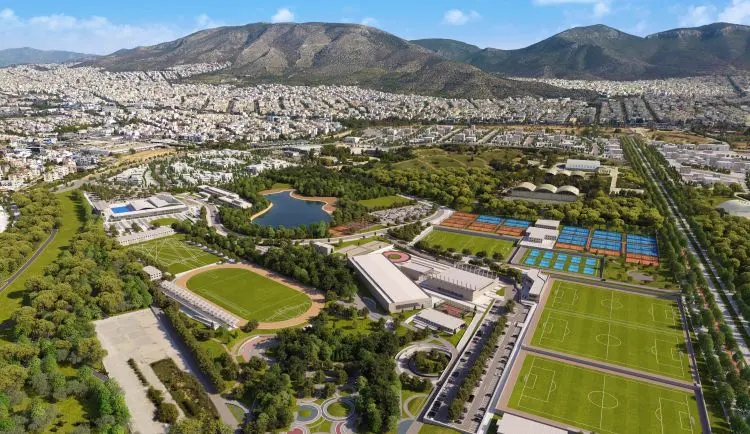
In September 2026, a public school and kindergarten opened in Belgrade Waterfront, while Athens inaugurated the new Ellinikon Sports Park. Both developments had already begun attracting visitors beyond their residential areas. Belgrade Waterfront introduced its shopping centre, park, and riverside promenade, while Ellinikon opened its Experience Park in 2021 and its Experience Centre in 2022.
These openings offer a useful starting point for examining urban regeneration in the Balkans. Former industrial sites, neglected waterfronts and underused public land are being transformed through different combinations of public funding and private investment. Sofia’s Toplocentrala and Thessaloniki’s Nea Paralia illustrate the role of municipal and European financing. Belgrade Waterfront and The Ellinikon show what large-scale private investment can deliver.
The four projects differ considerably in size, purpose and stage of development. Their financial results cannot be compared directly, but their experiences reveal how cities finance regeneration, what they receive in return and which costs remain after construction. The four projects were selected to illustrate different models of urban regeneration, from the adaptive reuse of an industrial building and the renewal of public space to large-scale mixed-use developments. Rather than comparing their performance directly, the analysis examines how different financing and governance arrangements shape the distribution of costs, benefits and long-term responsibilities.
This article draws on publicly available information and seeks to provide a balanced assessment of the four projects, while recognising the limitations of the available data. It does not attempt a comprehensive assessment of their architectural and technical merits or investigate possible informal arrangements in their financing and implementation. These issues deserve separate investigation and, in some cases, have been central to public debate. The focus here is narrower: how regeneration is financed, who captures the economic value it creates, who bears its long-term costs, and how public interests are represented in decisions about urban development.
Who pays for urban regeneration in the Balkans?
Municipal budgets across the region are often constrained, while access to European funding differs between EU member states and their neighbours. Private investment can help deliver projects that cities could not easily finance themselves. Yet even privately led developments may require substantial public commitments, particularly for land preparation, transport and utilities.
In Sofia, the transformation of a former heating plant into the contemporary arts centre Toplocentrala began with an initiative by independent artists and the municipality in 2014. The city financed the building’s conversion, while subsequent activities have relied on public support and external grants. Between December 2022 and April 2024, the centre benefited from a grant of €199,996.93 under the EEA Financial Mechanism, funded by Iceland, Liechtenstein and Norway. The programme supported cultural development, international cooperation and cultural entrepreneurship. The grant was separate from the municipal financing of the original reconstruction, as documented on the official project website. Renovation was only the first financial challenge. Running an arts centre requires continuing expenditure on staff, programming and maintenance. Toplocentrala remains active, but publicly available information does not provide a complete breakdown of its operating income, including the relative contributions of municipal support, grants and commercial activities.
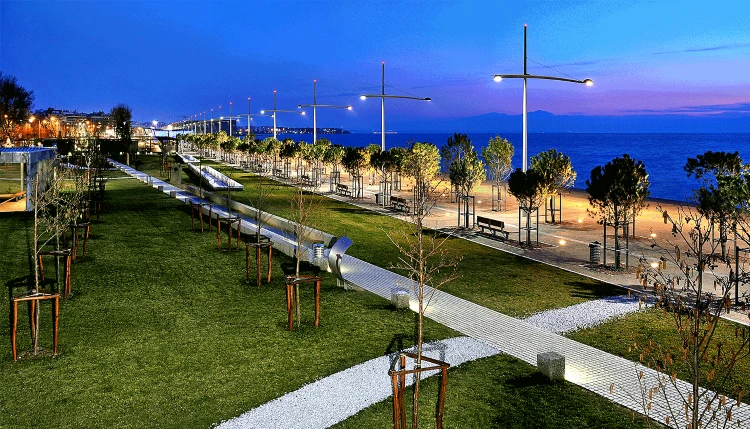
Thessaloniki’s Nea Paralia followed a different route. Completed in 2013, the waterfront reconstruction had an official budget of €22.03 million, supported by the European Regional Development Fund. The investment created a connected public landscape of gardens, promenades and recreational facilities along the Thermaic Gulf. European funding helped finance the transformation, while the municipality remains responsible for maintaining the waterfront. A capital grant can make an ambitious project affordable without resolving how its upkeep will be financed over the following decades. Private investment changes the scale of the equation, although it does not eliminate public financial obligations.
Belgrade Waterfront was established through a joint venture between a private investor and the Serbian state. The 2015 agreement provided for a 68% private and 32% state shareholding structure, while more recent corporate data indicate 67% and 33%, respectively. Under the original agreement, the strategic investor undertook to provide up to €150 million in additional equity and up to €150 million in shareholder loans to the project company. These were financing commitments, not the total value of the development or proof that the full amounts had been disbursed. The agreement also provided for separate loans to Serbia of €40 million for site preparation and €90 million for infrastructure. Preparing the land and delivering supporting infrastructure involved public obligations whose ultimate financial implications cannot be determined from ownership shares alone.
The project’s commercial results have become substantial. According to 2025 financial data filed with Serbia’s Business Registers Agency and reproduced by CompanyWall, Beograd na vodi recorded net profit of RSD 19.19 billion, approximately €164 million. This indicates corporate profitability, but not how much the Serbian state received through dividends, taxes or other financial flows. Assessing the public financial return would require a fuller account of costs, payments and obligations.
Athens’ The Ellinikon demonstrates how private capital can support development on a scale difficult to finance through municipal budgets. According to LAMDA Development’s financial disclosures, cumulative capital expenditure on buildings and infrastructure reached €1.265 billion by June 2026. The company also reported more than €1.8 billion in cumulative cash receipts from property sales and leases by the end of August. These receipts are not equivalent to profit.
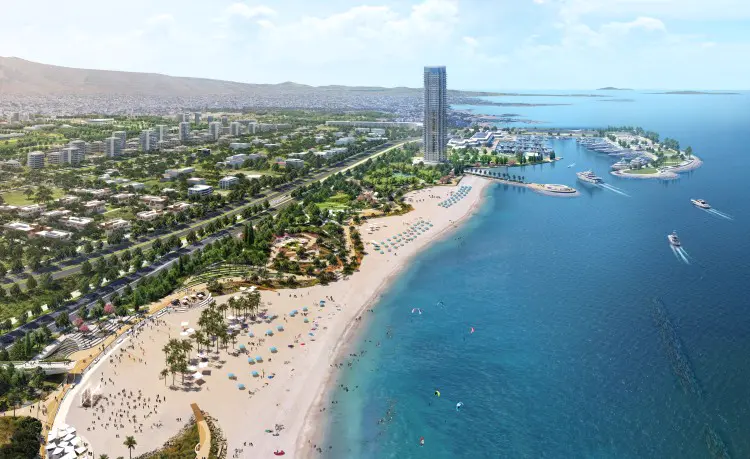
A dispute over transport infrastructure illustrates why construction financing is only part of the financial picture. LAMDA is financing the €55 million underground section of Poseidonos Avenue, intended to improve connections between the former airport site and the coast. However, the Region of Attica has been designated as the authority responsible for its future operation, according to Kathimerini. Market sources estimate annual operating and maintenance costs at €1.5–2.5 million. These are preliminary estimates, not approved public expenditure, and the final operating arrangements remain unsettled.
The disagreement has also exposed differing views of who benefits. The mayors of Glyfada and Alimos have questioned public responsibility for the costs, arguing that the infrastructure primarily serves the development. The municipality of Elliniko-Argyroupoli, by contrast, sees wider benefits for coastal access and the road network.
Privately financed infrastructure may serve a broader public purpose, making some public involvement reasonable. The question is how its benefits and costs should be assessed over the life of the project, rather than simply who paid for construction.
What does the city get in return?
The presence of a park, school or cultural centre does not by itself establish the public value of a regeneration project. That depends on who can use the facilities, how well they connect with surrounding neighbourhoods, whether they meet existing needs, and how they will be maintained. These questions are particularly important when new infrastructure is presented as a benefit to the entire city rather than to a single development.
In Belgrade Waterfront, the public elementary school Isidora Sekulić and kindergarten Car Dušan opened on 1 September 2026. The school serves approximately 450 pupils, while the kindergarten provides around 150 places. Together, they bring educational services into a rapidly growing residential district. However, Isidora Sekulić is an existing school that relocated to a newly constructed building, rather than an entirely new educational institution. Its 450 pupils therefore should not be counted as an equivalent net increase in the city’s school capacity. The new premises may improve learning conditions and provide more convenient access to educational services for local families. Assessing the broader impact, however, would require data on the school’s previous capacity, catchment areas, unmet demand for school places and the availability of educational facilities in neighbouring districts.
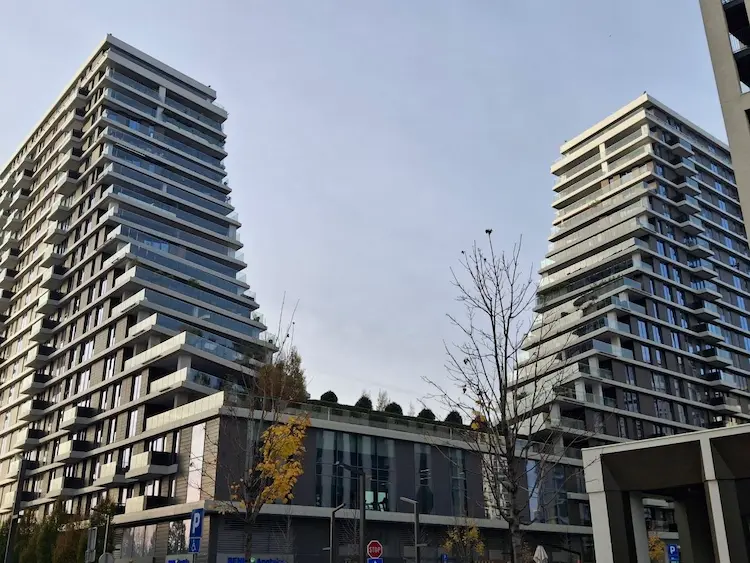
Belgrade Waterfront had already introduced major commercial and recreational facilities before the educational buildings opened. Galerija Belgrade, inaugurated in October 2020, offers approximately 93,000 square metres of leasable retail space within a shopping, dining and entertainment complex. The development also includes Sava Park, a 2.7-hectare green space with recreational facilities, and the publicly accessible Sava Promenada along the river. Galerija generates commercial activity, employment and visitor flows, while the park and promenade provide space for recreation and everyday public use. These are different forms of urban value. A shopping centre may attract people from across the city, but its economic activity should not be confused with the public benefits of an accessible park or waterfront.
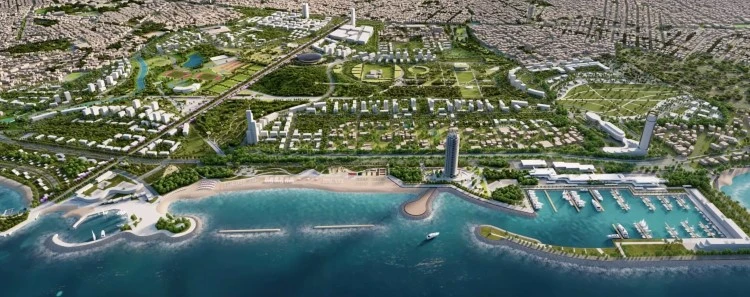
The Ellinikon began opening parts of its site to the public several years before the inauguration of its Sports Park. The Experience Park, which opened in December 2021, provides approximately 75,000 square metres of freely accessible green and recreational space, including playgrounds, outdoor fitness facilities and landscaped gardens. According to LAMDA Development, it had recorded more than 1.8 million visits by the end of 2023. The figure shows substantial public use, although it does not establish the park’s wider economic impact.
The Experience Centre, opened in April 2022 inside the reconstructed Hellenic Air Force Hangar C, offers a different kind of access. Built in 1950 and designated as a modern monument by the Ministry of Culture, the hangar now houses an interactive exhibition that introduces visitors to the site’s history and the development’s future plans. The centre functions primarily as an exhibition and visitor information facility, combining the reuse of an existing building with the developer’s communication and public engagement activities.
The next major addition was the Sports Park, inaugurated in September 2026. Covering 287,000 square metres, including 115,000 square metres of green and open space, the €100 million facility provides sports and recreational infrastructure with free general admission, although certain activities may involve charges. The park is managed by Hellinikon SA, a subsidiary of Lamda Development.
Together, these facilities show that public access can be introduced progressively during a large development rather than only upon its completion. Their longer-term contribution will depend on who uses them, how easily they can be reached from neighbouring municipalities and whether free access is maintained.
LAMDA has also financed social infrastructure outside the commercial housing market. In 2023, the company completed and transferred a €15 million care complex for people with disabilities to the municipality of Elliniko-Argyroupoli. According to the Greek Prime Minister’s Office, the facility comprises four buildings covering approximately 11,500 square metres and accommodates five organisations providing specialist services. Its construction is a tangible contribution, while its lasting value depends on the services delivered and their continuity.
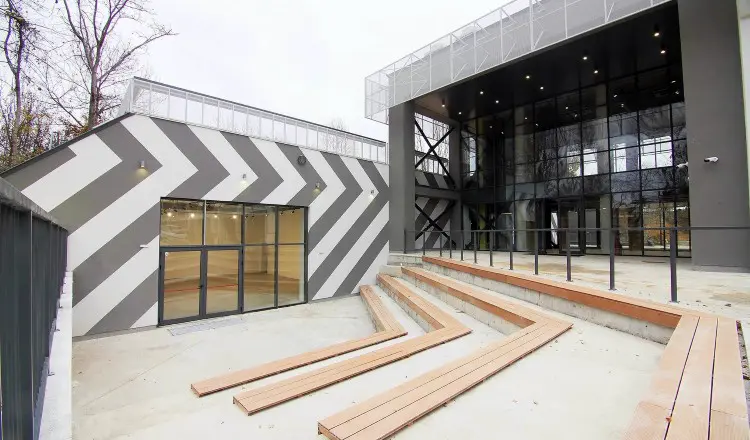
The results of smaller projects are less easily expressed in financial terms. Toplocentrala provides space for contemporary theatre, dance, exhibitions and public discussion in a building that had lost its original industrial function. The complex also includes an outdoor amphitheatre, terraces and spaces for public events alongside Sofia’s South Park. Its programme combines contemporary arts with educational activities, international collaboration, artistic residencies and outdoor performances, including free events. Municipal investment has given independent cultural initiatives a permanent venue, while artists and cultural organisations provide much of the activity that makes the space valuable to the city.
Nea Paralia offers a longer perspective on the relationship between public investment and economic activity. Its reconstructed waterfront connects a series of thematic gardens, walking and cycling routes, playgrounds and spaces for outdoor events. More than a decade after completion, it remains part of Thessaloniki’s everyday public life. In October 2026, the municipality opened a new Glass Gallery in one of its pavilions, adding another cultural use to the area.
A 2022 academic study examined 244 commercial properties around Nea Paralia and found a positive relationship between the waterfront’s regeneration and nearby commercial property values. The effects were uneven and concentrated relatively close to the renewed area, with the researchers identifying a zone of influence of roughly 200–300 metres.
The findings do not establish that the entire increase in commercial values was caused by reconstruction. They nevertheless suggest that improvements to public space can create economic advantages for nearby businesses and property owners.
The study also examined whether businesses benefiting from the renewed waterfront were willing to contribute to its maintenance. Respondents reporting positive commercial effects were more likely to express such willingness, although the overall readiness to pay was limited. These were stated preferences, not actual financial contributions.
Public investment can therefore create private economic benefits without automatically generating additional resources for the maintenance of public space. Turning some of those gains into continuing financial support requires agreements or financing mechanisms that municipalities may not yet have in place.
These differences also raise the question of land value capture: whether cities can recover part of the increase in land and property values generated by public investment or planning decisions. Nea Paralia illustrates the challenge particularly clearly: nearby property owners may benefit from a publicly financed waterfront, while its maintenance remains a municipal responsibility. In Belgrade Waterfront, the state’s participation in the development company offers a different potential route to financial returns, although the actual public benefit cannot be assessed without accounting for state contributions and obligations. At The Ellinikon, developer-financed public infrastructure represents another form of sharing development costs, but does not necessarily capture subsequent increases in land value. Toplocentrala, meanwhile, demonstrates a model in which public returns are primarily cultural and social rather than financial. These arrangements are not equivalent, and the available evidence does not establish how much of the value created by regeneration ultimately returns to the public sector.
Table 1. Four Models of Urban Regeneration in the Balkans.
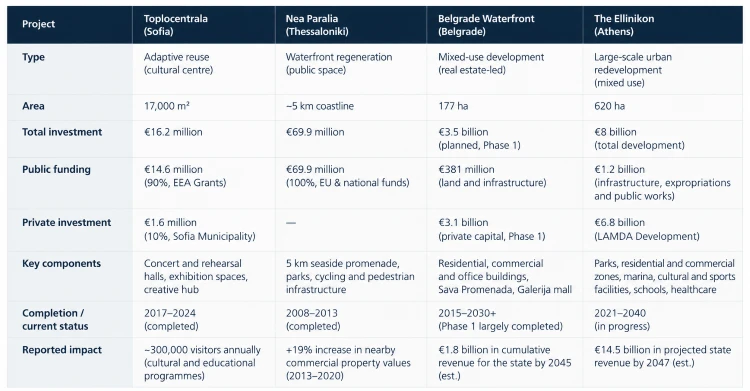
The figures describe different types and stages of financing and are not directly comparable project costs. The final column includes commercial facilities alongside public and cultural infrastructure; their economic and social functions differ.
Sources: Toplocentrala, EEA Grants Project (2022–2024); ESPA, Regeneration of the New Seafront of Thessaloniki; International Journal of Advanced Research, Study on the Economic Impact of Thessaloniki’s Waterfront Regeneration (2022); Government of Serbia, Belgrade Waterfront Joint Venture Agreement (2015); CompanyWall, Beograd na vodi Financial Data (2025); KADENA Sotheby’s International Realty, Belgrade Waterfront Market Report (2026); LAMDA Development, FY2025 Results Presentation; Euronext Athens, LAMDA Development Financial Announcements; Office of the Prime Minister of Greece, Disability Care Centre at Ellinikon (2023); Kathimerini, Public Costs Dispute Clouds Ellinikon Tunnel Project (2026).
Beyond the project boundaries
Urban regeneration can change the value of surrounding property long before a development is completed. New public spaces, improved infrastructure and a district’s growing reputation attract businesses and residents, often generating gains for landowners and investors. Yet those who helped create a neighbourhood’s appeal are not necessarily those who capture its financial rewards.
Belgrade’s Savamala district provides an example. Long before Belgrade Waterfront, independent cultural initiatives had begun transforming former warehouses and neglected buildings into venues for exhibitions, performances, design and public discussion. Magacin, KC Grad and Mikser House helped establish the district as an important centre of Belgrade’s creative life.
According to Mikser’s organisers, Mikser House hosted more than 1,500 cultural and public events between 2012 and 2017. These activities brought visitors into Savamala, supported local businesses and contributed to the district’s changing reputation. The economic effects of cultural regeneration are often indirect. Organisations may generate modest revenues themselves while making the surrounding area more attractive to commercial activity and investment. Without secure premises or long-term agreements, they can struggle to remain as property markets and neighbourhood conditions change.
Mikser House left Savamala in 2017 amid difficulties involving its premises, financial pressures and the wider transformation of the area. Its departure cannot be attributed solely to Belgrade Waterfront, and other cultural organisations, including KC Grad, have continued to operate. The history nevertheless illustrates how cultural initiatives can help create urban value without securing a lasting share in the resulting economic gains.
The residential markets of Belgrade Waterfront and The Ellinikon reveal another dimension of value creation. According to KADENA Sotheby’s October 2026 market report, drawing on Serbia’s Republic Geodetic Authority, the median price in 55 certified transactions with the Belgrade Waterfront developer during the first half of 2026 was €5,528 per square metre. The average price of apartments sold across Belgrade during the same period was approximately €3,219 per square metre.
In Athens, LAMDA’s FY2025 financial presentation estimated an average selling price of approximately €9,400 per square metre across the first phase of Little Athens residential developments, including properties not yet released for sale. This was a portfolio estimate, not an average of completed transactions. For comparison, Indomio reported an average asking price of €5,745 per square metre in the municipality of Elliniko in September 2026. Asking prices are not completed sale prices, and the municipality includes housing with different locations, ages and characteristics.
These comparisons describe the commercial positioning of new residential developments, not changes in property values across surrounding neighbourhoods. Establishing whether regeneration has increased prices beyond the project boundaries would require comparable transaction data over time, accounting for differences in location, housing quality and wider market conditions.
High property values are not inherently evidence of unsuccessful regeneration. Premium residential projects can attract capital, create employment and help finance infrastructure. They may also support local businesses and generate public revenues. How much of that value reaches the wider city depends on land ownership, taxation, contractual obligations and the extent to which new facilities serve people beyond the development.
For Belgrade Waterfront, this raises questions about connections with neighbouring districts, access to the riverfront and the place of existing cultural and commercial activities within the changing urban environment. For The Ellinikon, relationships with surrounding municipalities are equally important, particularly regarding traffic, coastal access and the integration of public spaces into the wider city.
The physical form of development also matters. Building density, street connections and the relationship between new construction and existing neighbourhoods influence how easily residents can move through and use an area. Possible effects on local ventilation and microclimate require technical assessment rather than assumptions based on building height or appearance.
Time is another important consideration. Nea Paralia has been in use for more than a decade, allowing researchers to examine some of its longer-term effects. Toplocentrala has several years of cultural activity behind it. Belgrade Waterfront and The Ellinikon, by contrast, remain under development. Their visitor numbers, property sales and newly opened facilities provide evidence of progress, but cannot yet tell us how these districts will perform over several decades.
Who has a say?
The distribution of costs and benefits also depends on who participates in decisions about land use, public infrastructure and the management of urban spaces. Formal consultations provide opportunities for public input, but their existence does not necessarily mean that residents can influence development priorities. The four projects illustrate different tensions between planning decisions, public expectations and the interests of those affected by regeneration.
Belgrade Waterfront provides a particularly contentious example. During the planning process in 2014, proposed changes to Belgrade’s urban plans underwent public review. According to a 2026 academic study, more than 3,000 objections were submitted by residents and planning professionals. The proposals were subsequently adopted, while the planning process also prompted questions about transparency, including those raised by Transparency Serbia. The Ne da(vi)mo Beograd initiative organised public demonstrations in 2016, bringing broader attention to questions of urban planning, public space and community participation in Belgrade’s urban development.
The Ellinikon in Athens also underwent formal consultations while facing sustained opposition. Its Strategic Environmental Impact Study was published for public consultation in 2017, followed by further environmental consultations in 2019. According to LAMDA Development’s Stakeholder Engagement Plan, residents, associations and municipalities submitted comments and objections. However, the available documentation does not clearly establish how substantially these consultations influenced the project’s main development decisions.
In 2018, 507 residents and four organisations challenged the development decree in court, citing environmental and quality-of-life concerns. Further disputes emerged during construction, including complaints about dust, noise and changes to coastal areas. In 2025, residents of Alimos mobilised against proposed works affecting a coastal wetland. These conflicts drew attention to environmental and social impacts experienced by neighbouring communities, even where the principal development was privately financed.
The experiences of Toplocentrala in Sofia and Nea Paralia in Thessaloniki show that publicly oriented projects can also generate competing demands. Toplocentrala originated in an initiative by independent cultural organisations working with Sofia Municipality, with professional participation in shaping the project. In 2024, hundreds of residents complained about noisy outdoor festivals in Sofia’s South Park, including events associated with Toplocentrala. The objections concerned activities in the park rather than the redevelopment of the cultural centre itself.
In Thessaloniki, Nea Paralia was developed through a municipal architectural competition, but public debate continued after its completion. In 2017, civic organisations and residents opposed plans for commercial seating around the waterfront pavilions, while a 2023 protest drew attention to inadequate maintenance. Both disputes concerned the management of publicly funded space, particularly the balance between commercial activity, public access and municipal responsibilities.
The nature of these disagreements varies considerably. In Belgrade, the principal concerns involved control over public land and the transparency of planning decisions. In Athens, residents challenged environmental impacts and the consequences of development for surrounding communities. In Sofia and Thessaloniki, conflicts focused more on the everyday use and management of shared spaces. None of these disputes, by itself, establishes whether a project has succeeded or failed.
What matters for urban governance is whether consultation and public scrutiny can influence decisions, address competing interests and clarify responsibilities. Public participation can reveal concerns that technical assessments and financial agreements do not fully capture. Its effectiveness, however, should be judged not simply by the number of consultations held or objections submitted, but by how public input is considered and whether it leads to meaningful responses.
Measuring value beyond investment
The four projects demonstrate that urban regeneration can create public value through different financing arrangements. Municipal and European funding have supported cultural and public spaces in Sofia and Thessaloniki, while private capital has enabled much larger developments in Belgrade and Athens. Yet investment volumes alone reveal little about how the resulting benefits and obligations are distributed.
First, cities need to assess the full financial implications of regeneration, not simply the initial investment. Public land contributions, supporting infrastructure and long-term maintenance can place substantial obligations on public budgets. Corporate profitability does not necessarily translate into public financial returns, while privately financed infrastructure may still require public expenditure. Transparent agreements and realistic assessments of long-term costs are therefore essential.
Second, urban policy needs to consider who creates urban value and who captures it. Nea Paralia shows how public investment can benefit nearby property owners and businesses, while Savamala illustrates how cultural initiatives can contribute to a district’s attractiveness without necessarily sharing in the resulting economic gains. Appropriate land value capture mechanisms can help cities secure some of these benefits for public purposes, although cultural and social returns cannot always be measured financially.
Third, the public value of regeneration depends on its integration into the wider city and the quality of urban governance. New parks, cultural facilities and infrastructure should be assessed through their accessibility, connections with surrounding neighbourhoods and long-term management. Meaningful public participation can also help identify competing interests and address consequences that extend beyond project boundaries.
The central choice for cities is therefore not simply between public and private financing. Different models can deliver valuable results, but their success depends on the terms of investment and the institutions responsible for managing its consequences. For cities across the Balkans, the challenge is to translate regeneration into lasting public benefits without leaving future generations with disproportionate costs.