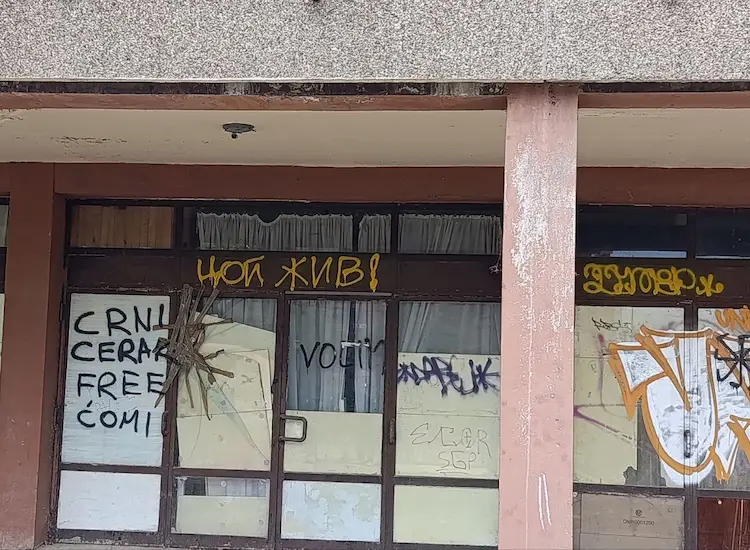
On 28 October 2026, three days after Serbia’s parliamentary elections, the student movement called on Belgrade residents to take part in one of the city’s small urban initiatives: cleaning their neighbourhoods. The appeal encouraged people to clear streets and parks, clean building facades and remove offensive graffiti. Residents were asked to bring gardening tools, bags, gloves and seedlings. The initiative had no fixed deadline and was intended to continue until the work was completed.
The initiative turned political mobilisation into collective work. It also raised a question relevant to many cities: can residents’ efforts address problems that public services and municipal authorities have failed to resolve? Cleaning a street or repainting a wall can produce an immediate, visible result. Yet the condition of public spaces depends on what happens afterwards. Who maintains the cleaned areas? What happens when graffiti reappears, or waste accumulates again? Experiences from other cities suggest that small actions can improve urban areas, especially when they connect local knowledge with professional support and municipal decision-making.
Banja Luka: turning small actions into an urban method
A useful example of this approach comes from Banja Luka, where Researchers developed and tested a methodology called Small Interventions for the redesign of public spaces. The study, published in the Serbian Architectural Journal, examined how relatively modest projects could improve neglected or underused urban areas.
The methodology was tested through six pilot projects between 2019 and 2021. Its central idea was to connect three groups: city authorities, urban professionals, and residents. The approach addresses a common problem in urban development: residents are often the first to notice problems in their neighbourhoods, but decisions about land use, design and funding are made by municipal institutions.
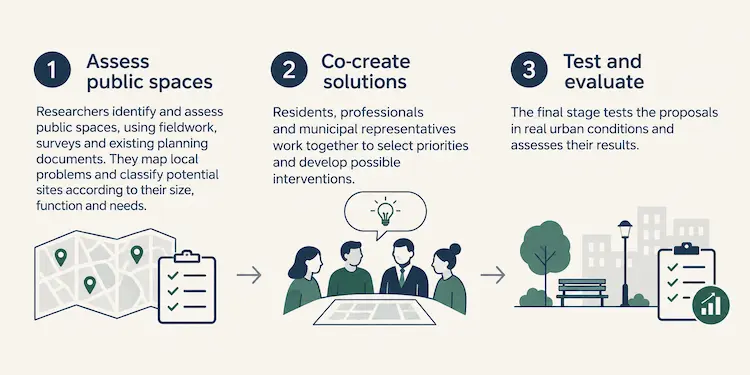
The proposed process has three stages. First, researchers identify and assess public spaces, using fieldwork, surveys and existing planning documents. They map local problems and classify potential sites according to their size, function and needs. Second, residents, professionals and municipal representatives work together to select priorities and develop possible interventions. The third stage involves testing the proposals in actual urban settings and assessing the results.
The methodology covers a range of relatively small-scale improvements, from greenery and street infrastructure to water management and urban furniture. It also includes practical forms of public participation, such as Citizen Work Actions: organised days when residents take part directly in improving a public space.
One example was Cleaning the City (Pospremanje grada), a public-space improvement action held on 28 September 2019. It brought together 145 participants, including residents, volunteers, students, engineers, artists and representatives of public institutions. Working in teams across the central area, from the city market towards the National Theatre, participants cleaned and repainted urban furniture, repaired damaged elements, installed new equipment and removed unsuitable structures. Preparatory work also included graffiti and sticker removal, clearing bulky waste and relocating market stalls and temporary toilets at Trg Krajine. The action put the idea of collective responsibility for public space into practice, giving residents an opportunity to contribute directly to visible improvements in their surroundings.
A different type of intervention was Smallscale+Park, which introduced a temporary spatial structure on a green area in front of the University Campus. Developed through an international student workshop involving architecture faculties in Banja Luka and Sarajevo and the Norwegian University of Science and Technology, the intervention was intended to encourage students and residents to spend time in a previously underused area. The city record describes it as the first stage of a wider plan for a university park and the activation of the Vrbas riverbanks.
Together, these projects show how the Banja Luka methodology sought to connect local initiative with municipal planning. Residents could identify problems and contribute ideas, while professional expertise and municipal involvement helped translate them into practical interventions. This cooperation is central to the approach: it gives residents a role in shaping public spaces without leaving them solely responsible for changes that require institutional support.
The evidence, however, has its limits. The six pilots demonstrate that the methodology was put into practice, but the study does not provide independent quantitative evidence of lasting social impact. It documents a process for involving residents in public-space improvements; whether these interventions produced lasting changes in how people use and care for these spaces remains a separate question.
Beyond Banja Luka: different routes from local action to urban change
In Ljubljana, the project Beyond a Construction Site transformed a vacant municipal site near Resljeva Street into a community garden and cultural space. Residents and other participants used the area for gardening, socialising, educational activities, and public events. According to the organisers, more than 200 people took part over the project’s 12 years. The initiative ended in October 2022, when the site was designated for non-profit housing. Before construction, nine trees were transplanted to other green spaces in the city. The case shows how temporary use of urban land can create a community space, while also illustrating its dependence on decisions about ownership and future development.
In Mexico City, a local campaign challenged plans to develop the former asphalt-plant site as part of the proposed City of the Future project. Following public opposition and a consultation process in 2016, the development proposal was abandoned in favour of a public park. Parque Imán opened in March 2018. This was not a case of residents building or managing the space themselves. Their influence came through public mobilisation that helped change a municipal decision.
Source Calles compartidas para un distrito bajo en carbono
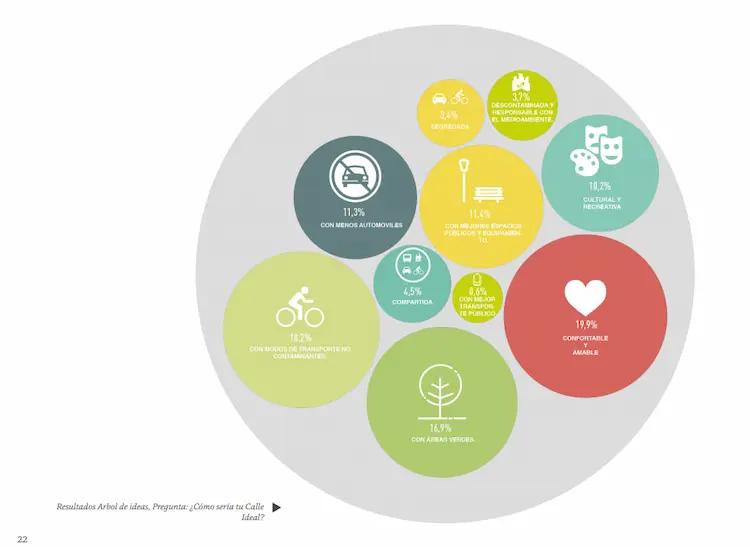
Santiago offers another perspective through experiments with cycling infrastructure and street use. In 2016, the organisation Ciudad Emergente tested a temporary shared-street intervention around José Miguel de la Barra and the Lastarria district. The project account reported more than 1,500 cyclists a day during the two-day pilot. This figure describes activity during the experiment; it should not be treated as evidence of a sustained increase in cycling or confused with figures for other cycleways in the city. The example demonstrates how temporary interventions can test ideas and generate material for further urban planning.
These cases differ in their organisers, methods and outcomes. Some were initiated by civic organisations, others relied on resident participation or public campaigning. What connects them is the ability of relatively small-scale action to make local needs visible and open up a discussion about how urban space is used.
What makes a small initiative more than a one-day action?
A successful clean-up or temporary intervention does not automatically produce lasting change. Several conditions influence whether a small initiative can have a wider effect.
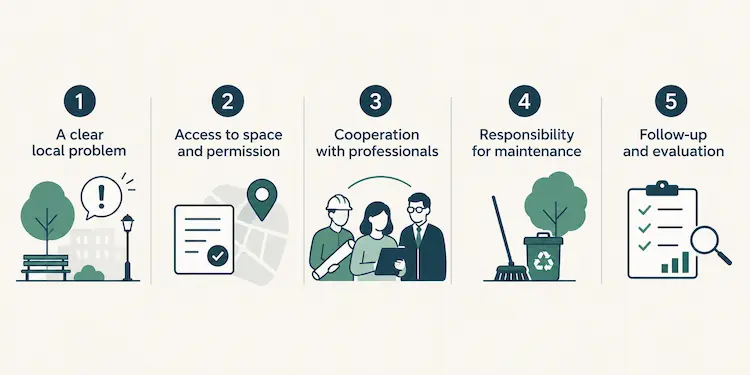
A clearly defined local problem gives residents a practical reason to participate. Neglected green spaces, unsafe walking routes, waste or a lack of places to meet are tangible issues around which people can organise.
Access to space and permission to act are equally important. Residents may be willing to improve a courtyard, vacant plot or street, but questions of ownership, liability and municipal approval can prevent them from doing so. The Ljubljana project illustrates how the future of a community space can ultimately depend on the landowner’s plans.
Cooperation with professionals and local institutions helps turn ideas into workable projects. Design expertise, technical advice and access to municipal services can make a difference, especially where interventions involve infrastructure or public safety. The Banja Luka methodology provides one model for organising this cooperation.
Responsibility for maintenance is often the decisive issue. Without an agreed arrangement for cleaning, repairs and ongoing care, improvements may disappear quickly. Even an active community project can remain vulnerable to changes in municipal land-use priorities.
Finally, follow-up and evaluation help establish what has actually changed. Counting participants or recording a completed intervention is useful, but it does not reveal whether a space is used more often, whether new relationships have developed or whether municipal practice has changed. These effects require observation over time.
From civic energy to better urban practice
Small urban initiatives can improve neglected places, encourage residents to take responsibility for their surroundings and bring local problems to the attention of decision-makers. Their contribution may begin with something as simple as cleaning a street or planting a tree. In some cases, it can lead to a community space, a change in municipal plans or a new approach to public-space design.
The examples also show why local enthusiasm alone is rarely enough. Initiatives need access to space, clear responsibilities, resources and, where necessary, professional and institutional support. Municipal authorities remain responsible for public services and the maintenance of public infrastructure. Civic action can complement that responsibility, but it cannot replace it.
The experience of Banja Luka is particularly relevant because it offers a way to connect residents’ ideas with professional planning and municipal processes. The Belgrade clean-up, meanwhile, provides a timely reminder that collective action can begin outside formal programmes. Whether such mobilisation becomes a lasting urban practice will depend on what follows the initial effort. The broader challenge for cities is to create ways for small urban initiatives to move beyond isolated acts and become part of regular urban decision-making.