
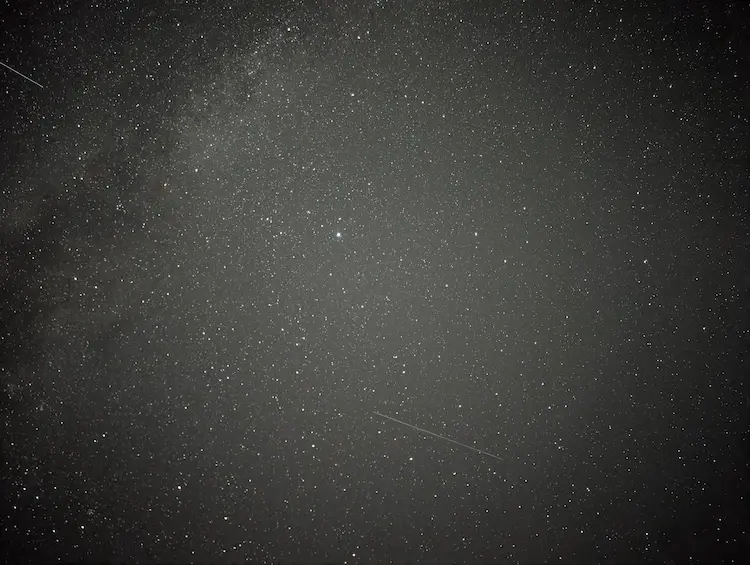
This August offered unusually good conditions for watching the night sky. The Perseid meteor shower reached its peak on August 12–13, 2026, close to the New Moon. NASA estimated that under dark skies observers could see about 25 meteors per hour, with the absence of moonlight providing particularly favourable conditions. For many people in European cities, however, the experience was very different. The meteors were still there. Artificial skyglow made many of them difficult to see.
This is one of the most visible consequences of urban light pollution. It also raises a more complicated question about the role of artificial light in cities. Good street lighting supports pedestrian visibility and can contribute to safer public spaces. A review by the Campbell Collaboration found that improved street lighting was associated with a 21% reduction in crime across 13 studies from the United Kingdom and United States.
Read more about urban safety in our article on gender-responsive urban planning here.
Cities therefore need light. The environmental question concerns the amount, timing, direction and spectrum of that light.
What is light pollution?
Light pollution is the alteration of natural illumination levels at night by artificial light. Its most familiar form is skyglow, the diffuse brightness created when artificial light scatters in the atmosphere. Light pollution also includes excessive brightness, glare, poorly directed light, and unnecessary illumination.
A 2024 review in Nature Reviews Earth & Environment describes artificial light at night as a growing environmental pressure. In urban areas, zenith radiance can reach around 40 times the level of an unpolluted night sky. The review also estimates that lighting, including indoor and outdoor lighting, accounts for about 20% of global electricity consumption and 6% of global CO₂ emissions. This makes light pollution relevant to several urban policy areas at once: public safety, energy efficiency, biodiversity, public health and land-use planning.
How fast is the night changing?
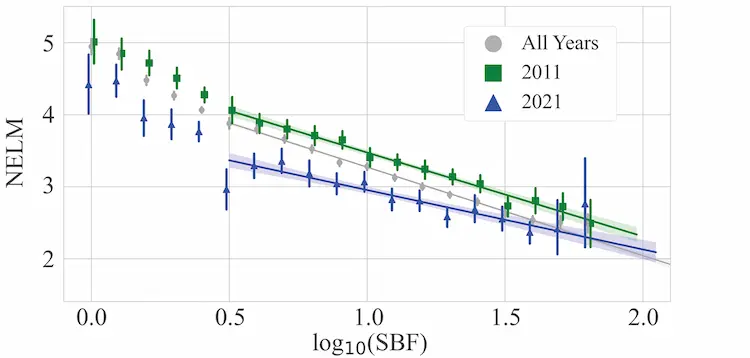
One of the most direct measurements of the changing night sky comes from observations made from the ground. A 2023 study in Science analysed 51,351 observations collected by citizen scientists through the Globe at Night programme between 2011 and 2022. Participants reported which reference sky map best matched the stars they could see with the naked eye. The researchers estimated that the change in visible stars corresponded to a 9.6% annual increase in sky brightness globally and 6.5% in Europe. At the global rate, sky brightness would double approximately every eight years. The researchers estimated that, if this rate continued for 18 years, a location where 250 stars were visible could have only about 100 visible stars. This is a projection based on the observed rate, not a forecast for every location.
Satellite observations provide a different perspective. A 2017 study using the VIIRS instrument found that the artificially lit area of Earth’s land surface increased by approximately 2.2% per year between 2012 and 2016. The radiance of continuously lit areas also increased by approximately 2.2% annually. These measurements record light detected from space rather than the brightness of the sky perceived from the ground.
New satellite research published in Nature in 2026 adds another dimension. Using daily night-time imagery from 2014 to 2022, researchers found frequent and simultaneous brightening and dimming across different parts of the world. They identified 2.05 million km² of abrupt changes and 19.04 million km² of gradual changes in artificial light at night. Brightening contributed a radiance increase equivalent to 34% of the 2014 global baseline, while dimming offset 18%, resulting in a net 16% increase in global artificial night-time radiance over the period.
The study also found substantial differences between countries. Artificial night-time radiance declined by 33% in France, 22% in the United Kingdom and 21% in the Netherlands between 2014 and 2022. The researchers associate these reductions with changes in lighting technology, measures to reduce light pollution and energy consumption, and national and EU energy-efficiency policies.
Together, these studies show why light pollution is difficult to describe with a single global growth rate. The night environment is changing at different speeds in different places, and different measurement methods capture different parts of that change.
Europe’s changing night sky
Europe is particularly relevant to this discussion because of its high population density and extensive artificial illumination. The New World Atlas of Artificial Night Sky Brightness, published in Science Advances, estimated that more than 99% of the populations of Europe and the United States lived under light-polluted skies. The Milky Way was invisible to approximately 60% of Europeans. The study also estimated that 88% of Europe’s land area experienced light-polluted nights. These figures come from a 2016 global atlas and should not be treated as a current measurement for 2026. They remain an important baseline for understanding the scale of the transformation.
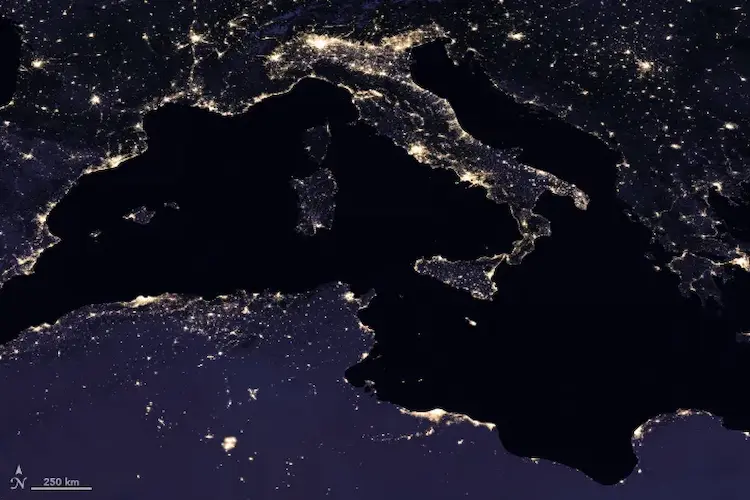
The geography of light pollution also matters. Artificial skyglow can travel far from its sources. The World Atlas found that light domes from cities affect areas far beyond urban boundaries, including protected landscapes. This means that protecting dark skies cannot rely solely on preserving remote wilderness. Urban and regional lighting policies can influence the night environment across much larger areas.
Ecosystems depend on darkness

Natural darkness is part of the environmental conditions under which many species evolved. Artificial light at night can alter circadian rhythms, feeding patterns, migration, reproduction and interactions between species. The effects vary between species and ecosystems.
Nocturnal insects provide one of the clearest examples. Research published in Nature Communications in 2024 examined why flying insects gather around artificial lights. The study found that insects do not simply fly towards light as if they were attracted to a beacon. Their flight orientation can become disrupted around artificial light sources, affecting their ability to navigate through their environment.
Artificial light also affects birds and bats. Responses vary between species, which makes blanket solutions difficult. Research therefore increasingly examines the intensity, duration and spectrum of lighting when assessing ecological impacts.
Light pollution and human health
The human health evidence requires a careful interpretation. Light exposure at night can interfere with circadian regulation and sleep. A systematic review and meta-analysis published in 2026 included 15 studies with 765,838 participants. Participants in the highest exposure group had a 27% higher risk of sleep disturbance than participants in the lowest exposure group. The authors rated the certainty of the evidence as high, although most individual studies had a high risk of bias, mainly because of difficulties in measuring exposure.
Evidence for specific diseases requires more caution. A review of 51 epidemiological studies found associations between outdoor artificial light at night and several health outcomes. The authors also identified significant limitations in exposure measurement and control of confounding factors.
For urban policy, the most defensible conclusion is therefore straightforward: night-time lighting can disrupt sleep and circadian regulation, while evidence for wider health effects continues to develop.
From more light to better light
The policy response does not require cities to become dark. The objective is better lighting. Several principles have emerged from research and urban practice: illuminate areas that require lighting, direct light towards the intended surface, reduce unnecessary upward and sideways light, use appropriate intensity, consider operating hours and select spectral characteristics according to the location and purpose.
Energy policy provides an additional reason to examine existing lighting systems. An EU analysis of road lighting estimated that lighting covered more than 1.6 million kilometres of roads and consumed approximately 35TWh of electricity annually, equivalent to around 1.3% of total electricity consumption.
LED technology can substantially improve energy efficiency. Energy efficiency alone does not solve light pollution. Cities can use efficiency gains to reduce electricity consumption while maintaining excessive illumination. Planning decisions determine whether technological improvements reduce the environmental footprint or simply make more lighting affordable.
Three scenarios for the urban night
1. Business as usual
Cities continue expanding artificial illumination while replacing older systems with more efficient technologies. Energy consumption per lamp falls. Total illumination can still increase through new roads, buildings, public spaces, and longer operating periods. The night sky continues to brighten in many urban and suburban areas. A 9.6% annual increase through citizen observations is not suitable for being used as a prediction into infinity. The observations have shown that the skies can change during one’s lifetime.
2. Uneven transition
Cities introduce LED upgrades, dimming, and better shielding at different speeds. Some areas become darker. Others continue to brighten. The 2026 Nature study already documents this pattern of simultaneous brightening and dimming across the planet. Under this scenario, access to dark skies becomes increasingly dependent on geography and local policy.
3. Lighting as urban infrastructure
Cities treat darkness as one of the conditions that urban infrastructure must manage. Street lighting remains essential for mobility and public safety. Lighting systems become more targeted, adaptive, and context-specific. Municipalities assess energy use, human needs, biodiversity, and skyglow together. A third scenario is a policy choice rather than a trend already measured at global scale.
Rethinking the night
The Perseids offered a useful entry point into this debate. The meteor shower showed how strongly our experience of the natural sky depends on the environment we create on the ground.
Observing the Milky Way is not the biggest problem faced by European cities. The issue of light pollution is important in a much wider context. It brings together issues such as security, energy use, biodiversity, human sleep, and urban planning all in one infrastructure network. The challenge of urban light pollution is therefore not to choose between safety and darkness. It is to determine how much light a city needs, where it needs it, when it needs it, and how it can minimise unnecessary impacts on people, wildlife, energy use and the night sky.