
Every year on June 3, World Bicycle Day, since its establishment by the UN General Assembly in 2018, celebrates one of the simplest and most sustainable modes of transport.
Cities around the world have learned a crucial lesson: people do not start cycling because they buy bicycles. They start cycling when cities build safe, connected, and comfortable cycling networks. Today, urban cycling infrastructure is increasingly viewed as essential urban infrastructure, alongside public transit, sidewalks, and utilities. They influence mobility choices, air quality, public health, and the overall livability of modern cities.
The global rise of cycling infrastructure
Over the last decade, cycling has rapidly migrated from a niche, recreational activity to a mainstream urban mobility strategy. As part of the drive towards addressing climate objectives, decongestion objectives, and public health considerations, cycling is now seen as one of the key cornerstones for European cities.
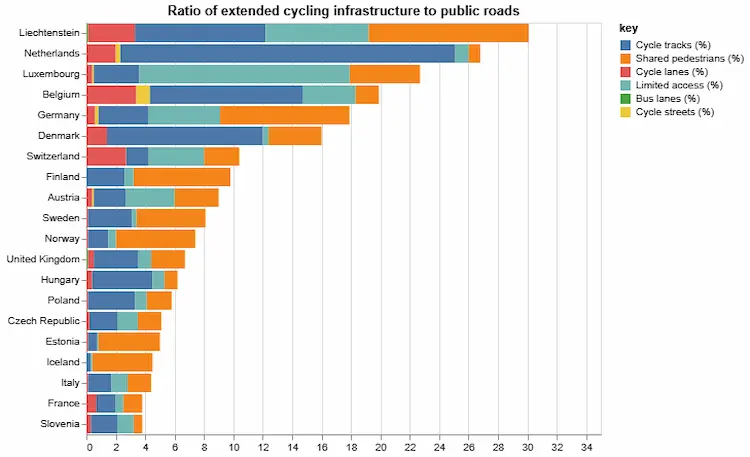
According to the latest data from the European Cyclists’ Federation (ECF) and the EU’s Cycling Counts initiative, Europe now boasts over 900,000 kilometres of dedicated cycling infrastructure (including protected tracks, lanes, and specialized routes). A major milestone came in 2025, when Europe completed its first EU-wide assessment of cycling infrastructure. The findings showed that the continent now boasts more than 340,000 kilometres of dedicated cycling routes, highlighting the growing importance of active mobility in transport planning. This structural shift is matched by public behavior: leisure and commuting traffic across the cross-border EuroVelo network grew by an additional 4% in 2025 compared to 2024.
Why bike lanes matter for urban air quality & traffic dynamics
Transport remains a major source of urban emissions
According to the European Environment Agency (EEA), road transport is responsible for approximately three-quarters of greenhouse gas emissions in Europe and remains the primary driver of localized air pollution. Passenger cars are the main contributors to high concentrations of nitrogen dioxide and fine particulate matter, which severely impact respiratory public health.
The infrastructure effect
Data from spatial analyses show that high-quality cycling infrastructure generates measurable modal shifts:
- The Physical Protection Mandate: A comprehensive analysis of 72 million trips within New York City’s Citi Bike network confirmed a direct causal link between infrastructure and ridership. Following the installation of physically protected bike lanes, cycling trips in adjacent neighborhoods increased by approximately 18%.
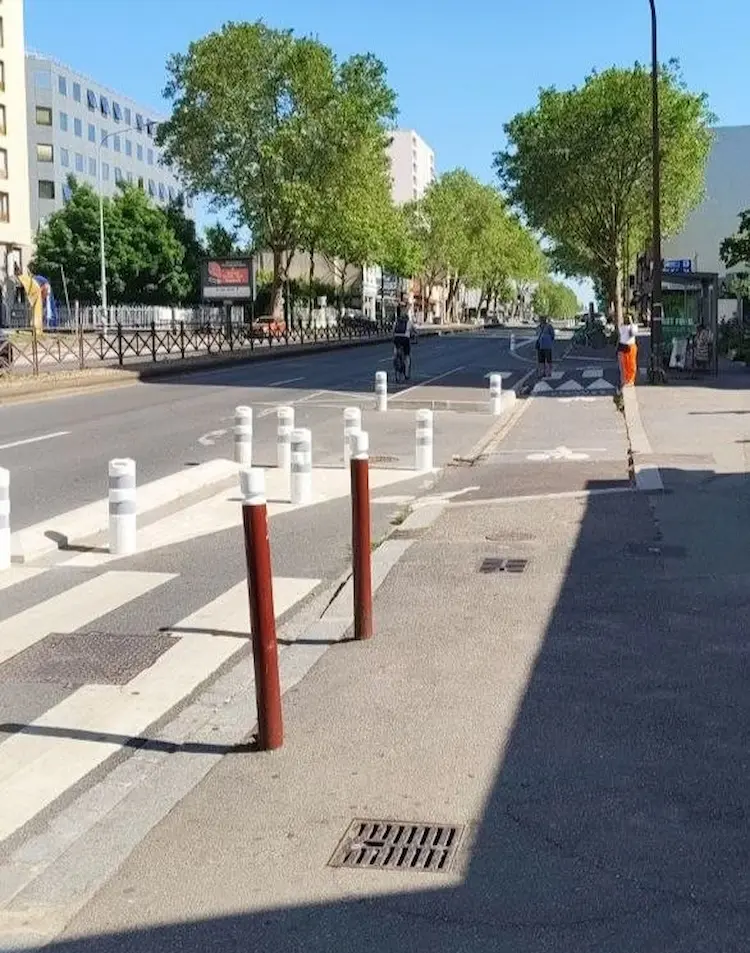
- The Failure of Painted Lines: The same study revealed that standard, painted road markings produced a negligible impact on ridership. Physical separation is the decisive factor required to get less-confident demographics out of cars and onto bikes.
The London breakthrough
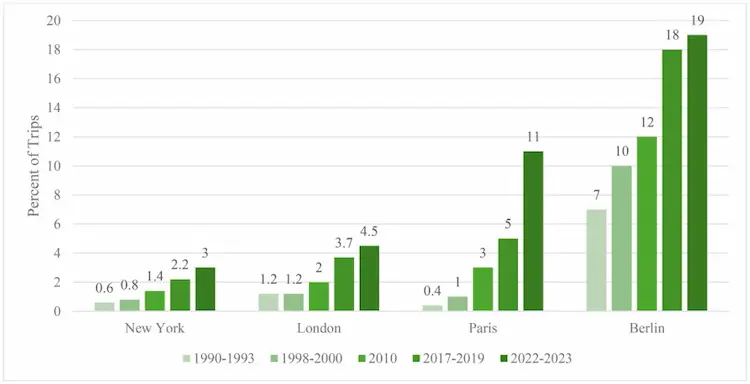
Recent data from central London perfectly illustrates the impact of protected cycling infrastructure. Following the aggressive implementation of new protected cycling lanes and dedicated routes, the number of cyclists in the city center surged by over 50% in two years, with daily trips climbing from 89,000 in 2022 to 139,000 in 2024. Recent traffic counts show that bicycles now outnumber private cars on central London streets during peak hours by nearly two to one, a growth pattern directly credited to protective infrastructure.
Paris: how a city rebuilt itself around cycling
Few cities illustrate the power of political will and infrastructure investment better than Paris. Over the last decade, the French capital has aggressively transformed from a car-oriented metropolis into one of the world’s leading cycling capitals.
Through successive iterations of the Plan Vélo, Paris has built more than 1,000 kilometres of cycling infrastructure. The city’s achievement was converting temporary pandemic-era “corona cycle paths” into permanent, concrete-protected lanes and systematically reallocating road space across its entire urban core. By reclaiming space from major roundabouts and arterial boulevards, Paris turned disconnected tourist pathways into a continuous, high-capacity arterial grid linking the inner center directly to the surrounding suburbs.
The data compiled by the city of Paris and regional air quality monitors (Airparif) reveal a profound structural shift:
- The Modal Leap: Cycling now accounts for 11% of all daily trips in Paris proper, more than doubling its 5% baseline in just a five-year period.
- Traffic Reduction: Motor vehicle traffic inside the urban core has dropped significantly as road space was systematically reallocated to active transit.
- Cleaner Air: Concurrently, regional monitoring recorded a major drop in nitrogen dioxide concentrations along major axes. While cleaner vehicle fleets played a role, localized air quality improvements were most acute where car lanes were directly swapped for bicycle tracks.
Read more about Paris here.
The critical bottleneck: the safety deficit
Despite massive investments across Western Europe, the active mobility transition faces a severe headwind: safety.
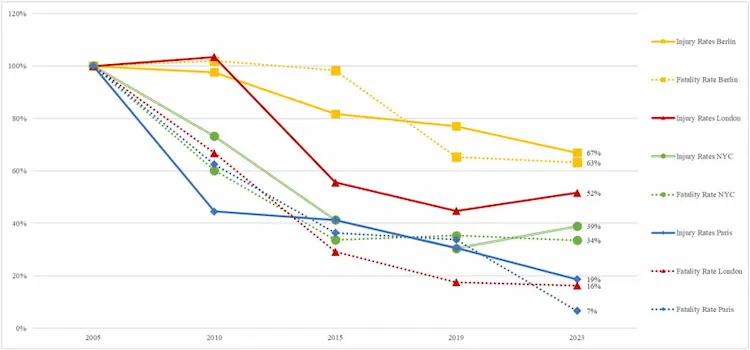
According to the European Transport Safety Council (ETSC), 1,926 cyclists lost their lives on EU roads in 2024. Over the past decade, cyclist mortality has declined by only 8%, a rate significantly slower than the decline in fatalities among motorized vehicle occupants.
Urban planning experts argue that this safety deficit stems directly from incomplete networks. To combat this, the ETSC insists that cities must prioritize two structural interventions: complete physical separation of bike infrastructure from heavy traffic and the implementation of mandatory 30 km/h speed zones in dense residential and commercial areas.
The Balkans: is the region falling behind?
While Western and Northern Europe continue to rapidly expand their networks, the Western Balkans present an uneven, fragmented landscape. While public interest in active mobility is surging, actual infrastructure development remains highly inconsistent.
- Slovenia: The undisputed regional frontrunner. With an established cycling culture and strong integration between tourism, public transport, and municipal sustainability goals, Ljubljana sets the standard for what the region can achieve.
- Croatia: Demonstrating solid progress in selected coastal and urban centers, backed by significant investments in European cycling tourism networks, though internal municipal networks remain uneven.
- Serbia: Experiencing isolated project-driven growth. Cities such as Belgrade and Novi Sad have developed high-quality recreational corridors along major rivers, but everyday commuting networks remain fragmented and disconnected from many residential areas.
- North Macedonia, Albania, Montenegro, Bosnia & Herzegovina: While local activism is high, infrastructure predominantly consists of short, painted lanes on sidewalks rather than connected, protected networks.
The recent launch of the Trans Dinarica cycling route, the first major corridor connecting all Western Balkan countries, proves that regional stakeholders recognize the economic and eco-tourism value of cycling. However, the region’s primary challenge remains the lack of connected, protected, and continuous urban cycling infrastructure. Balkan riders do not need more promotional cycling events; they need safe routes physically separated from heavy traffic.
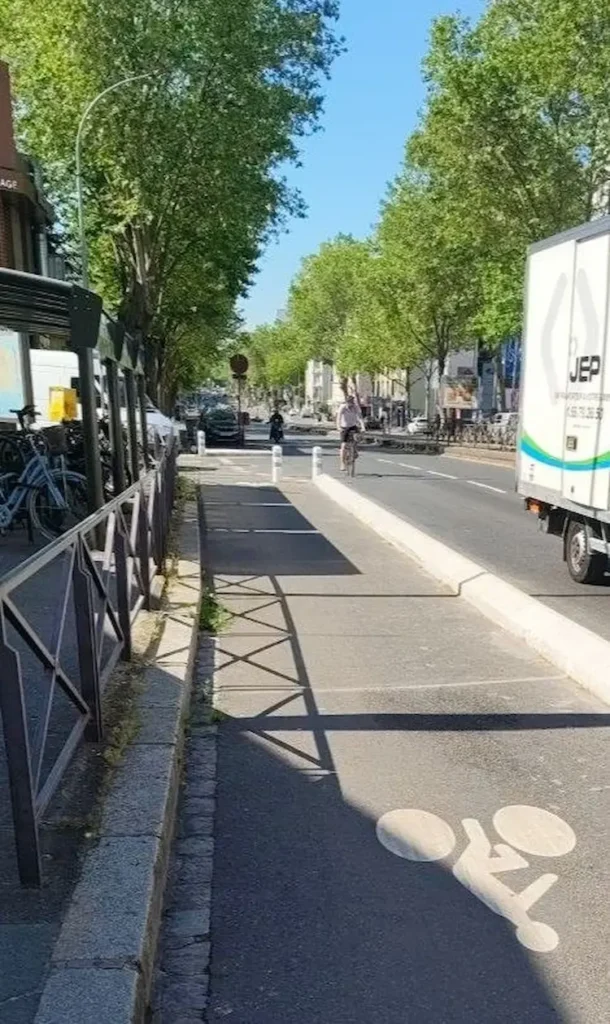
World Bicycle Day is often presented as a celebration of a two-wheeled invention. In reality, it highlights a fundamental question about the future of cities. The global transition toward sustainable mobility shows that success depends not on changing people’s attitudes, but on building safe and accessible urban cycling infrastructure. Paris and London have demonstrated that even car-dominated cities can be transformed within a decade. The Western Balkans now face a critical choice: whether cycling will remain a recreational activity or become a fully integrated component of everyday urban mobility.