
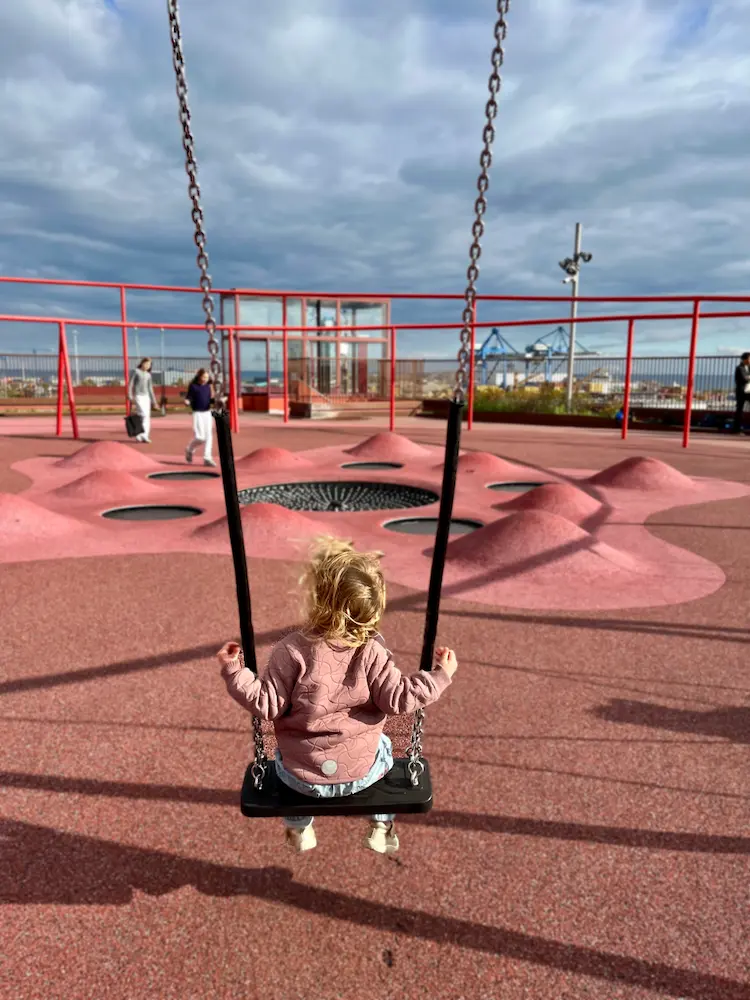
Recently, I went to the park with my daughter. She loves the swings, but they were occupied by teenage girls. Almost automatically, the girls got up and left when they saw us approach. We didn’t ask them to. Yet there seemed to be an unspoken understanding embedded within the design of the park itself: that the swings were acceptable for teenage girls only until a “more appropriate” user appeared.
Invisible Rules
Public spaces operate through invisible rules of permission. Some are explicit: football cages, playgrounds, designated zones for designated activities. Others are quieter social codes about how space should be occupied. A bench is for sitting. A street is for movement. A playground belongs to children.
These spaces were intended to encourage movement, interaction, and public life. But the more precisely we define what a space is for, the less freedom people have to define it for themselves.
This raises a broader question about how inclusive public spaces are created and whether cities unintentionally restrict who feels entitled to stay, play, or participate.
This creates cities filled with unspoken rules about what can happen where, and who feels permitted to occupy certain spaces. A bench, for example, is rarely considered a place for play, despite the fact that many children instinctively use it as one.
And then we caged it. Our obsession with assigning singular uses to singular spaces is exemplified in football.
A game that can be played almost anywhere. Jumpers become goals, benches become obstacles, curbs become boundaries. Football developed precisely because it was portable, adaptable, and self-organising.
Across Northern European cities, football has increasingly been confined to enclosed game areas (Multi-Use Games Area -MUGA) with fixed goals, dimensions, and boundaries. Spaces once open to negotiation became designated football zones. The enclosure does not simply contain the game physically; it fixes it socially too. You must enter the cage, claim it, control it, something generally undertaken by the most skilled and confident users.
Research by Make Space for Girls found that 90% of teenage facilities in parks consist of MUGAs, skateparks or BMX tracks. These spaces were used overwhelmingly by boys, particularly MUGAs, where just 8% of users were girls, dropping to only 4% outside London. A Stockholm study identified a similar pattern in Scandinavian cities: in spaces designed for spontaneous sport, 83% of users were male and just 17% female.
A game that once required almost nothing becomes dependent on a highly controlled environment that limits spontaneity and casual participation.
The Opposite of Prescription
Recently, a friend described her daughter’s school, which avoids conventional toys almost entirely. No toy trucks, no bikes, none of the objects adults instinctively associate with children’s play. My first reaction was concern; my own son had just started there. Then she described what the children had done instead. They laid coats across the floor to create houses. Lunchboxes became furniture. Twigs and stones became characters in imaginary worlds.
This idea is not new. In 1971, architect Simon Nicholson proposed the “Theory of Loose Parts,” arguing that creativity increases with the number of variables within an environment. A tree stump can become almost anything. A toy truck can only really become a truck. Since then, research into loose-parts play has repeatedly shown that open-ended environments encourage deeper engagement, imagination, collaboration, and adaptability.
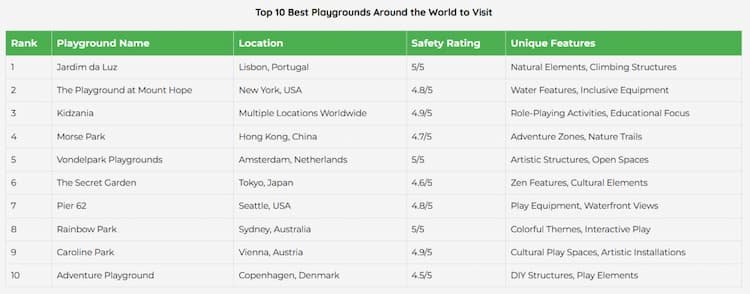
The same logic increasingly influences playground research and urban play design. The World Playground Research Institute, hosted by the University of Southern Denmark, explores how playgrounds influence children’s health, development and access to play opportunities. Their research and global examples can be explored through the Playscapes platform, which also includes international comparisons and city rankings of play environments.
Additional international examples of playground design approaches can also be found in the article “An International Comparison of Playgrounds” by Playground Landscape.
Why do cities continue designing public spaces with a single intended use, rather than spaces that allow people to negotiate meaning for themselves?
The problem is not simply that cities prescribe activities, but that prescribed activities inevitably privilege certain users over others. Once a space becomes strongly coded around a particular behaviour, it also becomes coded around the people most associated with that behaviour.
Importantly, this is not an argument against intentional design. Open-ended environments are not automatically inclusive. Ambiguous spaces are often easiest for the most confident users to occupy. The challenge is not to design less, but to design differently: not for a single predetermined activity, but for the conditions that allow multiple forms of occupation to emerge.
Designing Inclusive Public Spaces Instead of Activities
For cities, this means rethinking how success is measured. Highly visible activities are easy to quantify, but quieter forms, lingering, socialising, informal play, are often what make spaces feel welcoming to a broader range of users.
For developers and councils, the evidence points to five practical shifts:
- Audit what you already have. Before adding new facilities, assess whether the existing provision serves all users.
- Widen the brief. Design for a broader range of activities than sport. Shelters, swings, social seating, and spaces designed for older children saw girls three times more likely to show up than at MUGAs or skateparks.
- Apply an Equality Impact Assessment to all current and future provision, not just new developments, observing who is absent from spaces, not only who is present.
- Distribute, don’t concentrate. Rather than consolidating activity into a single dominant zone, spread smaller social spaces throughout the park. Concentration creates hierarchy: one group claims the centre, everyone else retreats to the edges. Distribution creates multiple points of belonging.
- Design for conditions, not activities. Spaces that invite multiple forms of occupation serve more people and create longer-term value for developers and communities alike.
The teenage girls leaving the swings were not excluded by rules or barriers. They simply understood, instinctively, that the space was not designed with them in mind.
Maybe the best public spaces resist that certainty. They leave enough room for people to define the space for themselves. Ultimately, inclusive public spaces may depend less on prescribing activities and more on creating environments where different users can coexist, negotiate meaning and feel ownership.
FAQ
What makes a public space inclusive?
Inclusive public space is not about designing one neutral space that works equally for everyone. Cities are made up of people with different needs, behaviours, comfort levels, and ways of occupying space.
Some forms of inclusion are infrastructural: equal access to toilets, transport, seating, lighting, and safe movement through the city. But inclusion also depends on whether people feel socially permitted to stay, gather, rest, play, or simply exist within a space.
The most successful public spaces often provide a balance of environments: spaces for activity and energy alongside quieter and more social spaces that support different forms of occupation.
Why do play spaces matter for urban inclusion?
Play spaces are often among the first public environments children experience independently, making them early places where ideas of confidence, belonging, and participation are formed.
Although designed for children, play spaces also shape how parents, carers, teenagers, and wider communities occupy public space. Seating, visibility, lighting, pathways, and types of play all influence who feels comfortable staying and for how long.
Because play spaces operate at a smaller and more visible scale than cities themselves, they often reveal broader patterns about who public space is designed for and how people are expected to occupy it.
How can cities create more inclusive public spaces?
Creating more inclusive public spaces is not about designing one environment that works equally for everyone. Inclusive environments often emerge from providing a wider range of ways to occupy space.
This can include balancing highly programmed areas, such as sports facilities, with quieter and more social spaces; distributing activities throughout parks rather than concentrating them into a single dominant zone; and designing environments that support multiple forms of use rather than prescribing a single behaviour.
Cities also need to pay attention to who is absent from public space, not only who is present. Observing which groups stay, retreat, gather, or avoid certain areas can reveal how design influences confidence, ownership, and participation.
Many inclusive environments emerge not from designing for a generic user, but from recognising that different people may need different spatial conditions to feel welcome and able to belong.
Read more about quality of life here.