
In the first part of this series, we explored the operational realities that shape the environmental performance of sustainable sports events. We showed how transport systems, logistics networks, procurement decisions, and supply chains often have a far greater influence on sustainability outcomes than the highly visible initiatives that tend to dominate public discussion.
Yet even the most sophisticated operational systems cannot deliver meaningful results if they are disconnected from local realities, weak governance structures, or unrealistic expectations about what sustainability can achieve in practice.
As sustainability becomes increasingly embedded within the sports industry, new challenges are emerging. Success depends not only on reducing environmental impacts, but also on understanding local contexts, creating meaningful legacy, communicating responsibly, and building trust among stakeholders. These dimensions are becoming just as important as emissions reductions and operational efficiency in determining whether sustainability programmes succeed or fail.
Why local context matters more than global sustainability rhetoric
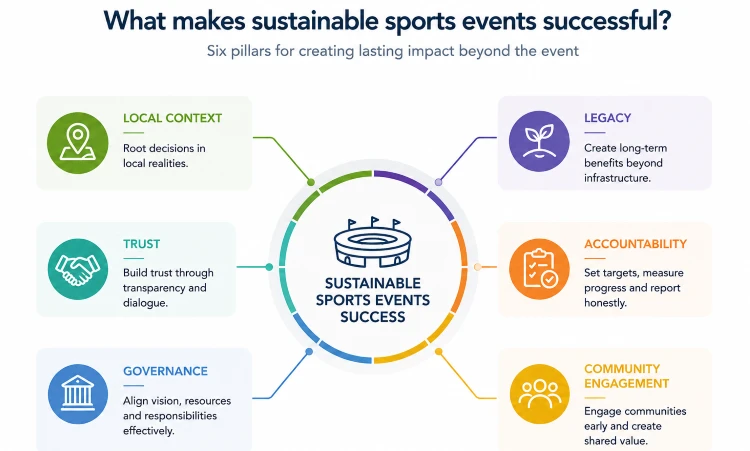
One of the most underestimated aspects of sustainable event management is the importance of local context. While international sport often relies on global frameworks and standardized objectives, successful implementation always depends on understanding the realities of the local ecosystem in which an event takes place.
This includes infrastructure capacity, regulatory systems, cultural expectations, supply chain maturity, workforce capabilities, political structures, and social priorities. Without this understanding, even the most ambitious sustainability strategy can quickly become disconnected from operational reality.
This became particularly evident while delivering major events in markets where the global event ecosystem was still developing and where international event requirements had to be adapted carefully to local infrastructure, supplier capacity, and governance realities.
One of the most challenging examples involved delivering a major international event in a Middle Eastern market that had not previously hosted a global event of that scale. The challenge was not a lack of ambition or willingness. It was that the local event ecosystem was still developing. There were gaps in planning and delivery knowledge, limited recycling and waste-management infrastructure, limited availability of biofuels for temporary power, and different levels of health and safety maturity on site.
The lesson was that capability-building takes time. You cannot expect a local event ecosystem to immediately deliver systems, infrastructure, and supplier maturity that more established markets have developed over many years. International standards still matter, but implementation has to be adapted to local reality while maintaining clear minimum expectations.
In some markets, language barriers, cultural expectations, and religious sensitivities can affect workforce communication, training, supplier engagement, scheduling, site behaviour, and stakeholder management. The challenge becomes even more complex in global events involving multiple layers of public authorities, ministries, local agencies, contractors, and international governing bodies. Under these conditions, sustainability management becomes as much about relationships and communication as about technical expertise.
Strong local teams therefore become essential. Organizations need people who understand both international standards and local realities. They must be capable not only of translating language, but also expectations, working cultures, institutional sensitivities, behavioural norms, and trust dynamics.
An experience in Morocco illustrates this dynamic particularly well. During the second year of operations there, one colleague remarked: “Do you know what I discovered? Everyone here speaks English. Last year nobody spoke English to me.” The reality, of course, was not that people had suddenly learned English within twelve months. The issue was trust.
In many cultures, particularly across parts of the Middle East and North Africa, trust and personal relationships play a central role in professional collaboration. During the first year, local stakeholders were assessing whether international teams were reliable, respectful, and genuinely committed. Once those relationships were established, communication became significantly easier.
This dynamic is often misunderstood by international organizations working under intense operational pressure and strict timelines. What may appear to be resistance can simply reflect caution toward external experts who may only be present for a short period of time.
Sustainable event delivery therefore depends heavily on relationship-building and credibility. Indonesia offers another useful example. In parts of Southeast Asia, plastic pollution and coastal waste management were already significant public and policy concerns before many international sports organizations began introducing their own sustainability strategies in the region. Governments were already developing policies around single-use plastics and biofuel implementation.
In that context, focusing on single-use plastics and alternative fuels made sense because these were not abstract external priorities; they were already relevant to local communities and public authorities. This is an important lesson for international sport: sustainability strategies are more effective when they align with local policy agendas and community priorities rather than imposing generic global narratives.
This principle applies equally to small events and mega-events. However, the larger the event, the greater its potential influence, both positive and negative. Without local understanding, sustainability initiatives can quickly become performative exercises disconnected from the realities of host communities. With proper local engagement, however, events can contribute to institutional learning, infrastructure improvements, and long-term capacity-building.
Ultimately, sustainable event management is not only about environmental performance metrics. It is also about understanding people, systems, governance cultures, and the social realities within which events operate.
Legacy beyond infrastructure
Discussions about sustainability often focus on reducing negative impacts. Yet major sporting events are also expected to create positive long-term value for host communities. This is where the concept of legacy becomes particularly important.
Legacy is one of the most frequently used terms in the sports events industry. Almost every major championship, tournament, or mega-event now presents itself as a catalyst for long-term positive impact. Yet despite its constant use, legacy often remains poorly defined.
In many cases, discussions about legacy focus primarily on physical infrastructure: stadiums, transport systems, public spaces, or energy projects developed around major events. These projects can create long-term value when properly planned and integrated into broader urban strategies.
For example, Formula E events in Paris contributed to discussions around electric mobility and charging infrastructure at a time when electric vehicle adoption was still relatively limited globally. In that context, EV infrastructure projects carried clear strategic relevance for the city.
However, physical infrastructure alone does not necessarily constitute meaningful legacy. The more important question is whether events leave behind lasting value that continues to function after the event itself disappears.
Real legacy should ideally be designed before the event, funded during the event, and ultimately owned locally after the event. This distinction is critical because many event-related initiatives lose momentum once media attention, sponsorship visibility, and organizational resources move elsewhere.
To make legacy meaningful, it should be measured through practical indicators: the number of local people trained or employed, the proportion of procurement directed to local suppliers, the number of community organizations engaged, accessibility improvements delivered, infrastructure or equipment still in use after the event, and whether programmes continue six or twelve months later. Without such indicators, legacy risks remaining an aspiration rather than an outcome.
One of the strongest forms of legacy often emerges not through infrastructure, but through people. A useful example comes from Formula E events organized in Red Hook, one of the poorest areas of New York City. Initial efforts to engage local residents relied primarily on volunteer participation. While the initiative generated some involvement, long-term engagement remained limited.
The situation changed significantly once organizers introduced paid workforce opportunities connected to event operations. Local residents became involved in catering, logistics, crowd management, hospitality, waste operations, and other practical aspects of event delivery. More importantly, they acquired professional experience and operational skills that remained valuable after the event itself had ended.
Paid local workforce opportunities often create a stronger legacy than short-term volunteering because they provide income, skills, professional exposure, and credible pathways into the events industry. Volunteering can be positive, but paid roles create a more direct connection between the event and local economic opportunity. This type of legacy is frequently underestimated.
When individuals, particularly young people, gain exposure to industries that previously felt inaccessible, the impact can extend far beyond the event itself. Large-scale sports events bring together engineers, logistics specialists, sustainability professionals, communications teams, broadcasters, mechanics, hospitality managers, and technology experts. For many young people, especially those from underrepresented communities, this may be the first time they can imagine themselves participating in such professional environments.
This also matters from an inclusion perspective. Major events can expose young people, especially women and underrepresented groups, to technical, operational, and leadership roles they may not previously have imagined as accessible.
Motorsport, for example, has traditionally struggled with female representation across many operational and technical roles. Greater inclusion within event ecosystems can help reduce barriers to entry and expand access to industries that previously appeared closed or unattainable.
This broader understanding of legacy shifts the conversation away from purely infrastructural outcomes toward long-term human capacity-building. It also reinforces a wider principle within sustainable event management: events should not only minimize negative impacts. They should also strengthen local systems, create opportunities, and leave communities better equipped for the future. Without that dimension, the concept of legacy risks becoming little more than a communication slogan attached to temporary spectacles.
When sustainability becomes a communication strategy
Sport is one of the most powerful communication platforms in the world. Together with music, it remains one of the few truly universal languages capable of mobilizing global audiences across cultural, political, and linguistic boundaries. That influence creates enormous opportunities for promoting sustainability awareness. But it also creates responsibility.
One of the growing risks within the sports industry today is that sustainability narratives sometimes advance faster than the operational evidence supporting them. Over the past several years, sustainability communication has become increasingly ambitious. Organizations frequently announce carbon neutrality targets, net-zero roadmaps, circularity commitments, or green event strategies. In some cases, these initiatives are supported by robust operational frameworks and credible data. In others, communication has moved ahead of implementation.
This creates growing exposure to accusations of greenwashing. The issue is becoming more significant not only reputationally, but also legally and financially. Regulatory scrutiny around environmental claims is increasing rapidly, particularly within the European Union.
The pressure is already influencing corporate behaviour. For example, a 2026 survey of more than 250 UK business leaders found that 85% of organizations had reduced external sustainability communications because of concerns about greenwashing accusations, while 89% were worried that their environmental claims would not withstand regulatory scrutiny. These trends illustrate how rapidly expectations around sustainability communication are changing.
In Europe, this direction is reflected in the Empowering Consumers for the Green Transition Directive (Directive (EU) 2024/825) on empowering consumers for the green transition through better protection against unfair practices and through better information. Together with wider EU scrutiny of environmental claims, including the Green Claims framework, it signals a clear direction of travel: vague, generic, or unsubstantiated sustainability claims will become increasingly difficult to defend.
For many years, broad sustainability statements could be communicated without significant external verification. Today, stakeholders increasingly expect measurable evidence, transparent reporting systems, and credible data supporting environmental and social claims.
The problem is not that sport organizations communicate about sustainability. On the contrary, sport has an important role to play in shaping public awareness and influencing behaviour. The challenge emerges when communication relies too heavily on trends, buzzwords, or symbolic narratives without sufficient operational substance underneath.
Carbon neutrality illustrates this challenge particularly well. Only a few years ago, “carbon neutral” became one of the most widely used sustainability claims across industries, including sport. Yet in many cases, the methodologies, accounting systems, and offsetting mechanisms behind these claims remained poorly understood by audiences and sometimes even by organizations themselves.
A credible sustainability claim should also be clear about its boundary. Is it referring to the venue, the event operations, spectator travel, team travel, freight, energy, waste, procurement, or the full value chain? Without clear boundaries, sustainability communication becomes vulnerable to misunderstanding and challenge.
As investigations, legal scrutiny, and public criticism increased, many organizations realized that sustainability communication could quickly become a reputational risk if claims were not fully supported by evidence. This is why data management, reporting systems, and evidence-based communication are becoming increasingly central to sustainable event governance.
Organizations need stronger systems for measuring emissions, tracking operational impacts, assessing supply chain performance, evaluating social outcomes, and monitoring legacy initiatives. Communication teams and marketing departments also require greater sustainability literacy in order to avoid oversimplified or potentially misleading narratives.
Precision matters. Large sport organizations operate under growing public scrutiny from regulators, sponsors, investors, NGOs, local communities, fans, and media organizations. Sustainability claims are no longer evaluated only as branding exercises. They are increasingly treated as statements requiring accountability.
Frameworks such as ISO 20121 are most useful when they help organizations build accountable systems that connect strategy, risk, procurement, supplier management, operations, data, reporting, and communication. Certification should not be presented as proof that an event has no significant impacts. It is evidence that a management system exists and that the organization has committed to a structured process of continual improvement. The real test is whether that system changes decisions in practice.
This is also where the core principles of ISO 20121 remain particularly relevant: inclusivity, integrity, stewardship, and transparency. These principles are not only relevant to event operations; they should also guide how organizations communicate, report, and make claims about sustainability performance.
Once organizations publicly position themselves as sustainability leaders, expectations increase rather than decrease. Practices that may once have been considered best practice quickly become baseline expectations.
In an environment of increasing transparency and scrutiny, organizations that genuinely want to lead can no longer rely solely on ambitious storytelling. They need governance systems, operational consistency, measurable evidence, and credible reporting structures capable of supporting their claims.
Ultimately, sustainability communication should emerge from operational reality, not replace it.
The future of sustainable sports events
One of the most thought-provoking observations ever made during an event management programme was this: “The most sustainable event is the event that does not take place.” This does not mean that events should not take place. It means that every event must justify its footprint. The real question is whether the event has been designed responsibly, whether avoidable impacts have been reduced, and whether the social, economic, and community value created is strong enough to outweigh the resources consumed.
Yet events continue to play an important role in society. They generate economic activity, cultural identity, social engagement, urban visibility, tourism, investment, and collective experiences that remain highly valuable for communities and cities.
The sustainable sports event of the future will not be defined by symbolic environmental gestures or isolated sustainability campaigns. It will be defined by whether sustainability is integrated throughout the entire life cycle of the event itself.
This begins with host city selection and venue strategy. It extends into procurement systems, transport planning, freight logistics, energy sourcing, temporary infrastructure, workforce management, accessibility, supply chain governance, community engagement, measurement systems, reporting frameworks, and post-event legacy planning.
At the same time, it is important to recognize a fundamental reality: there is no such thing as a zero-impact event. Major sporting events will always generate environmental footprints. The objective is therefore not perfection, but balance — minimizing negative impacts while maximizing long-term positive outcomes for host cities, communities, and local economies.
For urban events, sustainability is not only about carbon. It is also about social licence. If residents feel that an event arrives, blocks streets, creates noise and disruption, and delivers no meaningful local benefit, then the event becomes a problem rather than an opportunity. Cities therefore need to assess not only economic return and international visibility, but also disruption, access, emergency services, local business impact, and perceived value for residents. In practical terms, this means designing events capable of generating value that outweighs the resources they consume.
Several broader trends are likely to shape this transition over the coming decade. Logistics optimization and geographically rationalized event calendars will become increasingly important as organizations seek to reduce freight emissions and operational inefficiencies. Existing venues and permanent infrastructure are likely to become more attractive than highly resource-intensive temporary systems. Data analysis, AI-supported logistics planning, and real-time operational monitoring will also play growing roles in sustainability management.
At the same time, regulatory pressure around environmental disclosure, reporting standards, and greenwashing will continue to intensify, particularly in Europe. Sustainability in sport is therefore likely to move further away from voluntary branding exercises and toward more formalized systems of accountability and governance.
However, despite technological progress and regulatory development, one principle will remain fundamental: sustainable event management ultimately depends on people. It requires leadership capable of integrating sustainability into decision-making rather than treating it as a communications exercise, operational teams willing to rethink established systems, and strong local partnerships built on trust and meaningful stakeholder engagement. Above all, it requires organizations to understand the environments and communities in which they operate.
The future of sustainable sport will therefore not be determined only by technology, infrastructure, or carbon accounting methodologies. It will be determined by whether organizations are capable of aligning ambition with operational reality.
Conclusion
In the first part of this series, we explored how transport, logistics, procurement, and operational planning shape the environmental footprint of major sporting events. In this second part, a broader picture emerges.
Sustainability is not simply a technical challenge. It is also a governance challenge, a communication challenge, and ultimately a human challenge. Events that ignore local realities, treat legacy as a public relations exercise, or communicate ambitions that cannot be supported by evidence are unlikely to achieve lasting impact. By contrast, organizations that invest in local partnerships, build trust, create meaningful opportunities, and communicate transparently about both achievements and limitations are far more likely to deliver successful and sustainable sports events.
As sustainability expectations continue to evolve, credibility will become one of the most important assets in sport. In that sense, the future of sustainable sports events is not only about environmental performance. It is about trust — and trust is earned through governance, evidence, operational consistency, and transparent action.
About the author: Pierluigi Zacheo is the Founder of MyStadium, a strategic sustainability consulting company specializing in major sporting events, with expertise in environmental strategy, event operations, logistics, and ESG implementation.
Read about sustainable stadiums here