
In our previous article, Europe’s Wildfire Risk: Why the EU Needs Integrated Fire Management, we looked at why Europe needs to move beyond emergency firefighting and develop a more integrated approach to wildfire prevention and management. The summer of 2026 has made that argument even harder to ignore.
Europe has not experienced another record-breaking fire season on the scale of 2025. Yet the figures are alarming. By 3 September, 647,882 hectares had burned across the EU, according to the European Commission’s Joint Research Centre (JRC) and the European Forest Fire Information System (EFFIS). By the same date in 2025, the figure had reached 994,706 hectares, making 2025 the worst wildfire season recorded in the EU. But comparing 2026 only with last year misses the bigger picture. As of 26 August, the area affected by fires was almost twice the 2006–2025 long-term average for the same period: 647,579 hectares compared with 328,010 hectares.
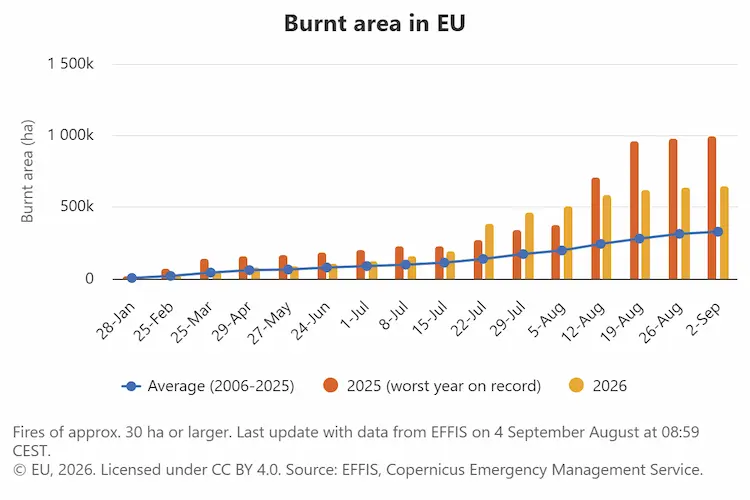
The question is therefore no longer whether Europe is having a “record” fire year. It is whether an exceptional fire season is becoming part of the continent’s new climate reality.
2026: a severe fire season, even without a new record
At the beginning of August, the EU’s 2026 wildfire season ranked fourth for cumulative area burned at that point in the year, behind 2012, 2022 and 2017. By the end of week 31, 489,826 hectares had burned across the EU, 13% above the 2012–2025 average at this point in the season.
Spain was particularly affected. By early August, 185,948 hectares had burned there, around 38% of the EU total and more than twice Spain’s average for the same period between 2012 and 2025. France had also experienced an exceptionally severe season, with more than 100,000 hectares affected by early August.
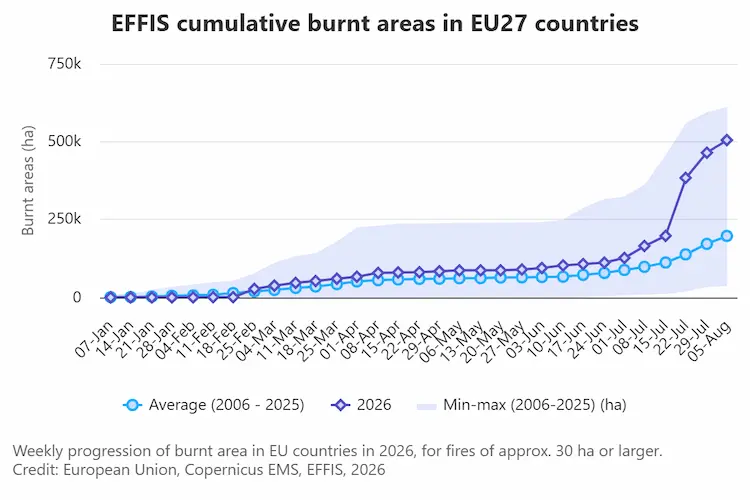
The situation deteriorated rapidly during the summer. On 5 August, the JRC reported 505,683 hectares burned in the EU, compared with 379,392 hectares on the same date in 2025. In other words, 2026 had overtaken the previous record year when the seasons were compared at the same point.
This volatility is itself important. A single annual ranking cannot fully capture wildfire risk in Europe, as fire seasons are increasingly shaped by short periods of extreme heat, drought, and wind.
Heat and drought are fueling the fires
Wildfires do not start simply because temperatures rise. Ignition still depends heavily on human activity, while the intensity and spread of fires are shaped by weather, vegetation, topography and land management. But climate change is changing the conditions under which fires develop. The European Environment Agency reports that high fire danger is increasing across Europe, with longer fire seasons and an expansion of fire-prone areas towards central and northern Europe.
In 2026, prolonged periods of poor rainfall were followed by recurrent heatwaves. By August, drought had deteriorated across large parts of Europe, while the Loire, Po, Rhine and Danube experienced exceptionally low water levels. The JRC linked the combination of heat and drought directly to the extraordinary wildfire activity recorded during the summer.
A dry spring can leave vegetation ready to burn. A prolonged heatwave removes remaining moisture. Strong winds then allow a fire to spread rapidly across landscapes that have accumulated large amounts of dry biomass. This is also why wildfire risk cannot be managed by firefighting services alone. The conditions that make fires catastrophic are created across entire landscapes.
The environmental cost goes beyond burned forests
The first number we usually see after a wildfire is the number of hectares burned. But hectares do not tell the whole ecological story. Large and repeated fires can damage biodiversity, degrade air and water quality, increase soil erosion and release greenhouse gases. The European Environment Agency identifies all of these as major environmental consequences of large-scale forest fires. Smoke can also become a regional public-health problem.
In July 2026, the Copernicus Atmosphere Monitoring Service reported that wildfires in France, Spain and Portugal exposed millions of people to extremely poor air quality. French wildfire emissions were already comparable to, or higher than, the country’s extreme fire years of 2022 and 2023.
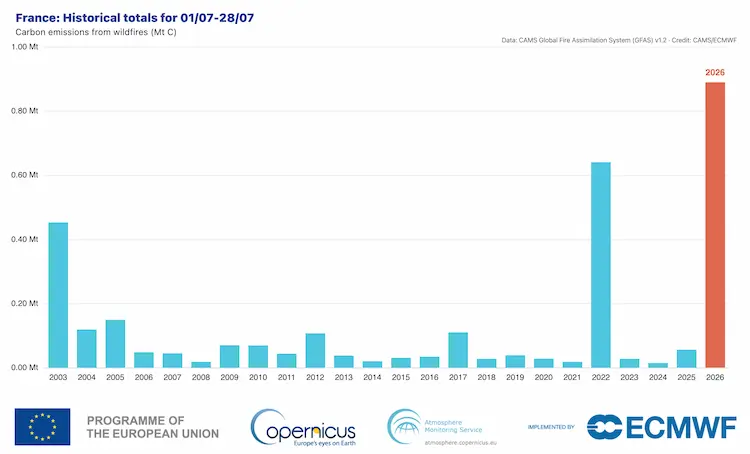
France provides a particularly striking example. By the end of July, its annual wildfire carbon emissions had already reached the highest level recorded for that point in the year. July alone produced approximately 0.89 megatonnes of carbon, compared with the previous July record of 0.64 MtC. There is also a long-term ecosystem problem. The EU’s 2025 fire season burned 424,023 hectares within Natura 2000 protected sites, approximately 39% of the total EU area burned that year.
Repeated fires can eventually change the character of an ecosystem. Forests may regenerate more slowly, some species may disappear, and landscapes can shift towards shrubland or other vegetation better adapted to frequent disturbance.
Wildfires are becoming an economic risk
The economic consequences of wildfire risk in Europe extend far beyond the immediate cost of putting out a fire. AccuWeather estimated in early August that the major European wildfires of 2026 had already generated approximately €15.6–19.1 billion in total damage and economic losses. The company described the estimate as preliminary and warned that it could increase as the fire season continued.
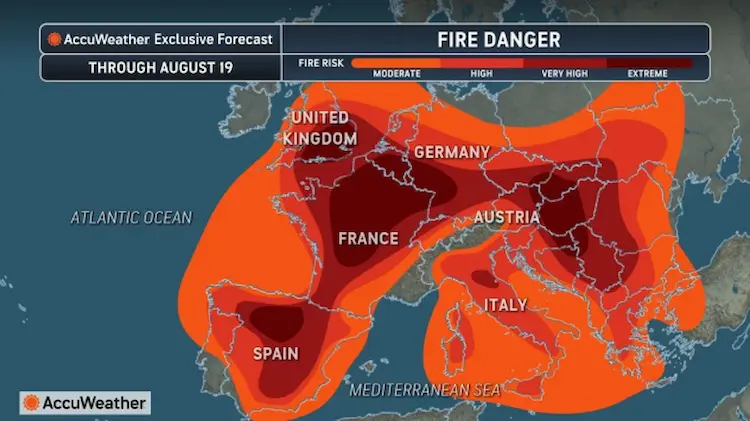
The costs include destroyed property and infrastructure, agricultural losses, emergency response, evacuations, firefighting aircraft and personnel, and disruptions to tourism and local businesses. But fires are also part of a much broader economic shock caused by extreme heat and drought.
A separate analysis cited by Euronews estimated that the combined economic impact of extreme heat and wildfires could reach approximately €180 billion in the EU in 2026, equivalent to around 1% of EU GDP. This figure should not be interpreted as the cost of wildfires alone. It includes the effects of heat on agriculture, energy, transport and labour productivity as well as wildfire damage. This distinction is important because climate-related losses often accumulate through multiple channels.
Low river levels can disrupt freight transport. Drought can reduce agricultural output. Heat can lower labour productivity, particularly in construction, agriculture and other physically demanding sectors. Wildfires can simultaneously damage the same regions’ forests, tourism assets and infrastructure.
The Balkans are under growing pressure
The Balkans show particularly clearly why absolute burned area is not enough to understand wildfire risk. According to an analysis by Experts Club based on operational Global Wildfire Information System (GWIS) data, approximately 29,587 hectares had been affected by fires in Serbia in 2026. That represents around 0.335% of the country’s territory and placed Serbia ninth among the European countries included in the comparison.
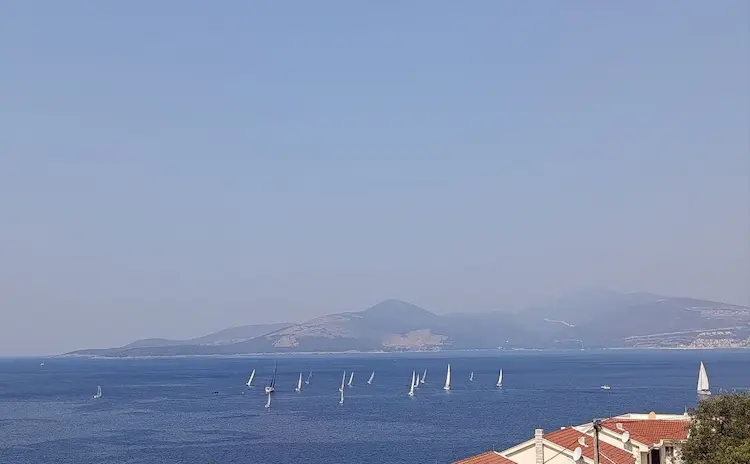
Several neighbouring countries experienced an even greater proportional impact. The same analysis estimated that fires affected approximately 1.68% of Montenegro, 1.05% of Bosnia and Herzegovina, and 0.75% of North Macedonia. Albania was also among the countries with a substantial share of territory affected. Together, Serbia, Montenegro, Bosnia and Herzegovina, North Macedonia and Albania accounted for roughly 142,000 hectares in the dataset.
For relatively small countries, the consequences can be disproportionately large. Forests, agricultural land, pastures, roads, electricity infrastructure, watersheds and tourism destinations are often concentrated within the same limited territory. The region is also facing a structural problem. Climate change is increasing heat and drought stress, while rural depopulation and land abandonment can contribute to the accumulation of dry vegetation. The European Environment Agency identifies both climate change and land abandonment as factors contributing to fire-prone conditions.
Deliblatska Peščara: a warning for Serbia
One of the most revealing examples comes from Serbia’s Deliblatska Peščara, a unique dune and woodland landscape approximately 80 kilometres from Belgrade. The 2026 fire has forced foresters to confront a difficult question: should restoration attempt to recreate the forest that existed before the fire, or should the landscape be redesigned for a hotter and drier future?
According to Reuters, damage assessment alone is expected to take about a year. Specialists are considering whether vulnerable conifers should eventually be replaced by species such as birch, poplar, ash and oak. The European Forest Institute has also advised against rushing into large-scale replanting, recommending a three-to-five-year observation period in areas without immediate erosion risks.
From firefighting to fire-resilient landscapes
The lesson of the 2026 fire season is not that Europe needs more firefighters, although it certainly needs sufficient emergency capacity. The deeper lesson is that wildfire risk in Europe must be managed before a fire starts.
The European Environment Agency points to nature-based solutions including adaptive forestry, agroforestry, green corridors, rewetting and rewilding as potential tools for increasing landscape resilience. Its analysis also estimates that the wildland–urban interface already covers 7.4% of the EEA33 land surface, making land-use planning increasingly important.
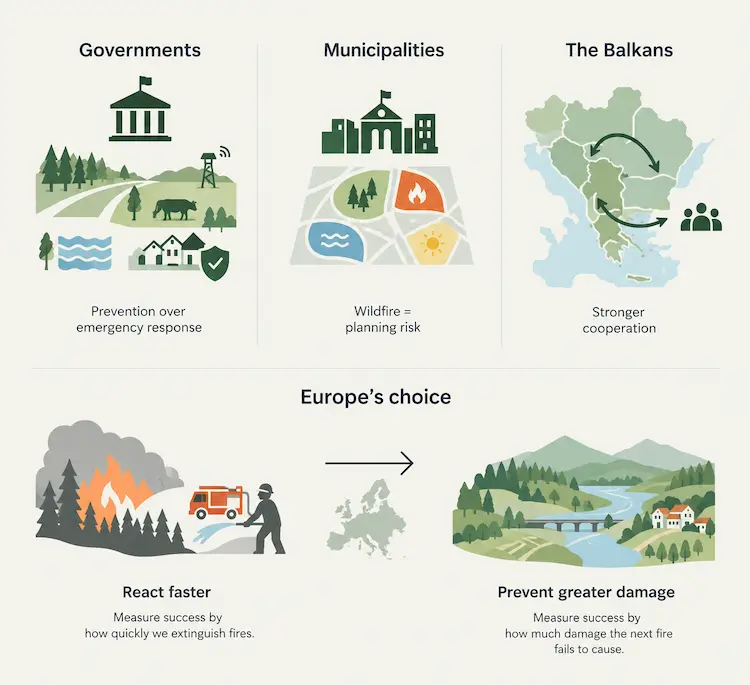
For governments, this means shifting part of public spending from emergency response towards prevention: better forest management, strategic firebreaks, landscape restoration, early-warning systems, controlled grazing, water retention and stronger protection of settlements at the wildland–urban interface.
For municipalities, it means treating wildfire as a planning risk, alongside flooding, heat and water scarcity, rather than as an exceptional emergency.
For the Balkans, cooperation across borders will become increasingly important. Fires do not stop at national boundaries, while the countries facing the highest proportional losses often have fewer financial and technical resources to manage the risk alone.
The summer of 2026 therefore leaves Europe with a choice. It can continue to measure success by how quickly firefighters extinguish the next major blaze. Or it can measure success by how much damage the next fire fails to cause. The difference is more than a matter of emergency management. It is a question of how Europe will design its forests, farms, infrastructure and settlements for a hotter climate.