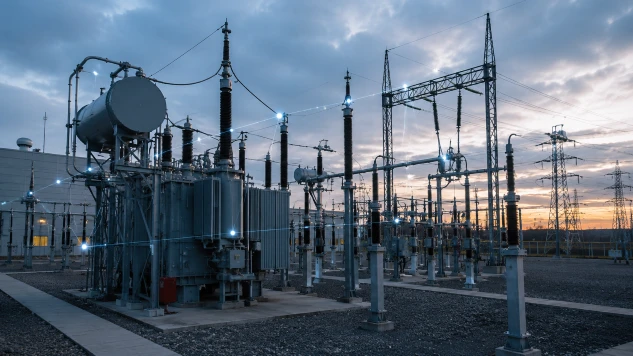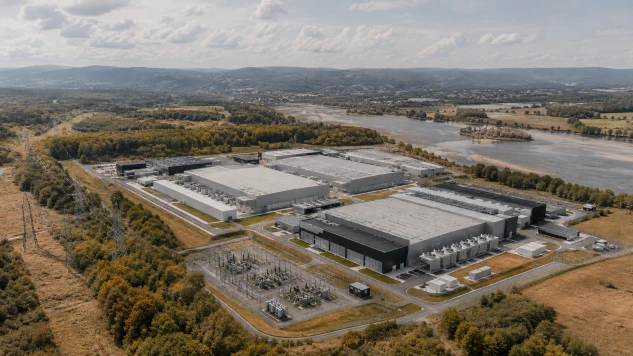

Imagine an investor looking for a site in Southeast Europe for a data centre, battery factory or another electricity-intensive project. Balkan grid readiness may matter more to that decision than the headline size of a country’s power system. The practical question is simple: where can I connect 100 MW, how long will it take, and what will it cost?
New Polis in cooperation with E3 International examined eight Balkan electricity systems through three factors that increasingly matter to such an investor: generation, grid capacity and flexibility. Together, they tell a rather different story from national rankings based on installed megawatts.
From megawatts to usable power
Installed capacity remains a useful measure of the scale of a power system, but a large industrial consumer does not connect to a country’s generation fleet. It connects at a particular location, through a particular part of the grid, and needs electricity when its operations require it.
Bulgaria, for example, had 18,668 MW of installed power capacity in 2025, including 1,382 MW of battery storage, and generated 40.2 TWh of electricity during the year (ESO, Statistical Pocketbook 2025, pp. 3–4). These figures make it one of the larger electricity systems in the region. They do not, however, tell an investor whether another 100 MW can be delivered to a particular industrial site.
Nor does a high share of domestic renewable generation necessarily mean that the same amount of power is available throughout the year. Albania produced 7.47 TWh of electricity domestically in 2025, most of it from hydropower (INSTAT, Balance of Electric Power 2025, pp. 1–2). But in the third quarter, when hydrological conditions were less favourable, domestic generation fell by 31.3% year on year while gross electricity imports rose by 65.3% (INSTAT, Balance of Electric Power, Q3 2025, p. 1).
The two examples point to the same distinction from opposite directions. Generation capacity tells us how much a system can produce; annual statistics tell us what it did produce. Neither tells us how much additional electricity can be delivered reliably to a new consumer at a specific location. Installed megawatts tell us how large an electricity system is. They do not necessarily tell us how investable it is.
Balkan Grid Readiness: Where the Bottleneck Begins
Suppose an investor has chosen Southeast Europe and needs 100 MW of continuous power. Finding a country with sufficient generation is relatively easy. Finding a site where those 100 MW can actually be connected is not.
Transmission operators publish network maps, development plans and connection rules, but the decisive number is often missing from public statistics: how much additional load can a particular node accommodate without major reinforcement? Serbia’s connection procedure shows why there is rarely a simple answer. Before a large user can connect to the transmission system, EMS carries out a Connection Study covering power flows, voltage conditions, N-1 security and short-circuit currents. The result may identify missing infrastructure, limit the approved connection capacity or impose operating restrictions (EMS, Connection to the Transmission System).
The same project-specific logic applies across the region. What complicates comparison further is that figures labelled as “available capacity” may describe quite different things. Greece’s Gemini data-centre project offers a good example. IPTO and Serverfarm announced an initial campus in Greater Athens with 130 MW of committed power, with IPTO providing sites with access to electricity and fibre infrastructure (IPTO, Gemini hyperscale data centre project). The figure proves that a hyperscale-class connection can be secured at that location. It says nothing about another investor’s ability to obtain 130 MW elsewhere in Athens.
Bulgaria approaches the problem from another direction. ESO operates a public Free Connection Capacity platform where users can select grid infrastructure and request an indicative capacity value in MW. This is unusually useful for initial site screening, but the platform itself describes the result as an approximate value. It is not a binding connection offer.
Montenegro illustrates another distinction. Reinforcement around CGES’s 400/110/35 kV Lastva substation increased grid transfer capability by around 500 MW and strengthened the system for power flows associated with the Montenegro–Italy submarine cable (CGES, Substation 400/110/35 kV Lastva). That does not make 500 MW available to a new industrial customer. Transfer capability, transformer rating, indicative headroom and firm connection capacity are different measures, even when all are expressed in megawatts.
For investors, there is another variable that national energy statistics barely capture: time. A technically feasible 100 MW connection that requires a new substation, permits and transmission reinforcement is a very different proposition from 100 MW that can be supplied through existing infrastructure. Across the eight systems examined by New Polis, we did not identify a sufficiently comparable public benchmark for how long it normally takes to connect a new 100 MW load.
This is where grid transparency itself starts to matter for investment. Transmission operators cannot guarantee future capacity on a static map, but investors do not need a final connection agreement simply to compare potential locations. Indicative substation headroom, connection queues, expected reinforcements and scenarios for large new loads could make the first stages of site selection considerably faster.
This competition for grid capacity is becoming increasingly important for energy investment in the Balkans. New renewable plants need capacity to inject electricity, while data centres and electrified industry need it to withdraw power; batteries can require both. In Serbia alone, EMS said in 2026 that it was preparing the transmission system to integrate almost 12 GW of new renewable projects over the following six years, most of them during the first four (Balkan Green Energy News, Serbia’s grid to integrate 12 GW of renewables in next six years).
Grid capacity is therefore becoming something more than an engineering constraint. Visibility, connection certainty and time-to-power are increasingly part of the investment environment itself.
When Abundant Power Is Not Enough
Finding 100 MW of grid capacity does not solve the entire problem. The system must also be able to supply that power when it is needed. As solar and wind expand, this is becoming a different kind of constraint: electricity can be abundant at noon and scarce, or considerably more expensive, several hours later.
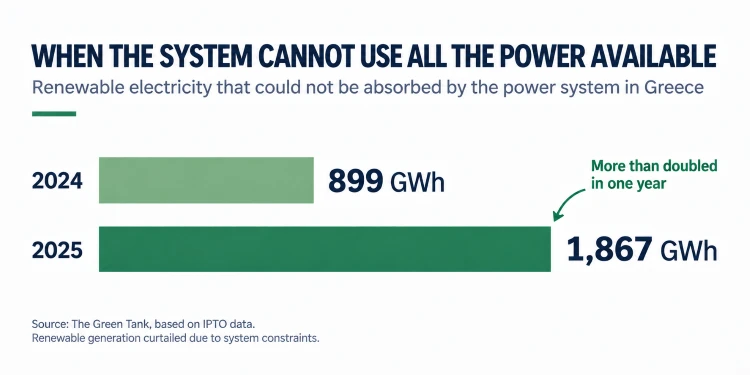
In Greece renewables, mainly wind and solar, supplied 46.7% of electricity demand in 2025, yet around 1.87 TWh of renewable generation was curtailed, more than twice the 2024 level. At the same time, gas-fired generation reached a record 23.3 TWh, while Greece recorded 483 hours with near-zero or negative wholesale prices (The Green Tank, Trends in Electricity Production, December 2025). The apparent contradiction is largely about timing: surplus renewable electricity cannot automatically be moved from periods of high production to periods of high demand.
Storage is one response. Bulgaria selected 82 standalone storage projects representing 9.7 GWh of usable capacity under the first RESTORE programme in 2025, followed by another 31 projects exceeding 4 GWh under RESTORE 2 (Bulgarian Ministry of Energy, RESTORE; RESTORE 2). But project pipelines need careful reading. Selected, licensed, contracted and operational capacity are not the same thing. By 2026, a 202 MW / 500 MWh standalone battery was operating at the former Maritsa East 3 coal complex, using existing grid infrastructure (Balkan Green Energy News, ContourGlobal installs 500 MWh standalone BESS facility in Bulgaria).
The same transition is visible elsewhere, although at different stages. Serbia now has standalone battery projects with grid-connection contracts and has begun to experience sustained negative day-ahead prices, while North Macedonia combines relatively modest operating battery capacity with a licensed storage pipeline measured in gigawatts. Both cases show how quickly storage is becoming part of the wider question of Balkan grid readiness.
What Makes Power Investable?
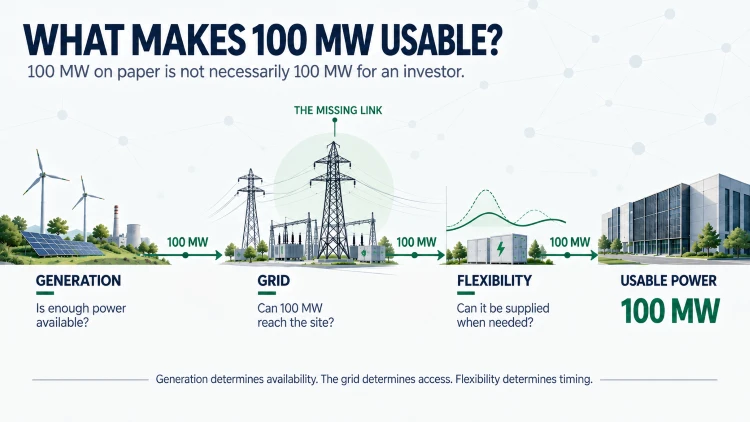
For the next wave of electricity-intensive investment, the real energy advantage may lie in usable power: electricity that is available, connectable at the right location and flexible enough to be supplied when it is needed. Generation determines whether the electricity exists. The grid determines whether it can reach the site. Flexibility determines whether the system can match supply with demand. Weakness at any one of these points can reduce the investment value of strength at the others.
For Balkan governments and transmission operators, this changes the competitive landscape. More generation will still be needed, but so will grid reinforcement, storage, stronger regional integration and clearer information about connection capacity and timelines. For an investor choosing between locations, knowing where 100 MW can actually be delivered, and by when, may increasingly matter as much as the headline electricity price.
The missing 100 MW is therefore more than a data-centre question. It is a test of whether Balkan power systems can turn their considerable energy resources into something the next wave of investment can actually use.
These questions, alongside the wider challenges of energy infrastructure and investment in the region, will also be discussed at Energy and Investment Days in Novi Sad on 14–15 October 2026.
In the coming days, New Polis will publish Beyond Megawatts: Grid Readiness and Energy Competitiveness in the Balkans, a white paper comparing generation, connection capacity and flexibility across eight Southeast European power systems.