
The 2026 FIFA World Cup is over, but the urban battles behind its venues are just beginning. World Cup stadiums are often presented as symbols of sporting excellence, yet their most lasting legacy is urban rather than athletic. A modern stadium is rarely just a sports venue. It is a land grab, a high-stakes investment model, a transit hub, and a gentrification engine.
Modern venues often boast advanced environmental credentials, reducing energy and water consumption. Yet green certifications leave deeper urban questions unanswered: Who controls the land? Who assumes the financial risk? How are neighbouring communities affected, and what happens between major events?
The stadium has become a small city within the city. The venues used during the World Cup in Mexico, Canada and the United States illustrate several very different versions of this relationship. New Polis has previously explored the environmental sustainability of modern sports venues. This article continues the discussion by examining the urban legacy, governance and land-use challenges behind major stadium projects.
A stadium begins with land
Behind the architecture lies a basic question: What else could have occupied this land?
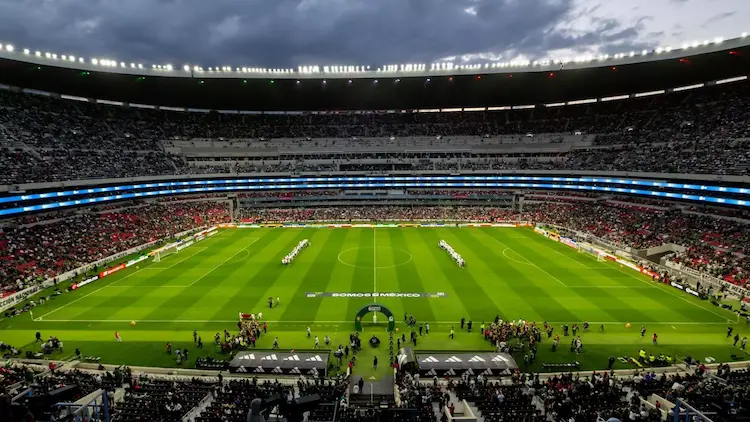
Mexico City’s Estadio Azteca (renamed Estadio Banorte) sits on land acquired in 1959. Construction displaced residents. Their legal challenges eventually forced the city’s mayor to resign. Decades later, plans to surround the arena with a mega-mall, hotel, and private infrastructure met fierce community opposition. By 2024, the commercial expansion was abandoned.
A major arena fixes the use of valuable urban land for decades, altering land values, commercial patterns, and the balance between public and private control. A similar dynamic shaped Levi’s Stadium in Santa Clara. By allocating a former amusement park for the stadium, the city made a long-term commitment to reserve public land for sports and entertainment rather than housing, offices, or public services.
The issue is not whether a stadium generates economic activity. The real question is whether that activity represents the best long-term use of the site compared to the opportunities given up.
Who carries the risk?
The complexity of its financing matches the physical scale of a stadium. Public ownership does not necessarily mean public operation, while private use does not necessarily mean private risk.
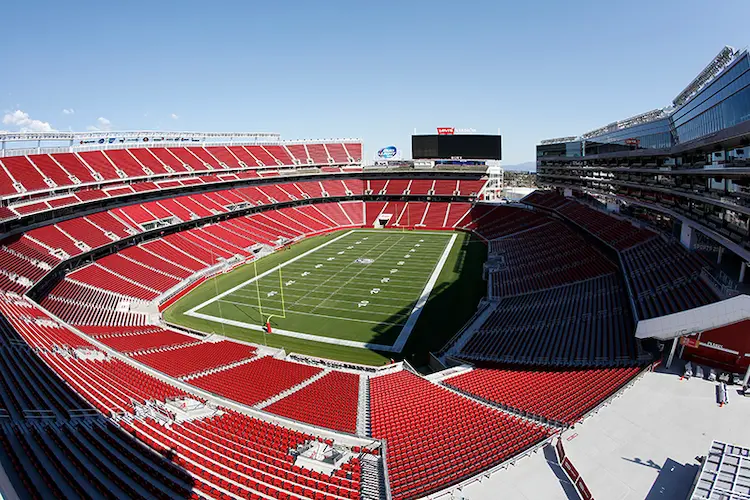
Take Levi’s Stadium in Santa Clara, which set up a public authority to own the venue, backing it with hundreds of millions in bonds and bank loans. The San Francisco 49ers moved in as the primary tenant, paying rent while stadium revenues, from tickets, parking, and naming rights, serviced the debt. On paper, the city kept control of the land. In reality, it bought into a decades-long, politically turbulent feud with a billionaire NFL franchise over costs, noise, and operations. Public ownership did not shield the city from private friction.
Toronto’s BMO Field represents another form of public-private cooperation. The current stadium was built after Canada secured the 2007 FIFA U-20 World Cup. A private sports company contributed part of the construction cost and took over management, while the city, province and federal government provided the remainder. The venue stands on publicly owned land within Exhibition Place, a historic municipal exhibition and event district.
Neither model can be reduced to a simple opposition between public and private investment. The real issue lies in how risks, revenues, decision-making powers and long-term obligations are distributed. A stadium may be formally public while operating largely for the benefit of a private team. It may be privately financed but depend on public land, transport infrastructure, tax arrangements or municipal services. Understanding the project therefore requires looking beyond the headline construction price.
From isolated arena to urban district
A stadium is easier to justify when it forms part of a functioning district rather than standing as an isolated object surrounded by parking.
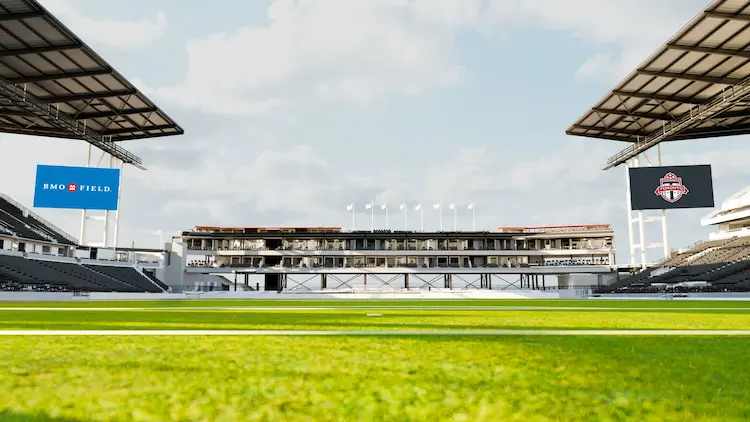
BMO Field benefits from being embedded within Exhibition Place, a territory that has hosted fairs, exhibitions and public events since the nineteenth century. The stadium is only one component of a larger municipal asset. Toronto develops multi-year strategic plans for the area and has adopted a master plan defining it as an event campus. Exhibition Place hosted around 2,000 events attracting approximately 5.5 million visitors, making the World Cup only one episode within a much broader programme of activity.
This does not automatically make the model socially or environmentally sustainable. The city also treats the territory as an income-producing asset and sets financial targets for it. Yet the integration of the stadium into an established event district gives the venue a role beyond football and reduces its dependence on a limited match calendar.
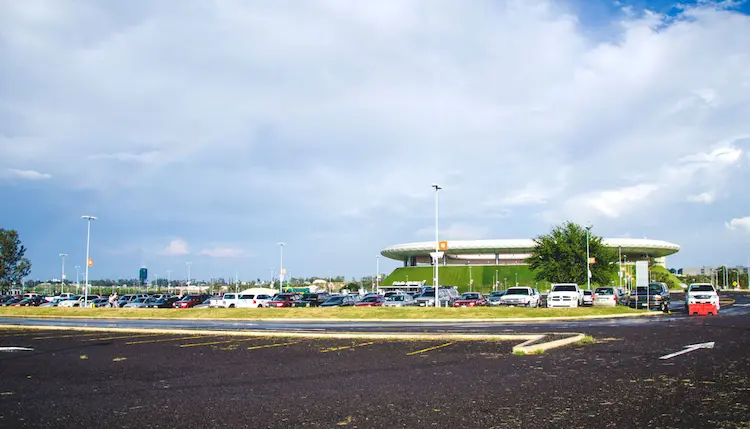
Estadio Akron in Guadalajara offers the opposite spatial image. It was originally conceived as one element of a much larger 200-hectare development containing hotels, shopping centres, conference facilities, a museum and a university. In the end, only the stadium was completed. The arena therefore remained surrounded by extensive empty land rather than the urban district that was supposed to support it.
The comparison is instructive. Multi-use does not simply mean hosting concerts inside the stadium. It means creating a territory where different activities, buildings and public spaces reinforce one another throughout the year. Without that wider context, even an architecturally distinctive and technologically advanced venue can remain disconnected from everyday urban life.
Environmental performance and urban justice
The 2026 tournament relied mainly on existing stadiums, avoiding the construction of an entirely new generation of arenas. Thirteen of its sixteen venues had obtained LEED certification before the competition. Collectively, the certified stadiums installed more than 11,500 solar panels and introduced measures expected to save over 100 million gallons of potable water annually. These achievements matter, but they do not remove tensions between venue performance and local conditions.
Estadio Akron was designed to collect rainwater from its roof and sloping exterior surfaces for reuse within the stadium. Its drainage and pitch systems also recover excess water. Such measures are particularly relevant in a region where water scarcity is a growing constraint.
Yet the case of Estadio Banorte shows why technical efficiency must be considered alongside access and distribution. While neighboring communities wait on water tankers during chronic droughts, the stadium holds an exclusive concession to a local water source, supplying water for pitch maintenance and premium hospitality facilities. A stadium may save water, but environmental sustainability ultimately depends on urban governance and social justice.
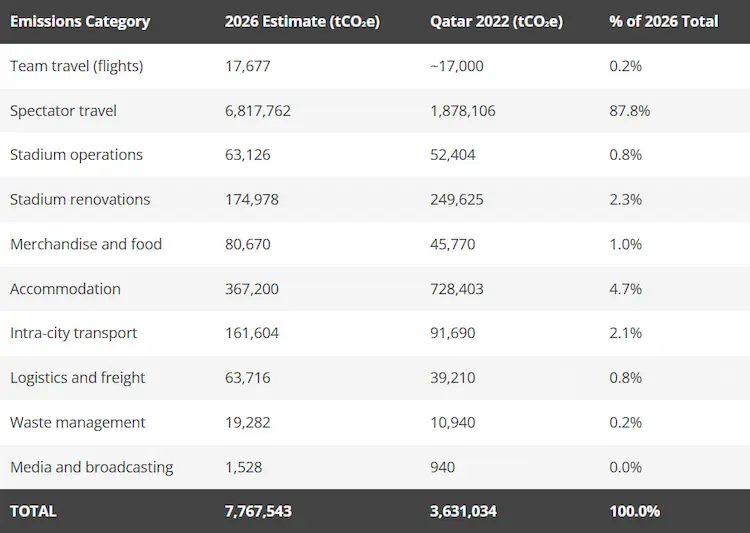
The tournament also showed the limits of concentrating attention on buildings alone. Although the use and upgrading of existing venues reduced the need for construction, one recent estimate placed the World Cup’s emissions at 7.8 million tonnes of carbon dioxide, with air travel accounting for most of the footprint. The geographical scale of the competition shifted much of the environmental pressure from stadium construction to mobility and logistics.
World Cup Stadiums as urban districts
SoFi Stadium in Inglewood is perhaps the clearest example of a venue functioning as the centre of a newly produced urban territory. The stadium was built on land formerly occupied by Hollywood Park racetrack. Earlier plans had proposed a large mixed-use neighbourhood for the site, but after the Rams’ owner acquired adjacent land, the two projects were combined around a new stadium. The resulting complex includes housing, offices, retail, a park, a lake and another performance venue. At an estimated cost of $5.5 billion, SoFi became the most expensive stadium ever constructed.
Unlike the unbuilt district around Estadio Akron, substantial parts of the wider Inglewood development did materialise. The venue helped turn the area into a major centre of the Los Angeles event economy. But the transformation has also been accompanied by rising housing and rental prices, increasing pressure on lower-income residents. Despite pedestrian areas within the development, its wider accessibility remains heavily dependent on highways, cars and large parking areas. SoFi illustrates how stadium-led development can drive investment while simultaneously deepening social and spatial inequality.
The urban legacy begins before construction
The cases of Mexico City, Guadalajara, Toronto, Santa Clara and Inglewood do not produce a single formula for a successful stadium. Their ownership structures, urban contexts and development histories are too different. They do, however, point to a common conclusion: the legacy of a stadium is determined less by the matches it hosts than by the system created around it.
A stadium may occupy public land but serve a private team. It may conserve water while competing with neighbouring communities for access to it. It may anchor a successful event district or remain isolated in a field of unrealised development. It may attract investment while contributing to higher housing costs. None of these outcomes can be judged through environmental certification or visitor numbers alone.
The most useful shift in stadium planning is therefore conceptual. Cities should not begin by asking how to fit a major arena onto a site. They should first decide what kind of district they need, what public interests the land should serve and whether a stadium genuinely supports those goals.
Once built, an arena may remain for half a century or longer. By then, football will account for only a small part of its urban history. The more important story will be written in the land around it, the infrastructure connected to it, the public money committed to it and the communities that must live with it every day.
This article complements New Polis’ two-part series on sustainable sports events, which explores operational sustainability, governance, legacy and public trust (Part I, Part II).