
Artificial intelligence is usually discussed in terms of algorithms, computing power and productivity. Much less attention is paid to the physical infrastructure that makes this revolution possible. Every AI model is trained, deployed and operated in AI data centres that require enormous amounts of electricity, reliable power supply and increasingly sophisticated energy infrastructure.
This is beginning to change the logic of the energy transition itself. Until recently, investment in renewable energy was driven primarily by climate goals, energy security and the need to reduce dependence on fossil fuels. Today, a fourth driver is emerging. The rapid expansion of AI is creating a new source of electricity demand and, with it, new priorities for energy investment. The numbers illustrate the scale of this shift. According to the International Energy Agency (IEA), data centres consumed around 415 TWh of electricity in 2024, equivalent to approximately 1.5% of global electricity demand. Since 2017, their electricity consumption has been growing by around 12% per year, more than four times faster than overall global electricity demand. By 2030, global electricity consumption by data centres is expected to exceed 945 TWh, with AI applications accounting for nearly half of this increase. In advanced economies, data centres could generate more than 20% of total electricity demand growth during the remainder of this decade.
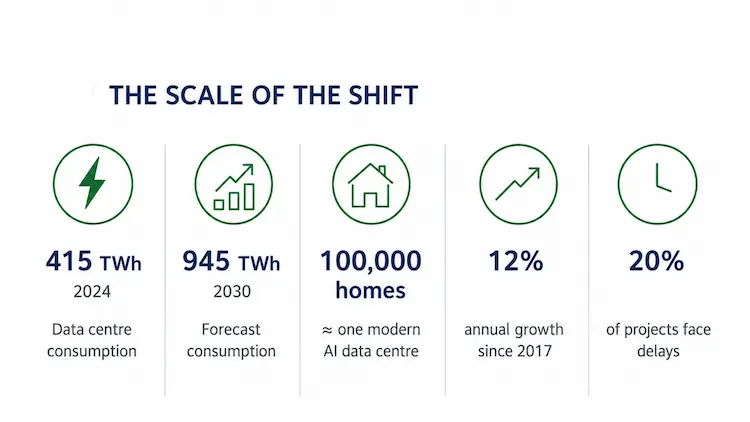
The significance of these figures lies not only in the growing volume of electricity consumption, but also in its concentration. Unlike households or conventional industries, AI data center infrastructure requires very large amounts of electricity in relatively small geographic areas. The IEA estimates that a modern AI-focused data centre can consume as much electricity as around 100,000 households, while the largest facilities currently under development may require almost twenty times more. Such projects can fundamentally alter electricity demand patterns within a single region.
Electricity is no longer the only challenge
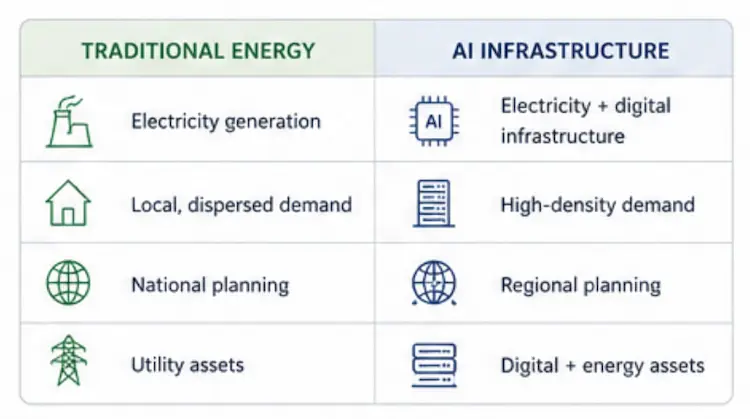
The discussion about AI and energy often focuses on electricity generation. In reality, generation is only one part of a much larger picture. The rapid expansion of AI is increasing demand for transmission capacity, grid flexibility, energy storage and digital system management. As electricity systems become more complex, these elements are turning into strategic assets rather than supporting infrastructure.
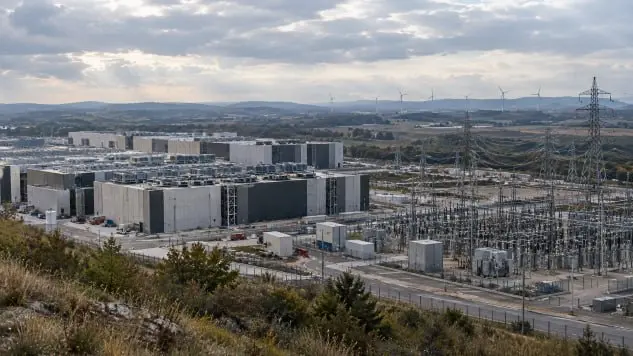
Modern AI data centres should no longer be viewed simply as large electricity consumers. In many respects, they resemble major industrial facilities. Their operation depends on dedicated high-voltage connections, on-site substations, redundant power supply, backup generation and sophisticated energy management systems capable of ensuring uninterrupted operation. Unlike most industrial consumers, however, AI facilities require this level of reliability from the moment they become operational, making industrial-scale energy infrastructure a prerequisite rather than a long-term objective.
The IEA identifies electricity networks as one of the main constraints on further AI development. Around 20% of planned data centre projects worldwide could face delays because of difficulties in securing grid connections or reliable electricity supply. In many advanced economies, building new transmission infrastructure typically requires between four and eight years, while waiting times for key equipment such as transformers and high-voltage cables have roughly doubled during the past three years. Digital infrastructure is expanding much faster than the energy systems needed to support it.
Electricity is only part of the equation. AI infrastructure also generates enormous amounts of heat that must be removed continuously to ensure stable operation. Cooling systems therefore become a critical component of data centre design, consuming significant amounts of electricity and, depending on the technology used, requiring substantial water resources or alternative cooling solutions. As computing density continues to increase, cooling is emerging as one of the defining engineering challenges for the next generation of AI facilities.
The same trend is becoming increasingly visible in Europe. According to the State of European Data Centres 2026, commercial and hyperscale facilities already account for more than two-thirds of Europe’s IT capacity. Demand for computing capacity is projected to grow by around 17% annually through 2031, while access to electricity, grid connections and cooling infrastructure has emerged as the sector’s main bottleneck. This suggests that Europe’s ability to compete in the AI economy will increasingly depend not only on digital innovation, but also on the availability of energy infrastructure.
Energy companies are rethinking their business models
Perhaps the clearest sign that AI is reshaping the energy sector is the way utilities themselves are changing their investment strategies. Traditionally, energy companies generated electricity, while technology companies developed digital infrastructure. That distinction is beginning to disappear.
A striking example comes from Greece. In 2025, Public Power Corporation (PPC) announced a €5.75 billion investment programme to transform Western Macedonia into a combined clean energy and digital infrastructure hub. The first phase includes a 300 MW data centre, with the possibility of expanding the site to 1 GW if market demand continues to grow. What makes the project particularly interesting is not its scale, but its underlying logic. PPC is integrating renewable generation, flexible power plants, electricity networks and digital infrastructure into a single long-term investment strategy. Former lignite sites offer another important advantage. They already possess many of the elements required for large-scale AI infrastructure, including high-capacity grid connections, industrial land and, in some cases, access to water resources that can support advanced cooling systems. Rather than becoming stranded assets, these former energy hubs may find a new role in Europe’s emerging AI economy.
Why regional cooperation matters
At first glance, the rapid growth of AI infrastructure may appear to be a challenge for individual countries. In reality, it is increasingly becoming a regional issue. Modern AI data center infrastructure requires far more than electricity alone. It depends on industrial-scale energy infrastructure, resilient transmission networks, advanced cooling systems, digital connectivity and long-term investment certainty. Large-scale facilities depend on reliable transmission networks, cross-border power flows, digital connectivity, resilient supply chains and long-term investment certainty. Few smaller economies can provide all these conditions independently.
This regional dimension is already reflected in European policy. Rather than developing isolated national systems, the European Union is building an interconnected AI ecosystem through its network of AI factories and future AI gigafactories. The programme combines high-performance computing facilities, research centres and innovation hubs across multiple member states. Bulgaria, Romania and Slovenia are participating through AI factories, while Serbia and North Macedonia have joined the initiative through AI factory antennas, providing access to European AI computing infrastructure for researchers and businesses across the region.
Romania offers another example of this changing approach. The proposed Black Sea AI gigafactory is designed not simply as a national project but as infrastructure capable of supporting AI development across a much wider geographical area. According to the Romanian proposal, the project could eventually include more than 100,000 AI accelerators, require up to 1.5 GW of electricity and involve investments of around €5 billion.
A new opportunity for the Western Balkans
For the Western Balkans, this shift may open opportunities that did not exist only a few years ago.
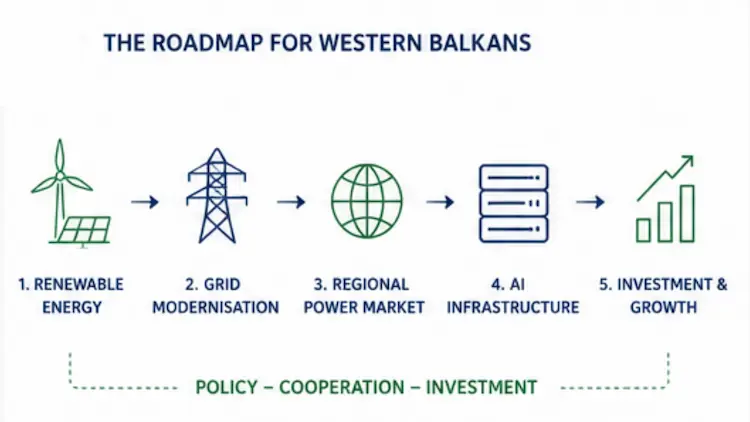
Individually, the region’s economies are relatively small and would find it difficult to compete with Europe’s largest AI infrastructure hubs. Together, however, they already possess many of the building blocks required for future investment. Renewable energy capacity continues to expand, electricity markets are becoming more closely integrated and cross-border infrastructure is gradually improving.
This process is already underway. The Energy Community has identified its first Projects of Energy Community Interest, including five cross-border electricity transmission projects and one energy storage project. Several of these initiatives have already secured financial support through the Western Balkans Investment Framework and international financial institutions. Although these projects were launched to strengthen regional energy security and market integration, they also contribute to the flexible and interconnected electricity systems that future AI infrastructure will increasingly depend on.
Recent investment decisions within the region point in the same direction. Serbia is expanding its state data centre in Kragujevac while strengthening its national AI infrastructure. Greece’s Public Power Corporation is integrating renewable energy, transmission infrastructure and large-scale data centres into a single regional development strategy for Western Macedonia. These projects differ in scale and purpose, yet they reflect a common trend: digital infrastructure and energy infrastructure are no longer being planned separately.
Perhaps the most important lesson is that AI is changing not only the demand for electricity but also the geography of energy investment. Reliable grids, flexible power systems and regional interconnections are becoming economic assets capable of attracting entirely new categories of investment.
Read how AI is transforming road safety here.
For the Balkans, this may prove to be one of the region’s most significant strategic opportunities. Rather than competing individually for every major AI project, countries may achieve greater long-term benefits by strengthening regional electricity markets, expanding cross-border infrastructure and coordinating investment in energy and digital systems. In the emerging AI economy, competitiveness is likely to depend not only on how much electricity a country can generate, but also on whether an entire region is ready to support the industries of the future.
Looking ahead
As AI continues to reshape electricity demand and infrastructure investment, questions surrounding grid modernization, regional energy cooperation and digital infrastructure are becoming increasingly important across Southeast Europe.
These themes will also be explored at Energy & Investment Days 2026, taking place in Novi Sad, Serbia, where policymakers, investors, utilities and technology leaders will discuss the region’s evolving energy and investment landscape.