

Tha article about AI accident investigation is provided by our media partner 7ITSNews.
As road traffic becomes increasingly complex, authorities around the world are seeking faster, safer, and more accurate ways to investigate collisions while minimizing road closures and preserving high-quality digital evidence. AI accident investigation technologies are emerging as one of the most promising developments in this field, combining 3D reconstruction, computer vision, and digital documentation to support more efficient traffic accident investigation.
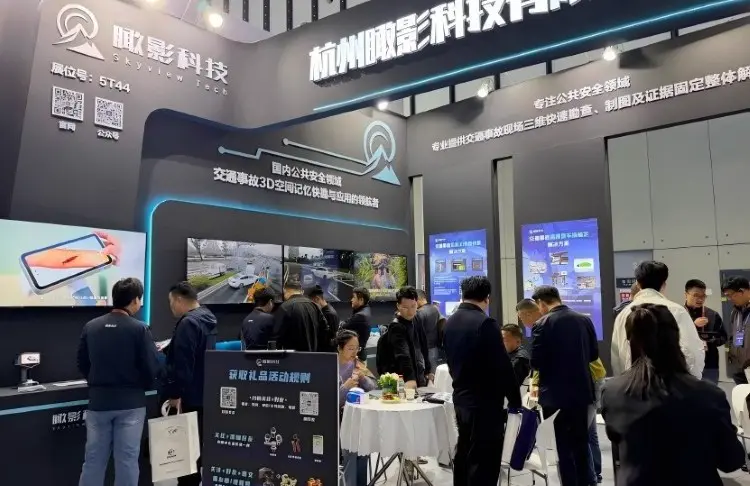
Recent innovations presented at the 16th China International Road Traffic Safety Products Expo (CTSE 2026) in Nanjing illustrated how these technologies are moving from research into real-world deployment. Among the solutions showcased, Skyview Tech demonstrated an AI-powered platform for rapid 3D accident reconstruction, digital evidence collection, and accident scene documentation designed to support frontline traffic police under a wide range of operating conditions.
Held on 22–24 April 2026 under the theme “New Quality Productivity for Transportation · Building Safety with Four Innovations,” CTSE brought together hundreds of companies, public authorities, and technology providers working in road safety technology and smart mobility. The exhibition highlighted a growing industry focus on digital tools that improve both operational efficiency and public safety.
Strong industry interest in digital accident investigation
Skyview Tech presented several integrated solutions, including real-scene 3D accident reconstruction, high-precision vehicle damage and personal injury assessment, and traffic hazard investigation. The technologies attracted considerable interest from transportation professionals, public safety agencies, and industry partners attending the exhibition, generating extensive technical discussions throughout the event.
Visitors focused particularly on the practical application of the company’s digital spatial technologies for accident investigation. Discussions covered implementation methods, operational workflows, data management, and opportunities for future collaboration, reflecting the increasing demand for digital solutions that can improve the speed and accuracy of AI accident investigation.
How the AI accident investigation solution works
Rather than relying on conventional accident documentation methods, Skyview Tech’s solution combines multimodal 3D scanning, AI-assisted image processing, and digital evidence management into a single workflow. The system has been developed to address several long-standing operational challenges faced by traffic police, including lengthy on-site investigations, complex evidence collection, limited personnel, and the need to reopen roads as quickly as possible.
Key capabilities include:
All-weather, all-scenario adaptability
The multimodal mobile real-scene 3D scanning technology performs real-time reconstruction across a wide range of environments and weather conditions, including night-time operations, rain, tunnels, mountainous roads, and large highway accident scenes.
Rapid scene documentation
The mobile scanning platform integrates scene scanning, photography, diagram generation, and digital signature functions into a single application. According to the company, a complete digital record of an accident scene can be created in as little as five minutes, helping reduce investigation time and accelerate traffic recovery.
AI-assisted 3D accident reconstruction
Using proprietary AI algorithms and high-resolution spatial modelling, the system reconstructs accident scenes while automatically removing temporary objects such as passing vehicles or pedestrians, producing cleaner digital evidence for subsequent analysis.
Comprehensive digital evidence management
The platform stores 3D models, video recordings, written reports, measurement data, diagrams, and other evidence within a unified digital archive, allowing investigators to review cases or conduct additional analysis when required.
From operational challenges to practical deployment
The development of Skyview Tech’s solution was driven by direct experience supporting traffic accident investigations and a broader understanding of the operational challenges faced by frontline police. Traditional accident documentation often requires considerable time for scene measurements, photography, report preparation, and evidence collection. Longer investigations not only increase the workload for officers but can also extend road closures and raise the risk of secondary accidents.
The company sought to address these challenges by combining AI accident investigation, 3D accident reconstruction, and digital evidence management into a single operational workflow. Rather than focusing solely on faster documentation, the approach aims to improve the overall quality, consistency, and accessibility of accident records throughout the investigation process.
A distinguishing feature of the platform is its ability to create a complete digital representation of an accident scene while preserving multiple forms of evidence within a unified archive. Investigators can review 3D models, photographs, videos, measurements, diagrams, and written documentation together, reducing fragmentation and making later analysis more efficient.
As digital technologies become increasingly integrated into traffic accident investigation, comprehensive digital evidence management is emerging as an important complement to traditional forensic procedures. Digital scene reconstruction not only supports on-site decision-making but can also facilitate subsequent reviews, training, and case analysis.
From pilot projects to operational use
According to Skyview Tech, the company’s AI accident investigation platform has been deployed in more than 1,000 accident investigations across over 20 provinces in China. These operational deployments have provided valuable opportunities to refine both the technology and investigative workflows under a wide range of road, traffic, and weather conditions.
Rather than demonstrating technology solely in controlled environments, the system has been used in real accident investigations involving urban streets, highways, mountainous terrain, tunnels, and adverse weather. Such operational experience is particularly important for road safety technology, where practical reliability often determines whether digital solutions achieve meaningful adoption.
The CTSE 2026 exhibition offered an opportunity to demonstrate these developments to transportation professionals, public safety agencies, and technology partners. Discussions extended beyond individual products to broader questions surrounding digital transformation, interoperability, evidence management, and the future role of AI within smart transportation systems.
As governments continue investing in intelligent transport infrastructure, technologies that combine artificial intelligence, spatial computing, and digital evidence management are likely to become an increasingly important component of modern road safety strategies. While implementation approaches differ across countries, the broader direction is clear: accident investigation is gradually evolving from manual documentation toward integrated digital workflows designed to improve both operational efficiency and public safety.
AI accident investigation and the future of road safety
The technologies presented at CTSE 2026 reflect a broader transformation taking place in road safety and traffic management. Around the world, transport authorities are exploring how artificial intelligence, spatial computing, and digital evidence management can improve both the efficiency and quality of traffic accident investigation while reducing disruption for road users.
The growing adoption of AI accident investigation is also part of a wider shift toward data-driven public services. As intelligent transport systems become more connected, accident scene documentation is evolving from manual recording into integrated digital workflows capable of supporting evidence preservation, remote review, training, and operational decision-making.
For solutions such as Skyview Tech’s platform, long-term success will ultimately depend not only on technological performance but also on interoperability with existing public safety systems, user training, data governance, and institutional readiness. These factors are becoming increasingly important as governments invest in smart transportation and digital public infrastructure.
The experience presented at CTSE 2026 demonstrates how 3D accident reconstruction, AI-assisted scene analysis, and comprehensive digital evidence management are moving beyond pilot projects into operational use. While implementation models will vary across countries, the direction of travel appears increasingly clear: digital technologies are becoming an integral part of modern road safety strategies.
As cities continue pursuing smarter and safer mobility systems, the challenge will not simply be adopting new technologies but ensuring that they deliver measurable improvements in public safety, operational efficiency, and evidence quality. In that sense, AI-supported accident investigation represents not only a technological innovation but also an important step toward more resilient and intelligent transport systems.
Read more about smart mobility here