

The Sustainable Development Report 2026 arrives at a critical moment for governments, cities, and international institutions. With less than four years remaining before the 2030 deadline, the report confirms a sobering reality: none of the 17 Sustainable Development Goals (SDGs) is currently on track to be achieved globally. Yet despite geopolitical tensions and growing conflicts, global political commitment to sustainable development remains surprisingly strong.
Сontinued political commitment but insufficient implementation, as a dual message, runs throughout the report prepared by the UN Sustainable Development Solutions Network (SDSN). According to the latest data, only 16 percent of SDG targets are currently on course to be achieved by 2030, while another 16 percent are actively worsening. Despite this, most countries continue to support the UN framework as the foundation for future prosperity.
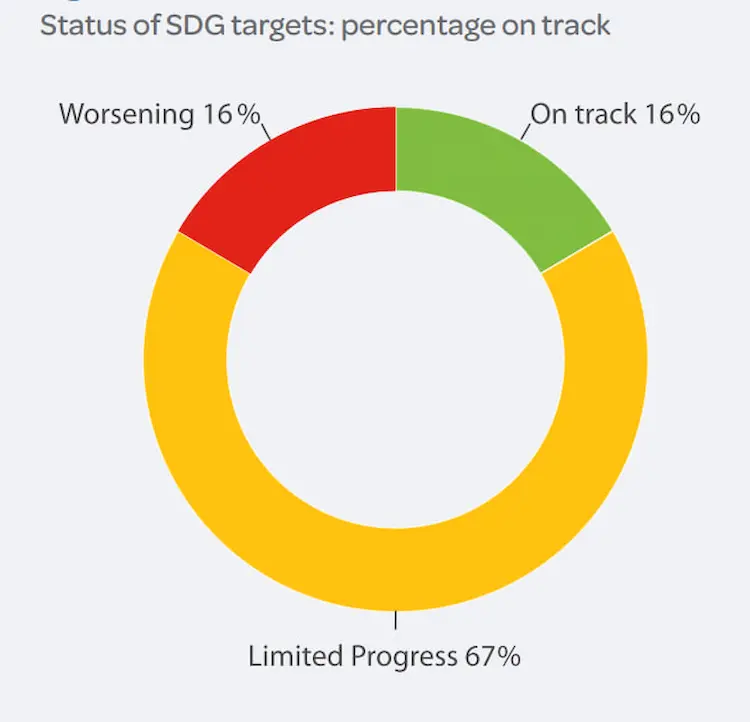
The scale of the assessment underlines its authority: the 2026 edition draws on nearly 250,000 individual data points to evaluate all 193 UN Member States across 123 indicators. For readers of New Polis, one conclusion deserves particular attention: cities have become the frontline of sustainable development.
Cities are no longer just participants
Many of today’s most pressing sustainability challenges- housing affordability, public transport, air quality, urban heat, waste management, energy efficiency, digital infrastructure, and social inclusion- are managed at the local level. Municipal governments increasingly determine whether sustainability policies succeed or fail.
This shift is reflected in the growing number of Voluntary Local Reviews (VLRs), which allow cities to measure and publicly report their progress. Local authorities are becoming active contributors rather than passive implementers of national strategies.
Global political support for the SDGs remains broad, although it is becoming increasingly polarized. According to the report, more than 170 of the 193 UN Member States supported every UN General Assembly resolution referring to sustainable development in 2025. The only two coGlobal political support for the SDGs remains broad, although it is becoming increasingly polarized.untries that systematically opposed the SDG framework were Argentina and the United States.
SDG 11 remains one of the biggest challenges
Perhaps the most striking finding for urban professionals is that SDG 11 (Sustainable Cities and Communities) remains among the goals furthest from achieving its targets. It is joined in this critical stagnation zone by SDG 14 (Life Below Water), SDG 15 (Life on Land), and SDG 16 (Peace, Justice and Strong Institutions).
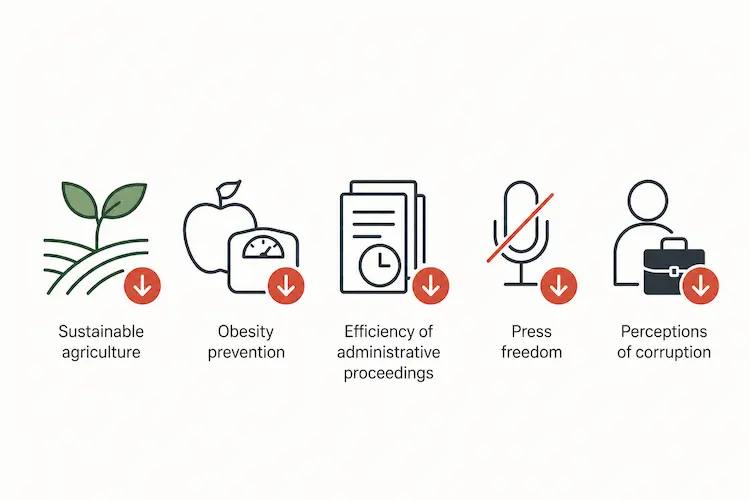
At the indicator level, progress remains particularly weak in:
- sustainable agriculture;
- obesity prevention;
- the efficiency of administrative proceedings;
- press freedom;
- perceptions of corruption.
These systemic bottlenecks mean cities are simultaneously facing multiple crises: accelerating climate change, increasingly frequent heatwaves, ageing infrastructure, housing shortages, demographic change, rising energy costs, and growing pressure on public services.
The report argues that cities must move beyond isolated pilot projects toward integrated urban transformation. Climate adaptation cannot be separated from transport planning, housing policy must incorporate energy efficiency, and digital innovation should directly support better governance.
Governance matters more than technology
One of the report’s most valuable observations is that technology alone cannot deliver sustainable development. Over the past decade, cities have invested heavily in digital platforms, sensors, smart mobility systems, and data infrastructure. Yet many urban challenges remain unresolved.
Effective institutions, transparent decision-making, long-term planning, and coordination across different levels of government consistently outperform technological innovation acting alone. A truly smart city is not simply one that deploys more sensors or artificial intelligence; it is one that makes evidence-based decisions through collaboration among government, academia, businesses, and civil society.
Science and data become strategic assets
In the 2026 SDSN survey of expert networks across 64 countries and the European Union, and over 1,000 respondents from 127 countries, three clear pillars were identified to accelerate progress: adequate financing, effective governance, and the strategic use of science and data.
At the same time, the report identifies several encouraging global trends:
- Mobile broadband subscriptions and internet use continue to expand rapidly;
- Electricity access is improving worldwide;
- Adolescent fertility rates and HIV infections continue to decline.
These indicators demonstrate that measurable progress remains possible when long-term investment and effective public policy reinforce one another. Data should no longer be viewed merely as a reporting requirement. Instead, it becomes strategic infrastructure for public administration, directly influencing how municipalities develop digital twins, urban observatories, GIS platforms, and open data initiatives.
Financing will determine success
Urban resilience requires long-term investments in transport networks, affordable housing, renewable energy, water infrastructure, digital connectivity, and public spaces. These capital-intensive projects often exceed municipal budgets and require partnerships with national governments, development banks, and private investors.
Delaying investment in climate adaptation only multiplies future economic losses. For city leaders, this means developing investment-ready projects supported by reliable data and transparent governance. Access to finance increasingly depends on the quality of project preparation as much as on the availability of funding.
Regional cooperation is becoming more important
Many sustainability challenges cross national borders, making continental and regional cooperation essential. The emphasis on cooperation is reinforced by the report’s Index of Countries’ Support for UN-based Multilateralism (UN-Mi). Barbados ranks first globally, reflecting its exceptional engagement with the UN system.
At the opposite end of the spectrum, the United States ranks dead last and stands out as a severe statistical outlier. According to Earth.Org, this rock-bottom ranking follows a series of disruptive foreign policy actions: under the current administration, the US has withdrawn from 66 international bodies, conventions, and treaties, including key climate frameworks. In total, the US voted with the international majority in just 5 percent of recorded UN General Assembly votes in 2025, with US officials openly stating that the 2030 Agenda represents a program of “soft global governance” inconsistent with their sovereignty.
This contrast illustrates how international cooperation itself has become an increasingly important dimension of sustainable development. This message is particularly relevant for Southeast Europe and the Western Balkans, where shared river basins, transport corridors, electricity markets, and ecosystems mean that cooperation on renewable energy or flood protection can generate benefits that individual countries would struggle to achieve independently.
Artificial intelligence needs better governance
Rather than focusing solely on the opportunities created by artificial intelligence, the authors call for the development of new global governance frameworks.
AI has enormous potential to improve urban planning, optimize transport systems, predict infrastructure failures, and enhance emergency response through digital twins and automated public services. However, without clear governance, these technologies introduce new risks related to privacy, cybersecurity, algorithmic bias, and public accountability. Digital transformation should always serve public value rather than technology for its own sake.
Unlike many technology reports that focus primarily on innovation, the SDR 2026 treats AI as a governance challenge. The question is no longer whether cities should adopt artificial intelligence, but how governments can ensure transparency, accountability, and public trust while deploying increasingly autonomous systems.
Lessons from the global leaders
Finland tops the 2026 global SDG Index, followed closely by Sweden and Denmark. Yet even these high-income leaders face major challenges and stagnation in Responsible Consumption and Production (SDG 12), Climate Action (SDG 13), Life Below Water (SDG 14), and Life on Land (SDG 15). Their performance demonstrates that advanced economies still struggle to reduce unsustainable consumption patterns and negative environmental spillover effects beyond their national borders.
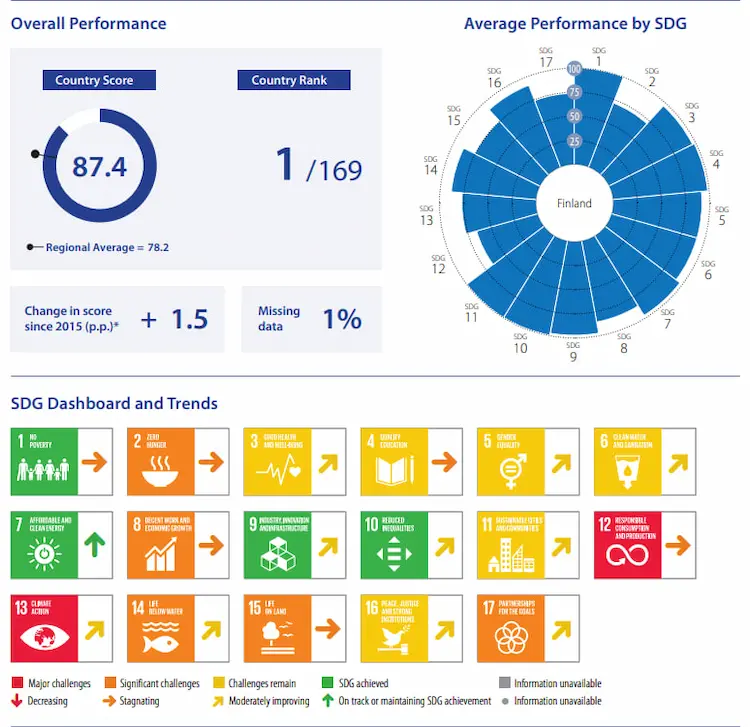
In contrast, East and South Asia have outperformed all other world regions in terms of overall SDG progress since 2015. Among major global economies, India has climbed 18 places, and China has risen by 14 places in the rankings. Their experience proves that sustained policy commitment and targeted infrastructure investments can produce measurable improvements even at a massive scale. Emerging economies are now actively shaping the global sustainability agenda.
From ambition to implementation
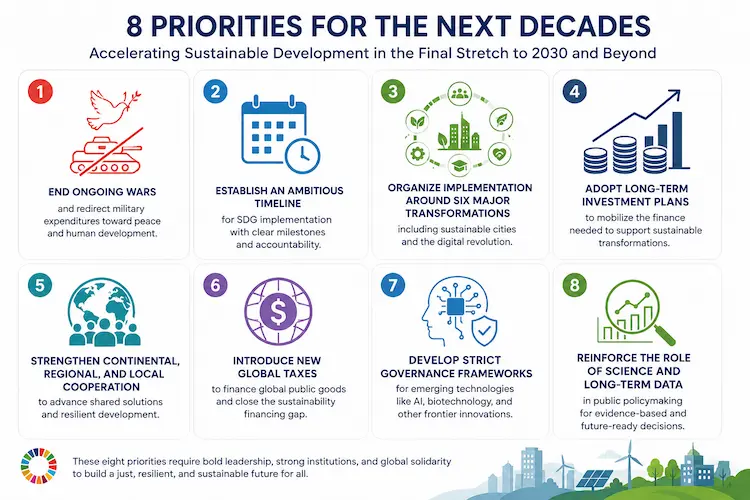
The central value of the Sustainable Development Report 2026 is its explicit shift from setting goals to executing them. The report identifies eight clear priorities for the coming decades to accelerate progress:
- End ongoing wars and redirect military expenditures toward peace and human development;
- Establish an ambitious timeline for SDG implementation;
- Organize implementation around six major transformations (including sustainable cities and the digital revolution);
- Adopt long-term investment plans to support these transformations;
- Strengthen continental, regional, and local cooperation;
- Introduce new global taxes to finance global public goods;
- Develop strict governance frameworks for emerging technologies like AI;
- Reinforce the role of science and long-term data in public policymaking.
Perhaps the most important conclusion is that the SDGs have entered a fundamentally different phase. During the past decade, success was measured by commitments and strategies. The next decade will be judged by implementation capacity. Cities able to combine strong governance, long-term investment, digital innovation, and regional cooperation will increasingly define whether the global sustainability agenda succeeds or fails.