
The global labor market is undergoing a fundamental transformation. According to the LinkedIn Global Green Skills Report 2025, job postings requiring green skills have increased by over 7.7% annually, while the talent pool has grown by only 4.3%. For a student today, choosing a sustainability career path is no longer just an ethical choice; it is a strategic move into one of the most resilient sectors of the 21st-century economy. As the report notes: “Green skills are now core business skills”.
Defining sustainability career path
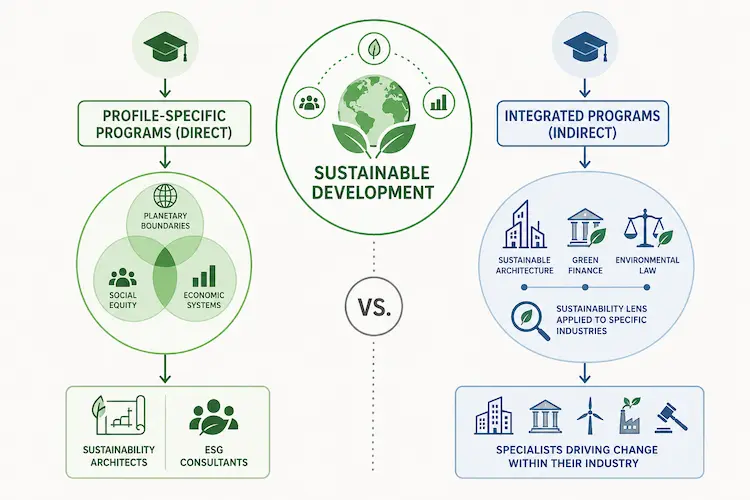
Before choosing a university, it is crucial to understand that “Sustainable Development” (SD) is not a single subject, but a multi-disciplinary framework. In the European and UK context, education in this field is generally split into two categories:
- Profile-Specific Programs (Direct): These degrees (e.g., BSc Sustainability Science) focus on the systemic nature of Sustainable Development. Students study the intersection of planetary boundaries, social equity, and economic systems. These are ideal for those who want to become “Sustainability Architects” or ESG (Environmental, Social, and Governance) consultants.
- Integrated Programs (Indirect): These are traditional degrees with a “sustainability lens” (e.g., Sustainable Architecture, Green Finance, or Environmental Law). These programs are designed for specialists who want to apply green principles within a specific industry.
The Difference: Direct programs offer the “big picture” along with systemic tools, whereas integrated programs provide “vertical expertise” in a certain domain. Choosing between them depends on whether you want to lead sustainability strategy or implement it within a technical field.
Market analytics: the numbers behind the degree
The growth of the green economy in Europe is closely tied to major policy frameworks such as the European Green Deal and the Circular Economy Action Plan. Recent data from the European Commissions suggests that the circular economy alone could create 700,000 new jobs across the EU by 2030.
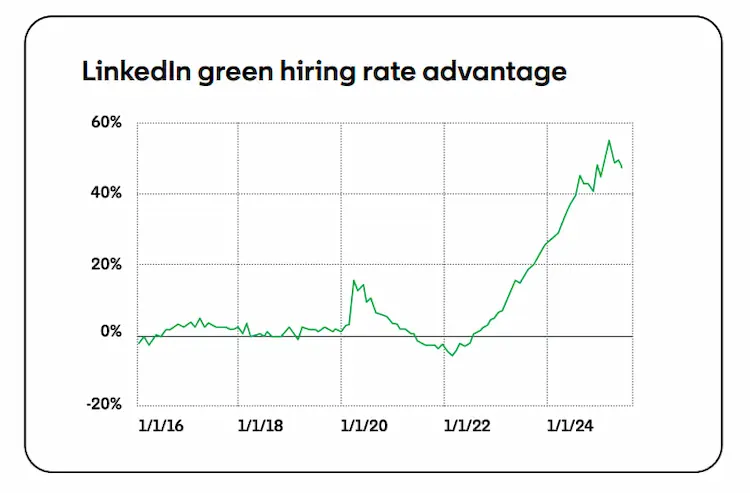
Hiring Premium: LinkedIn data shows that professionals with green skills are over 50% more likely to be hired, reflecting a significant talent gap in the labor market.
Growth Regions: This demand is particularly strong in countries such as the Netherlands, Sweden, Germany, and the United Kingdom, where sustainability education and green job markets are expanding in parallel with policy and investment frameworks. This alignment ensures that graduates find immediate opportunities in local innovation hubs.
Undergraduate level: building the foundation
Bachelor’s programs in Europe typically last 3 years (UK/most of EU) or 4 years (The Netherlands/ Scotland). At the undergraduate level, students typically navigate a choice between early specialization and broad entry pathways. This stage is less about professional certification and more about developing a “sustainability mindset,” the ability to see the world as a set of interconnected systems rather than isolated problems.

Defining the two pathways:
Broad Entry Pathways: These degrees focus on the “Triple Bottom Line” (social, environmental, and economic). They are ideal for students who want to keep their options open for future Master’s degrees in Law, Public Policy, or Corporate ESG.
Example of direct sustainability bachelor’s programs:
| University of Edinburgh | Sustainable Development (Hons) | Multidisciplinary Analysis of social, economic, and environmental systems to address global sustainability challenges. |
| Utrecht University | Global Sustainability Science | Natural and Social Sciences. Innovation, water management, and energy transition. |
| Lund University | Sustainability Studies in BA Economy and Society | Sustainability, business, and society: how they interact and how to create a more sustainable world. |
If your goal is to work in the public sector or NGOs, the University of Edinburgh offers a superior focus on policy. If you aim for the tech or energy sector, Utrecht provides better technical integration.
Early Specialization (Indirect Pathways) : These are “sector-specific” degrees. They integrate sustainability into a specific industry from the outset, preparing you for immediate entry into specialized labor markets such as green infrastructure or forest management.
Example of indirect pathway:
| University of Sussex | Climate Justice, Sustainability and Development | Policy & Equity: Explores the ethical dimensions of climate change and international development. |
|---|---|---|
| Universidad Carlos III de Madrid | Urban Sustainability Studies (Young Universities for the Future of Europe) | Smart Cities: Urban mobility and European collaboration. |
| University of Eastern Finland | Sustainable Forest Bioeconomy | Natural Capital: Forest ecology, remote sensing, and wood science. |
Programs like the one at Universidad Carlos III de Madrid are part of the Young Universities for the Future of Europe (YUFE) network. This model allows students to earn “virtual” and “physical” credits across multiple European campuses, providing valuable insight into diverse national regulatory frameworks. On the other hand, the University of Sussex leverages its world-class expertise in “Climate Justice.” Students here do not only engage with academic theory; they find themselves in an environment where social and legal advocacy are central to the green transition.
Level of postgraduate education: selecting your specialization
The Master’s degree is where the sustainability career path truly narrows into a professional trajectory. In Europe, most MSc courses today are considered “dual-sector” programs, meaning that they are jointly run by the faculties of science and business. For most high-level roles in the corporate or intergovernmental sectors, a Master’s degree is a mandatory requirement.
Core sustainability degrees:
| UCL (University College London) | MSc Sustainable Resources: Economics, Policy and Transitions | Focus on resource economics, policy, and transition. |
| ETH Zurich | MSc in Environmental Science | High-quality research on global systems. |
| Stockholm Resilience Centre | MSc Social-Ecological Resilience for Sustainable Development | Focus on “Resilience Thinking” to manage social-ecological systems. |
| Bocconi University | MSc in Transformative Sustainability | High-tier business focus; perfect for corporate ESG roles. |
| University of Cambridge | MPhil in Engineering for Sustainable Development | Technical innovation coupled with business leadership skills. |
Specialized tracks (indirect but highly relevant):
For those already enrolled in a degree or looking to “test the waters,” Summer Schools provide high-density networking and an immediate skill boost.
- Urban Sustainability: Erasmus University Rotterdam. MSc Urban Environment, Sustainability and Climate Change.
- Circular Economy & Industry: NTNU. MSc Industrial Ecology
- Systems & Interdisciplinary Science: Leuphana University. MSc Sustainability, Energy & Environment
Short-term intensive: summer schools
For those already enrolled in a degree or looking to “test the waters,” Summer Schools provide high-density networking.
- LSE Summer School (London): Climate Change: Economics, Policy and Strategy in an Age of Uncertainty. Best for understanding the financial mechanisms of the green transition.
- University of Copenhagen:Understanding Sustainability. A research-heavy program focusing on the practical measurement of the SDGs.
- Climate-KIC Journey: A two-week residential programme that prepares young professionals to lead climate innovation.
- Stockholm Resilience center offers different kinds of programs from Ms to independent courses.
- ETH Zurich: Summer Programs – Design Ideas for Sustainable Food Systems
It is essential to combine scientific knowledge with management pragmatism when pursuing a sustainability career path. Whether you choose a focused Bachelor’s degree in Sweden or a Master’s degree in London, the key is to ensure your skills align with the specific “Green Skills” currently in demand.
The graduates who will lead the world as we approach the 2030 SDG milestones are those who know how to translate environmental necessity into an economic strategy. Your choice of education is the first step in becoming that leader.
FAQ
1. What is the difference between “Direct” and “Indirect” sustainability degrees? It depends on your career goal. Direct degrees (e.g., BSc Sustainability Science) train “system architects”, strategists who understand how ecology, policy, and economy intersect. This is the ideal career path for future ESG consultants in terms of sustainability. Indirect degrees (e.g., Sustainable Architecture or Green Finance) are for those who want to remain specialists but master the “green” tools of their specific industry.
2. Is sustainability just a temporary trend or a stable career move? It is a fundamental economic shift. According to 2025-2026 market data, demand for green skills is growing at twice the rate of the supply of qualified graduates. New regulations, such as the EU’s CSRD, now require thousands of companies to hire experts for mandatory ESG reporting, making this one of the most resilient sectors in the global economy.
3. Do I need a strong background in science (Biology or Chemistry) to apply? Not necessarily. Sustainability is highly interdisciplinary. While some technical programs at institutions like ETH Zurich require a science foundation, many others at universities like Sussex or LSE focus on social sciences, law, and ethics. Most European universities value “systems thinking” over specific scientific prerequisites.
Read more about educational opportunities for the young here.