
Every year, global media publish lists of the world’s smartest cities. Rankings are released, mayors celebrate, and urban branding campaigns quickly adapt the results. Yet behind these headlines lies a more complex issue: the methodology of smart city rankings is far from uniform, and different indices often measure fundamentally different aspects of urban development.
In the latest edition of the IMD Smart City Index 2025, Zurich once again ranked first, followed by Oslo and Geneva. In the United States, the ProptechOS Smart City Index highlighted Atlanta as a leader in digital readiness. Within Germany, Munich retained the top position in the Bitkom Smart City Index. Each of these results is valid within its own framework. But taken together, they raise an important analytical question: are these rankings describing the same kind of “smartness,” or are they evaluating different models of urban performance?
Understanding smart city rankings methodology is essential not only for interpreting league tables, but for assessing how cities define progress, competitiveness, and quality of life in the digital era. Before accepting any city as “number one,” it is worth examining what, exactly, is being measured and why. We have previously explored similar questions in our analysis of urban sustainability rankings, where methodological choices likewise shaped outcomes and public perception. The same critical lens applies here.
What do we actually mean by a smart city?
The term “smart city” has circulated for more than two decades. Yet despite its popularity, it has never stabilized into a single definition.
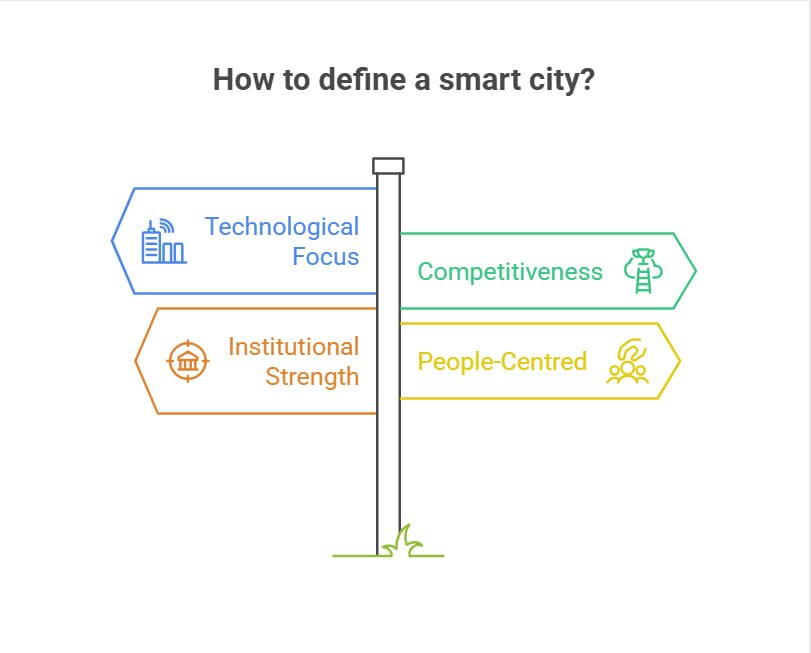
For some, smartness is primarily technological. It refers to sensors embedded in infrastructure, AI-driven traffic systems, predictive maintenance in utilities, and real-time urban dashboards. In this interpretation, the city is a system optimized through digital infrastructure. Efficiency is the core value.
For others, smartness is about competitiveness. Cities become smart when they attract tech firms, cultivate skilled labor, support innovation ecosystems, and integrate digital infrastructure into economic growth strategies. Here, connectivity is not an end in itself; it is a driver of global positioning.
A third perspective shifts the focus to governance capacity. A city is smart when its institutions can deploy digital tools effectively: when public services are accessible online, administrative processes are transparent, and regulatory frameworks keep pace with technological change.
And then there is the people-centred interpretation. A city is smart not because it has the most sensors, but because residents experience tangible improvements: easier access to services, safer mobility, more responsive governance, and higher trust.
These interpretations overlap. But they are not identical. And this is precisely where smart city rankings methodology begins to matter.
How smart city rankings methodology encodes different theories
If we look closely at major global smart city rankings, we see that they are not simply listing the same phenomenon in different orders. They are measuring different constructs.
This article focuses on four widely cited smart city indexes:
- IMD Smart City Index
- IESE Cities in Motion Index
- ProptechOS Smart City Index
- Bitkom Smart City Index
They were selected not as an exhaustive list, but because together they represent four distinct measurement logics: citizen perception, multidimensional systemic performance, digital infrastructure readiness, and municipal implementation. Other rankings exist, but these four illustrate structural differences in smart city measurement frameworks most clearly.
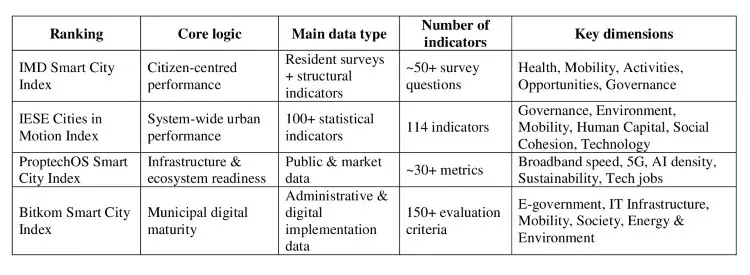
The IMD Smart City Index is built largely on resident surveys. It evaluates how people perceive digital services, governance, mobility, health, and opportunities. In 2025, housing affordability emerged as a concern even in high-performing cities, a reminder that technological sophistication does not automatically resolve social challenges. In this framework, smart city performance indicators are validated through lived experience.
The IESE Cities in Motion Index takes a broader systemic approach. It combines more than one hundred statistical indicators across governance, environment, mobility, human capital, social cohesion, and technology. Here, smartness is embedded in overall urban performance. Fast broadband alone does not secure a top position; consistency across domains does.
The ProptechOS Smart City Index emphasizes infrastructure and ecosystem readiness. It focuses on broadband performance, 5G availability, tech employment density, sustainability metrics, and innovation clusters. Cities such as Atlanta perform strongly because the ranking privileges digital competitiveness.
Meanwhile, the Bitkom Smart City Index evaluates municipal digital maturity within Germany. It assesses digital administration, IT infrastructure, mobility systems, and civic digital services. Munich’s leading position reflects implementation capacity rather than global perception or market scale.
It is worth noting that IMD and IESE operate globally, ProptechOS publishes regional lists, and Bitkom focuses exclusively on German cities. Scope, therefore, also shapes outcomes.
At first glance, these rankings seem to answer the same question. In reality, they are asking different ones.
Smart city index comparison: when rankings tell different stories
The differences become clearer when we compare the architecture of these rankings side by side.
Table 1. How major smart city rankings define and measure “smartness”.
And when we examine the actual leaders:
Table 2 Top 10 cities across major smart city rankings (2025)
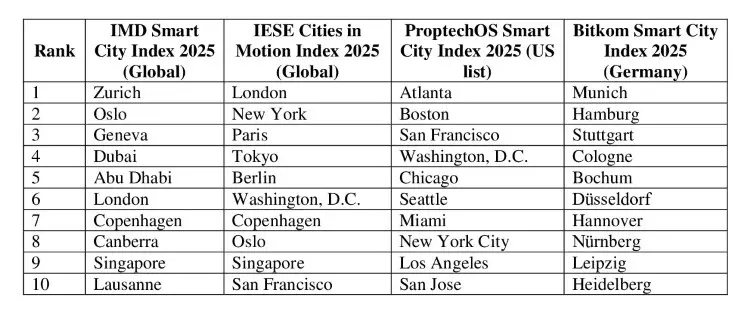
Even a quick glance at the smart city index comparison shows limited overlap among global leaders. The cities dominating perception-based rankings differ from those leading infrastructure-focused lists. The divergence is structural, not accidental.
Zurich performs strongly in perception-based models because residents report high institutional trust and service reliability. Atlanta, by contrast, stands out in infrastructure and tech-ecosystem metrics. Strong broadband speeds and digital industries support its ranking in infrastructure-oriented lists.
Tallinn is often cited for e-governance innovation. Barcelona is recognized for participatory platforms such as Decidim. Yet their positions vary depending on which smart city performance indicators are prioritized.
Change the theory of smartness, and the hierarchy changes with it. That does not make any ranking wrong. It makes them partial.
Where misinterpretation begins
Rankings themselves are not the problem. Misreading them is.
The first risk is assuming that smartness is a single universal variable. No ranking measures the entirety of urban intelligence.
The second risk is cross-ranking comparison without methodological awareness. A perception-based index and an infrastructure-driven index are not competing thermometers.
Third, year-to-year shifts may reflect methodological updates rather than real transformation. A city climbing five places may have benefited from changes in weighting or sampling rather than from policy breakthroughs.
Fourth, composite scores conceal trade-offs. Digital connectivity may compensate for weaker inclusion metrics in aggregated scores.
Finally, global comparability remains uneven. Differences in wealth, governance systems, and statistical capacity shape outcomes.
None of this invalidates global smart city rankings. But it demands interpretive caution.
What smart city rankings still offer
Used carefully, smart city rankings methodology can serve as a strategic tool.
They provide structured benchmarking. They shape policy agendas. They encourage institutional learning and improve data collection. They influence investment narratives and international visibility.
In short, rankings can function as diagnostic dashboards, provided they are not treated as trophies.
Beyond the league table
Smart city rankings do not reveal which city is objectively the smartest. They reveal how different institutions define smartness.
Is it digital infrastructure? Institutional maturity? Economic dynamism? Citizen trust? Each ranking answers one or two of these questions.
Technology alone does not make a city smart. Nor does a score. For city leaders, the real issue is not whether their city ranks first, but whether the ranking reflects the kind of urban future they are trying to build.
In the second part of the article, to be published next week, we examine how smart city rankings are calculated and where methodological choices shape outcomes.