Technology has become central to how cities are planned, managed and developed. Yet the growing sophistication of urban systems raises a fundamental question at the heart of the debate on human-centric smart cities: what are we actually trying to achieve? Efficiency, connectivity and economic growth matter, but they are not ends unto themselves. The real measure of a city’s success lies in the quality of life it offers, the relationships it fosters and the values that guide its development.
In an interview with New Polis, Corey Gray, President and Chair of Smart Cities Council, challenges some of the assumptions underpinning today’s smart city agenda. His diverse experience, spanning urban innovation, technology and the creative industries, informs a perspective that goes well beyond conventional approaches to smart cities. He reflects on what makes cities genuinely human, why governance and education often fall short, and how cities can retain control over their digital future.
Human-centric smart cities: beyond efficiency
At Smart City Expo World Congress in Barcelona, you questioned whether modern cities genuinely support human wellbeing. What do you see as the main shortcomings of today’s urban development model?
I think that’s an easy one. The crisis of the world we’re living in at the moment is the ongoing belief that operational and economic efficiency, and technological innovation will somehow provide us with a world that’s better, safer and more supportive.
It was Aldous Huxley in “The Perennial Philosophy” who, 80 years ago, spoke so eloquently to this species-level act of self-delusion, “Because technology advances, we fancy that we are making corresponding progress all along the line; because we have considerable power over inanimate nature, we are convinced that we are the self-sufficient masters of our fate and captains of our souls; and because cleverness has given us technology and power, we believe, in spite of all the evidence to the contrary, that we have only to go on being yet cleverer in a yet more systematic way to achieve social order, international peace and personal happiness.”
And I think, without a doubt, that nearly 60 years after Milton Friedman’s Capitalism and Freedom (and his Nobel Prize, which I consider the second most undeserved after Henry Kissinger’s) we still live in a world where people somehow believe in these ideas. And I think we fail citizens by treating them as parts of a machine, parts of an economy. We have this horrible term, human capital.
I find it so offensive. It’s like ethnic cleansing. It’s this terrible dehumanization of people into nothing more than their economic value.
I just find it terrible. The language we’ve created around modern economics and let’s call it post-industrial revolution society means that even the verb “to do” has come to mean “what you do to earn money”. We are so bizarrely preoccupied with how people earn money. And then tell ourselves: “If I just buy this new thing we’ll all become more operationally efficient and have more free time”.
But guess what? We’ve been telling ourselves this lie for 260 years since the Industrial Revolution began, and it hasn’t happened yet. We’ve sent men to the moon and created enough nuclear weapons to destroy all of humanity, but somehow, for all of our progress and god-like technologies, we’ve not succeeded in giving people back any time in their lives.
That time is always taken away and put somewhere else. So I think this idea that somehow technology and economic and operational efficiency will give us a better life has had its time and totally disproven itself. And we need to start designing cities and societies from the inside out and starting with people, not starting with money and things.
You also mentioned the demonstrations in Barcelona. We have seen growing public dissatisfaction in many places. Yeah, every year there is. But if you look around the world at the moment, you know, Czech is the latest place deeply dissatisfied with its government. We’ve seen what’s been going on, obviously, in America in a different way. We’ve seen it in France. We’ve seen in Italy. We’ve seen in Albania.
We have a planet that is at its elastic limit. Physics has a law, Hooke’s Law, which states the extension or compression of a spiral spring is directly proportional to the force applied, provided the elastic limit is not exceeded. And society’s elastic limit has been exceeded. There’s no more give and take. People are desperate, even in the West.
It’s the difference between the have and the have not that is the challenge, not the absolute amount of how much people have. It’s like electricity; voltage; it’s the potential difference that determines the magnitude of the energy created. The difference between the top and the bottom is the amount of social energy that’s created, and people are angry and upset, and they should be. In 2027 the UN estimates it would cost $93 billion to end world hunger. And we’re going to spend $160 billion building data centers, like I mentioned in my presentation, to store pornography.
Or Elon Musk could give 8% of his wealth away and make sure everyone on Earth is fed, but instead he’s trying to get people to Mars. None of it makes any sense.
Under the current system the vast majority of the economic and operational efficiency we’ve created serves to further concentrate the surplus wealth with a very small number of people. And we live right now in an environment where everyone in the world could be housed and fed, and we refuse to let it happen because of an ideological conviction to an outdated economic model predicated on artificial scarcity.
The debate on human-centric smart cities increasingly emphasises inclusion and wellbeing. Yet translating these principles into meaningful changes in urban governance remains a challenge. Where do you see the biggest gap between ambition and implementation?
So I think of all the challenges that we face, definitely governance is a big one. I think Winston Churchill said that democracy is the worst form of governance apart from all the others. Meaningful transformation of societies is a multi-generational process.
We’re talking 20, 40, 60, 100 years to change. If you think of South Africa coming out of apartheid, Germany coming out of the Second World War, or in fact all of Europe and Japan. The problem is we elect governments for three years, four years, maybe six.
But we’re asking politicians to make long-term decisions about their countries that are not in the best interest of their short-term career aspirations. It’s very hard to get meaningful investment into a 100-year plan. So that’s part of it.
The other part is, and it goes back to the start of the Industrial Revolution, and what I would describe as the vocational training system, not an education system. The idea was to train people to have skills to do a job to create value for someone. And they would get some of that value, but not a lot, a small amount.
We’re not educating people anymore. And so people in those positions of power quite often completely lack the skills to act competently and to understand the problems that they face. There’s this very interesting proposition called, they called Goodhart’s Law or Goodhart’s Effect.
Goodhart said, “When a measure becomes a target, it ceases to be a good measure”. And too many people in business and in government will point to a level of investment as if that somehow means that they’ve done good. Or they’ll point to some sort of quantified outcome or non-causal statistical relationship and hope that people assume that that means they’ve been successful.
Let me give you a secondary example; a manifestation of Goodhart’s Law. There’s a well-known, though not verified story from Delhi during British colonial rule, which has come to be known as the Cobra Effect. The story goes that there were increasing numbers of poisonous cobra snakes being attracted to the city in search of food, so the British authorities offered a reward for every dead snake handed in. The locals soon worked out that under the scheme they could make good money by breeding snakes to kill and hand in. When the British discovered what was happening, they immediately stopped paying the reward, with the effect being that the breeders immediately released the snakes into the streets as they no longer had any commercial value. The net result was that the streets of Delhi were infested with even more snakes than before.
That’s the Cobra Effect: when you try to solve a problem, but your proposed solution actually makes it worse.
This is the problem that we are experiencing in government: the Cobra Effect. Because they set numbers as targets, they become very bad ways to measure and track societal progress.
This is part of the overall challenge of government as an organisation. Part of it is the short lifecycle of government, and part of it is the way that government measures its performance.
Do you think improving education is an important part of addressing these problems in city government?
It is. But the challenge we have at the moment is that the education system is a business. And it’s a terrible business because it involves trading certificates to earn money, for money. We really do not have an education system. What we actually need is people who know how to work in groups, how to negotiate and compromise, and how to recognise when somebody is happy, sad, motivated, scared, nervous or confident. These are the things that make people actually successful when coordinating groups, managing teams and participating in teams. And we don’t teach it to anybody.
Today somebody leaves university qualified as an accountant or an engineer or a lawyer or an architect, but they can be a sociopath. They do not know how to work with a team to manifest that skill in a way that’s successful. They have no understanding of how to get people to buy into a team designing and delivering a solution. And the best skills in the world, poorly executed or not executed or not bought into get you nowhere.
What makes a city truly human?
Your career spans engineering, technology, investment, filmmaking and the arts. How have these different experiences influenced your understanding of what makes a city truly human-centric?
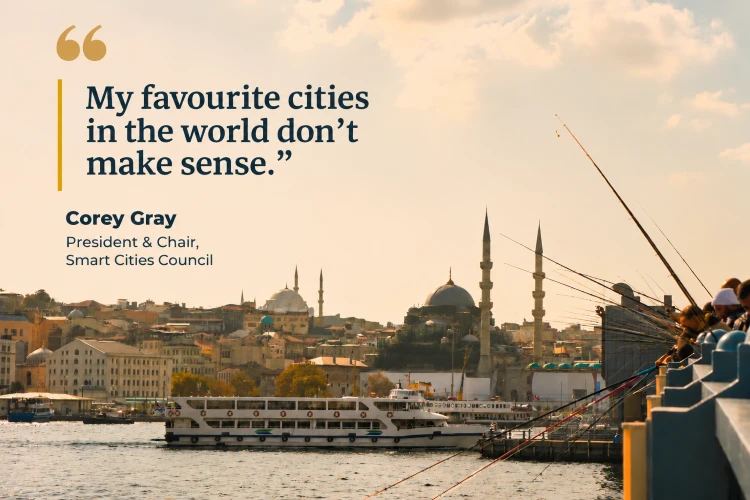
I often say that my favourite cities in the world don’t make sense. It’s a bit like when I was younger and I’d go out with a girl knowing full well that it was a crazy decision and that I’d probably end up getting hurt or damaged in some way. But I did it anyway.
I find Istanbul like that. I find Paris like that. I find Los Angeles like that. They’re crazy cities. And I’ve often say to myself: “Imagine if what inspired me about a city was how efficiently its bikeways worked or how clean its streets were, wouldn’t that be a strange thing”?
I’m totally in love with Istanbul, even though it makes no sense. With 21 million people, including, according to unofficial estimates I have encountered, as many as 4 million Syrian refugees, you know, there’s no homelessness problem in Istanbul. But in San Francisco, there’s a pandemic of homelessness in the richest city on Earth, where 80 people have more money than the five billion poorest on the planet.
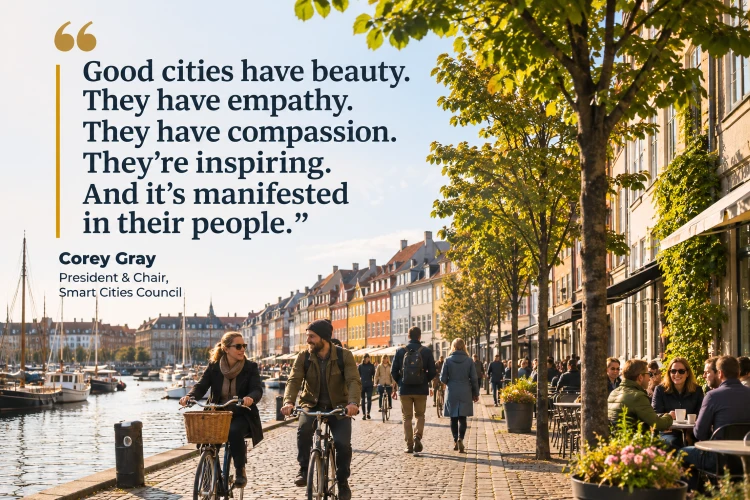
It is one of the most overrun cities with homeless in the world, and the reason is simple: no one cares. In America, I think it was Ronald Wright paraphrasing John Steinbeck who said “Socialism never took root in America because the poor see themselves not as an exploited proletariat, but as temporarily embarrassed millionaires.” And this is the narrative of the country. Good cities have beauty. They have empathy. They have compassion. They’re inspiring. And it’s manifested in their people. It’s manifested in the stories they tell about where they are and who they are in their art, in their architecture, in their food, in their music, in their fashion. But most of all, in what they do.
In Istanbul, there is no homelessness problem because if someone is unhoused, people take them in. That’s what they do. You know, in America, you step over them and say, try harder.
I go to Copenhagen once a year for the TM Forum event, and you see elderly citizens in that city go out and collect trash from the streets… because it’s their city. And if tourists come and leave trash, the locals pick it up because they’re proud of their city, they love their city and they want the best for their city. In other places, you see people throw the trash in the street because they don’t care.
In Singapore, my 16-year-old daughter could walk home at four in the morning. In Dubai, she can do the same because they’re cities where people take pride in the safety and wellbeing of their fellow citizens. Meanwhile these cities don’t foment all of this crazy nationalism, you know, keeping out refugees and foreigners. 89% of Emirati residents are foreigners, and they have orchestrated the entire social and economic miracle of the UAE over the last 51 years.
In Singapore and in Dubai, you can be proud of your culture and heritage and celebrate it publicly, yet have one shared national identity. People of wildly diverse cultural backgrounds come together proudly under the national flag, whilst still celebrating publicly their cultural history and all of that. It’s not binary.
You don’t have to choose. And that’s the one thing that I see, going back to your question; that successful human cities are places where humans come together. And the things that bring humans together aren’t data speeds and router locations and trash efficiency.
They’re the things I mentioned before, the ability to be with friends, laugh, sing, dance, eat nice food, be in a nice place, feel safe. And no one talks about it in smart cities. The prevailing voices are endlessly spruiking the next piece of tech, faster data and edge processing by AI. And I just get confused by it because that’s nothing that makes your life any better.
You mentioned Copenhagen and Singapore, two cities with very different systems of governance. How does that affect their ability to implement long-term urban development strategies?
Your point going back to governance, something that must be said is that the miracle of Singapore is largely to do with the leadership and vision of Lee Kuan Yew. But they have one other great advantage, which is they have one layer of government. If you want to coordinate a smart city initiative and you’re in America, you have four levels of government. You’ve got city level, county level, state level, federal level. That’s hard to do. If you want to do anything at scale, you’ve got to get four levels of government to agree and invest.
If you’re in China, you just do it. If you’re in Singapore, you just do it. If you’re in the United Arab Emirates, you just do it. In these places they don’t have this regular change of direction; start and stop: Obama, Trump, Biden, Trump. Trying to get a major project up across 4 layers of government with two Democrats and two Republicans ideologically opposed to one another and refusing to collaborate – and in a country that wants everything privatizes – is near-on impossible. Mohammed bin Salman, for whatever people think of him, says, “This is what we are doing for the next hundred years”, and that’s it. Decision made. No-one in Saudi talks about politics. No-one in the UAE talks about politics because there’s no point. There are no elections. It doesn’t happen. You either get with the program or you leave.
So these places with a ruling class, executive class and working class move slower, but their advantage is that they move in one constant direction for the long term. And unlike the American structure where the political investment in government is grifting and corruption, in kingdoms and emirates, leaders publicly invest their own money in their own country and then get other people to invest behind them. They have very clearly publicly disclosed skin in a long-term game.
Consequently, this engenders confidence in the international capital markets to invest and it gives foreigners to confidence to live there. Places like the UAE operate economic free zones that provide further confidence in the regulatory and legal framework.
Smart Cities Council: a changing mission
How has the role of Smart Cities Council evolved in recent years? What are its main strategic priorities today? Smart Cities Council has been expanding its international presence. What is driving this expansion, and which regions are your current priorities?
To answer that in two parts, I first came across Smart Cities Council in about 2018. At that time, a company I’d founded and was managing director of was expanding internationally from Australia into Europe, America and the subcontinent.
I joined Smart Cities Council in the US to meet people and build networks as we started our expansion. At that time, I think, speaking in direct terms, it was a private sector lobby group that had an event a year in DC to pitch to government, an event a year in Silicon Valley to showcase technology. And that was it.
So it was very American-centric, very pro-vendor. If you fast forward eight years, we’re a cross-sector organisation in six continents. We’re working very closely with government, NGOs, academia, and still with the private sector.
We’re engaging with capital markets and have established SCC Capital. We’ve set up Smart Cities Academy. We’ve set up Smart Cities Advisory and Smart Cities Marketplace. Anything that’s going to build capability and capacity to support on our mission statement of a creating a safer, more beautiful, inclusive, enabled, sustainable and resilient world for everyone, we’re doing. We’re not just saying, “Buy our bright, shiny things and the world will be a better place.”
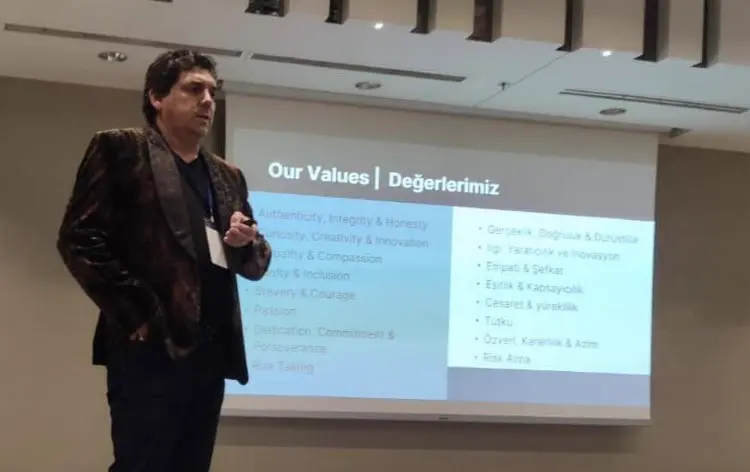
Going back to my comments earlier, which is this naive assumption that technology and capital make the world better; one of the first things I did when I sat down on the 1st of October 2022, having exited my former company to venture capital and having the opportunity to take this role, was look at our values. I read our vision statement.
I read our mission statement and then said, “Right, how do we do that?” And the key changes that we’ve made were to add “beautiful” into our vision statement that I mentioned earlier. “How do we make the world more beautiful?” At the end of it, we said “…for everyone”. Smart cities aren’t just for wealthy people in San Francisco or social media influencers in New York. After this the very next thing that I did was write a single word in my notebook, “Africa”.
If you’re serious about making a difference in the world, you have to ask yourself, “Where and how can I make the biggest impact”?
Africa is a continent of nearly 1.5 billion people in which the total fertility rate (TFR) is greater than three; where 600 million people don’t have electricity; where critical mineral resources have a potential estimated value of $350 trillion after processing, rather than as unprocessed reserves, and in this continent will reside 40% of the world’s population by 2100. Africa needs not just to be in the discussion, but to lead it.
And so, yeah, our organization has gone from being what I would call an elite private sector organization for lobbying to a democratized global organization that’s aiming to bring capability, capacity and cross-sector benefits to everyone everywhere.
What practical tools has Smart Cities Council developed to help cities improve urban development and quality of life?
I mentioned earlier that Smart Cities Council was very much an industry lobby group. Things that we’ve done that are making a difference include the Smart City Readiness Guide, which is a reference framework for cities, which has been downloaded hundreds of thousands of times. It provides the basic information for how to start a smart city journey that is people-centric and a new edition will be released in 2027. We are also launching the Smart Urban Readiness Assessment, which is an independent non-validated assessment of cities that, for the first time, includes wellbeing, healthspan index and nature in design indices. So, again, cities can use that and it provides outputs about, how and where to improve.
We established Smart Cities Academy to provide the critical knowledge, skills and training that we talked about before. We’ve set up Smart City Advisory and Marketplace, which independently validate organizations that can be trusted for cities to source solutions from. You know, it’s a very noisy, busy world and marketplace out there and cities really need help to identify the signal from the noise.
You have a lot of people wanting to sell things and often projects don’t progress because cities are confused or concerned about whether or not they can trust vendors or validate them. So, whilst we’re not directly involved in the project delivery that happens through our membership and partner base, what we are doing that I know is making a difference is creating the tools that allow cities to understand where they are and then access the knowledge, education and skills and solutions providers in a trusted environment that can allow them to design tender, construct, deliver and manage projects successfully.
We are also getting more cities and governments asking for us to have more direct involvement as that trusted intermediary. And we’re giving consideration to a structure where we become almost a trusted project coordinator for cities.
Technology, power and the public interest
Smart Cities Council brings together governments, technology companies and investors. How can cities ensure that private investment and innovation serve long-term public interests?
So, again, I like America, but it’s going to sound like I’m criticizing America a lot. I think standing around as President of the United States of America with the people who own AI and the three major cloud infrastructure providers that together account for roughly 63% of the cloud infrastructure services market and saying, “We don’t want to create a regulatory framework. This is going to be a trust-based process”, where Anthropic puts in its IPO document that some of their technology may be an existential threat to the world is obviously crazy. Imagine doing this with nuclear, or drug approvals, or cars and planes. It’s frankly nuts.
So, the answer is, and again, I’m probably sounding like some sort of Marxist in the minds of some people, but cities and governments need their own agency, and their primary interest is to represent and protect their citizens; to provide safety, security, agency and sustainability for citizens. So, handing over the keys of your city and citizens’ data to private sector is crazy.
I was invited last year to Paris to address the OECD at their fifth roundtable on smart cities. My session was at 4.30 p.m. so I’d heard all day all the cities and governments talk about how they’re buying more and more AI and trying to get bigger budgets. And I said to them, this is like being seven hours into hearing a bunch of heroin addicts taking turns to say how great their dealers are.
You know, I asked them, “What are you doing with this stuff? These people control you. They own you”. You know, Nvidia has a bigger market cap than the GDP of France. And France has a debt to GDP ratio approaching 120%.
Nvidia’s filings last week showed $53 billion of cash and cash equivalents and $32.0 billion of long term debt – mostly bonds. On October 8 their market cap hit $5.8 trillion. Their market cap is bigger than the GDP of Germany, the world’s third largest economy.
There’s this joke going around Silicon Valley that Oracle doesn’t have customers, it has hostages. To serve adequately the public interest, government needs to have control over the things that are critical to their citizens, and that includes their data; how that data is processed, how that data is accessed and how that data is secured. This fundamental role of government has slowly been taken away by the seduction of Big Tech saying, “We can make things simpler and easier for you”.
And all of a sudden, you live in a world where you can’t go outside anymore without a smartphone. You can’t just head out with a pocket full of cash, an ID card and a smile on your face and have fun for a day. Governments need to take back control of people’s data, their systems, their identities.
And I think we’re seeing a movement building; a push back against the mass rollout of data centers by hyperscalers, I hope so. It seems to be happening. There is growing awareness about the toxic nature of social media. Investment around data needs to come back and reside governments who can ensure sovereignty and protection of data.
We can’t just keep handing data and control over to seven mega companies in Silicon Valley.
As AI and digital twins become increasingly integrated into urban planning and management, which applications do you believe are most likely to deliver measurable public benefits?
The key processes that will be taken over by technology are the rudimentary convergent processes revolving around operational and economic efficiency: saving water, energy, traffic flow and parking optimization; waste management, information and data processing; things like certifications, permitting, approvals for buildings and the like.
All of these processes can be done literally a trillion times better and faster by AI agents than by people.
People will provide governance and oversight, and the divergent thinking – the creative processes – that add to life the part that feeds our human spirit; the beautiful things. Equally, humans will still need to select the data sets for agents and decide what questions to ask. We will need to provide the ethical and philosophical layers that will bind us.
A vision of the human city
Drawing on your diverse experience, what is the single most important change you believe we should make today to move closer to that vision?
For me an ideal city is one in which beauty, empathy, compassion, curiosity and inspiration are manifested by its people – in their place – with stories, art, architecture, food, music, fashion and, above all – their deeds.
In this realm of thought, and in the context of this question, I am often minded of a sentiment expressed by Aldous Huxley not long before he died,
“It’s a little embarrassing that, after forty-five years of research and study, the best advice I can give to people is to be a little kinder to each other.”
In the end, this is the single biggest difference that we can all make. There is little focus on it, because no VC can make a fortune out of it, and no politician will get elected for saying it, but it is self-evidently the beating heart of a thriving community.
It is also hard to deliver, because it involves courage and people taking time and expending significant effort in the building of trust – amongst citizens and between citizens and governments.
We all talk about culture as being “the difference” in thriving and successful groups – sports, business, cities – but almost no-one takes the time to understand what culture really is, or how it is created and sustained. In another interview recently I was asked about the best smart cities project I have seen, and with no hesitation I pointed to the “Go 25” project in Singapore.
What was it?
The Singaporean government asked citizens to adjust the thermostats on the air conditioners from 20 to 25 Celsius…
Not especially high-tech. No billions of dollars of investment, but guess what? In a country where the government has delivered incredible safety, education, healthcare and prosperity, her citizens just did it, with the net result of generating substantial energy savings and delivering huge environmental benefit.
This is a smart city.
Read also: As part of our coverage of Smart City Expo World Congress 2026, we spoke with Haruyo Fukuda, Director of Smart City Strategy at the Tokyo Metropolitan Government, about Tokyo’s approach to digital transformation and urban wellbeing.