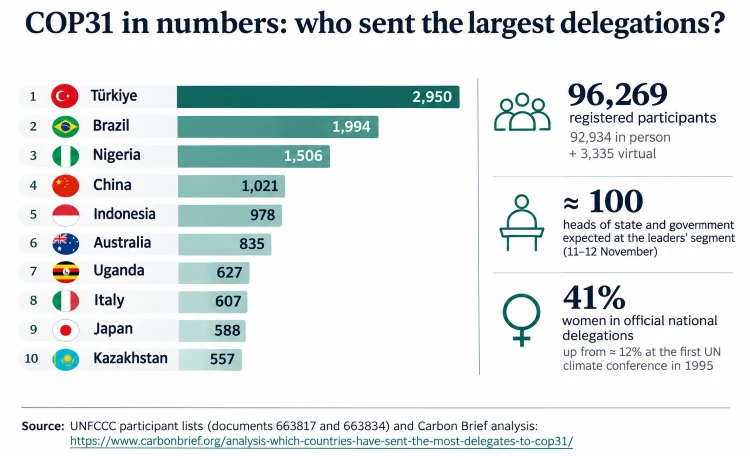
The UN Climate Change Conference in Antalya, Turkey, is setting a new record — at least on paper. According to UNFCCC registration data, COP31 participants include 92,934 people registered to attend COP31 in person, with another 3,335 signing up for virtual participation. If these numbers translate into actual attendance, the summit will surpass COP28 in Dubai, previously the largest climate conference in UN history.
But the impressive numbers conceal a striking contrast. While tens of thousands of government officials, experts, business representatives and activists have gathered in Antalya, many leaders of the world’s largest economies have stayed away.
The composition of COP31 offers an interesting picture of the current state of international climate diplomacy: participation continues to expand, but political engagement at the highest level remains uneven.
COP31 participants: the largest national delegations
An analysis by Carbon Brief, based on provisional UNFCCC participant lists, shows that host country Türkiye has registered the largest national delegation, with 2,950 people.
Brazil follows with 1,994 delegates, ahead of Nigeria (1,506), China (1,021) and Indonesia (978). Australia, Uganda, Italy, Japan and Kazakhstan complete the top ten. At the opposite end of the scale, North Korea has registered just two delegates, and Eritrea and Nicaragua three each.
These figures require some caution. National delegations may include representatives of non-governmental organisations, while some participants are registered under additional or overflow categories. A large delegation does not necessarily indicate greater political influence or stronger climate commitments.
The overall attendance figures also include far more than government negotiators. The provisional lists contain 3,645 media representatives and more than 12,000 delegates from non-governmental organisations. Another 14,285 participants are classified as host-country guests — an unusually large category compared with previous COPs. The final attendance figures will only be known after the conference, when the UNFCCC publishes data based on actual participation rather than registration.
More women at the negotiating table
Another revealing aspect of COP31 is the changing gender composition of national delegations. According to Carbon Brief’s analysis, women account for approximately 41% of registered national delegates, compared with 59% men. At the first UN climate conference in Berlin in 1995, women’s representation was around 12%.
The increase over three decades is substantial, although gender parity has yet to be achieved. Moreover, the current proportion is slightly lower than at the previous two climate conferences. The figures also describe participation rather than decision-making power. A more balanced delegation does not necessarily mean that women have an equal role in leading negotiations or shaping national positions.
The leaders who stayed away
The leaders’ summit on 11–12 November exposed a different kind of imbalance. Brazilian President Luiz Inácio Lula da Silva, Turkish President Recep Tayyip Erdoğan and British Prime Minister Andy Burnham were among the prominent participants. China was represented by Vice-President Han Zheng, while European Commission President Ursula von der Leyen also attended.
Yet several leaders of major economies were absent, including French President Emmanuel Macron, German Chancellor Friedrich Merz, Italian Prime Minister Giorgia Meloni, Indian Prime Minister Narendra Modi, Canadian Prime Minister Mark Carney and Japanese Prime Minister Sanae Takaichi.
The contrast is particularly striking because the G20 economies account for more than three-quarters of global greenhouse gas emissions. Former UN climate chief Yvo de Boer described the limited participation of major leaders as sending the wrong signal at a difficult time.
Still, attendance at a leaders’ summit is not the only measure of a country’s commitment. Climate negotiations are conducted largely by ministers, diplomats and technical experts, and governments can participate actively without sending their highest-ranking officials. The political symbolism nevertheless matters. COP conferences are not simply technical negotiations: they are also opportunities for national leaders to demonstrate that climate policy remains a priority alongside economic, security and geopolitical concerns.
The United States: absent officially, present politically
Perhaps the most unusual case is the United States. For the second consecutive year, Washington has not sent an official federal delegation to the UN climate conference. President Donald Trump’s administration has distanced itself from international climate cooperation. The United States withdrew from the Paris Agreement in January 2026 and has formally notified the UN of its intention to leave the UN Framework Convention on Climate Change in February 2027.
Yet American participation has not disappeared. A group of 18 Democratic members of the US House of Representatives travelled to Antalya, alongside other American political figures, including state and local leaders. Their presence followed the November midterm elections and was intended to maintain international contacts despite the federal administration’s position.
The congressional delegation, organised through the Sustainable Energy and Environment Coalition Institute, has been meeting international policymakers, businesses and civil society representatives. As The Guardian reported, the lawmakers travelled without the usual State Department assistance, relying instead on philanthropic support.
Their participation illustrates the fragmented nature of American climate policy. While the federal administration rejects the current international approach, other political actors continue to support cooperation on clean energy, climate finance and emissions reduction. American governors and mayors have also maintained a visible presence at COP31 through the America Is All In coalition, demonstrating how state and local governments can sustain international climate partnerships even when federal policy changes direction.
Does bigger mean more effective?
COP31 may set a new attendance record, but the more revealing figure could be the number of world leaders who chose not to attend. Nearly 100,000 registrations show that the climate agenda continues to attract enormous interest. Whether that interest translates into political will and meaningful agreements is another question. The answer will emerge not from the crowded conference halls in Antalya, but from the decisions made before delegates leave.
Next week, New Polis will take a closer look at the outcomes of COP31 and what they mean for global climate action.
Read about COP 30 here