
Energy & Investment Days 2026 will take place on 14–15 October at Novi Sad Fair, with the support of the Provincial Secretariat for Energy, Construction and Transport of the Government of Vojvodina. The programme of Energy & Investment Days brings together institutions, utilities, investors, technology companies and project developers from across the Western Balkans and beyond, with a strong focus on power grids, strategic energy infrastructure, investment and project development. An integral part of this year’s programme is the EUKI Final Conference, focused on energy communities, local partnerships and citizen participation. Together, these perspectives connect regional infrastructure and investment priorities with the local engagement needed to make the energy transition work in practice.
But the event also raises a broader question: what should a business event actually do today? With information available instantly online and the regional conference calendar increasingly crowded, putting speakers on a stage and companies in an exhibition hall is no longer enough. The real value lies in the connections, opportunities and follow-up an event can create before, during and after the event itself.
New Polis spoke with Lena Bratić, Senior Strategic Advisor to E3 International and founder of Balkan Energy Connect, and Slobodan Cvetković, General Director of Novi Sad Fair. As this year’s programme partners, E3 International and Balkan Energy Connect are working with Novi Sad Fair to strengthen the links between people, projects and business opportunities and to create value that continues beyond the event itself.
From their different perspectives, the two conversations explore how energy events can move beyond isolated panels toward stronger links between conference content, real projects and direct business conversations and how those connections can continue throughout the year.
Lena Bratić: Rethinking Energy & Investment Days
How would you describe the energy landscape in the Balkans today?
A lot is happening in the region right now. There is strong interest in renewables, but new investment is also putting more pressure on existing power systems and on the ability of networks to connect and integrate new generation. At the same time, major infrastructure needs, new technologies and growing attention to energy security are opening up new opportunities for regional cooperation and private investment.
You can see this very clearly in solar, battery storage and data centres. Investor interest can move quickly, while connection processes, network development and the infrastructure needed to support new capacity often take longer. There is also growing interest in how private capital and international partners — including U.S. companies, technology providers and investors — can help move infrastructure investment forward.
The challenge is that all of this is happening at the same time. Governments, utilities, investors, developers, financiers and technology companies are all trying to move projects forward, but they do not always move at the same pace. And because the region’s energy systems are so closely interconnected, many of these challenges — and opportunities — increasingly need to be looked at regionally, not only market by market.
Where do you see the main bottlenecks for energy investment in the region?
There are a few. Grid capacity and integration constraints are becoming much more important. Project preparation is often slow, permitting can still be difficult, and investors want more certainty.
But coordination is a big part of it too. We have grants, concessional finance, public-sector lending, technical assistance, commercial banks and investors. All of that exists. The problem is often getting the pieces to come together around a project at the right moment. A project may have an interested investor, for example, but still be waiting for a grid connection or permit. Another may be technically ready but not yet structured in a way that a commercial bank can finance.
Through our work with E3 International across the Western Balkans, we see this very clearly. Projects rarely slow down because of one single issue; more often, the technical, financial, institutional and commercial pieces are not aligned. A large part of the work is therefore connecting those pieces and keeping the right people engaged long enough for an opportunity to become an implementable project.
Energy Days has been part of the regional calendar for 15 years. What role do you see for the event today?
Information is no longer the scarce resource. People can watch presentations, read reports and follow industry news from anywhere. What is still difficult is getting access to the right people, the right projects and the right conversations at the right moment.
At almost every event, the same thing happens: the panel ends, people go for coffee, they start a useful conversation, and then somebody comes to bring them back because the next panel is starting. That tells you quite a lot. The conversation people do not want to interrupt is often where the real value begins.
So our idea is very simple: fewer panels, more conversations. But we want to take it one step further. The two days in Novi Sad are not the product in themselves; they are one moment in a 365-day process. We want strong speakers and serious discussions, but also real projects, targeted meetings, business introductions and, most importantly, follow-up after the event.
What does that 365-day approach look like in practice?
It means that matchmaking does not start when people walk into the venue and end when they leave. Before the event, we are identifying who should meet whom and around which projects or opportunities. During the event, we create space for those conversations. Afterwards, the important part is helping relevant people stay connected and continue the discussion where there is real potential.
That is also the logic behind Balkan Energy Connect. We are developing it as a year-round platform for project information, introductions and business connections across the Western Balkans. Energy & Investment Days is the physical meeting point, but the network should be active throughout the year.
There is also a regional dimension to this. Representatives of SET Trebinje and the Macedonian Energy Forum in Skopje will join us in Novi Sad this year to explore how established energy platforms in the region can work more closely together. Rather than competing for the same speakers, companies and participants, we see an opportunity to create greater continuity across the regional calendar — carrying relevant conversations, partnerships and project ideas from one gathering to the next. Over time, that continuity can help move regional dialogue beyond events themselves and contribute to a stronger pipeline of concrete projects and business opportunities.
What would make Energy & Investment Days 2026 a success for you?
For me, the answer is what happens afterwards. Did somebody meet a potential partner? Did a company find a project it wants to follow? Did an investor decide to continue a discussion? Did a conversation in Novi Sad lead to a meeting a month later somewhere else in the region? A successful event should not end when the lights go off. Ideally, that is when the most important part begins.
Slobodan Cvetković: What Should a Modern Fair Be?
Lena Bratić’s argument raises a larger question. If the value of a business event increasingly lies not only in what happens on stage, but in how it connects projects, people and opportunities before, during and after the event, what does that mean for the traditional trade fair itself?
For more than a century, Novi Sad Fair has been a meeting place for companies, institutions, producers and visitors from Serbia and abroad. But the way people in business connect, communicate and build partnerships has changed considerably. We asked Slobodan Cvetković, General Director of Novi Sad Fair, how fairs are adapting to those changes and why specialised partnerships are becoming an increasingly important part of that process.
Novi Sad Fair has been bringing people and businesses together for more than a century. What has changed most in what visitors and companies expect from a trade fair today?
A lot has changed. Trade fairs used to be one of the main places where companies could discover new products, meet suppliers and see what was happening in a particular industry. Today, much of that information is immediately available online.
What has not lost its value is direct contact. People still want to meet the person behind a company, see technology in practice, exchange ideas and talk face to face about possible cooperation.
The difference is that today they expect more from the time they spend at an event. They want an exhibition, but they also want relevant discussions, useful contacts and opportunities to develop new business. That changes the way we think about trade fairs.
So what should a modern trade fair offer beyond exhibition space?
It should create an environment where several things can happen at the same time. You can have an exhibition, a conference, a presentation of new technology, a business meeting and an informal conversation, all within the same event. That is one of the great advantages of a trade fair.
We have the infrastructure and experience to bring a large number of different stakeholders together in one place. The challenge today is to use that infrastructure in a way that responds to what a particular industry actually needs. That is why partnerships are becoming increasingly important.
Energy is a highly specialised sector. How do you build a credible programme around a subject that requires very specific technical and market knowledge?
A trade fair should not try to be an expert in every sector it brings together. Our expertise is in creating the platform: the venue, organisation, logistics, visibility and connections with the wider business community. When it comes to specialised content, it is important to work with partners who operate in that sector every day.
In the case of Energy & Investment Days, E3 International brings experience in the energy sector and project development, as well as an international perspective. Balkan Energy Connect brings a regional network of institutions, companies, investors and projects. New Polis contributes its media expertise and knowledge platform, while the Provincial Secretariat provides an important institutional link while the Provincial Secretariat provides important institutional and financial support as a sponsor of the event.
These partners help shape the programme, identify the issues that matter and bring relevant people into the discussion. I think this is a very natural model. The Fair provides the platform, while specialised partners help ensure that the content reflects what is actually happening in the sector.
Does this partnership model also change the way the programme itself is developed?
Yes, because the programme is no longer something separate from the rest of the event. Ideally, the conference programme, exhibitors, projects, business meetings and participants should all be connected.
If, for example, you have a discussion about electricity grids, it makes sense for the companies, institutions and system operators involved in that discussion to also be present in other parts of the event. The same applies to investment, new technologies or startups. That creates a much stronger event than simply placing a series of panels and an exhibition next to each other. The goal is to create connections between them.
Why is energy particularly well suited to this kind of format?
Because energy today touches almost every part of the economy. It involves the energy sector and public institutions, but also industry, agriculture, local governments, technology companies, banks and investors. Very few energy projects can be developed by a single actor.
That is why this sector works particularly well in a trade fair environment, where we can physically bring different communities together in one place. Vojvodina also has a strong industrial and agricultural base, so the connection between energy, technology, investment and economic development is particularly relevant here.
When people talk about the success of a trade fair, visitor numbers are often the main focus. Is that still the most important measure?
Visitor numbers are important, of course, but they do not tell the whole story. For business events, we increasingly need to look at the quality of participation as well.
Did companies meet relevant partners? Did a new collaboration begin? Did someone discover a technology, project or business opportunity they want to explore further? These outcomes are harder to measure immediately, but they are very important. A successful trade fair should create something that continues after the doors close.
Looking a few years ahead, what role would you like Novi Sad Fair to play?
I would like it to remain what it has always been at its core: a place where people and businesses meet. But it should continue developing the ways in which those meetings happen. Industries change, technology changes and expectations change.
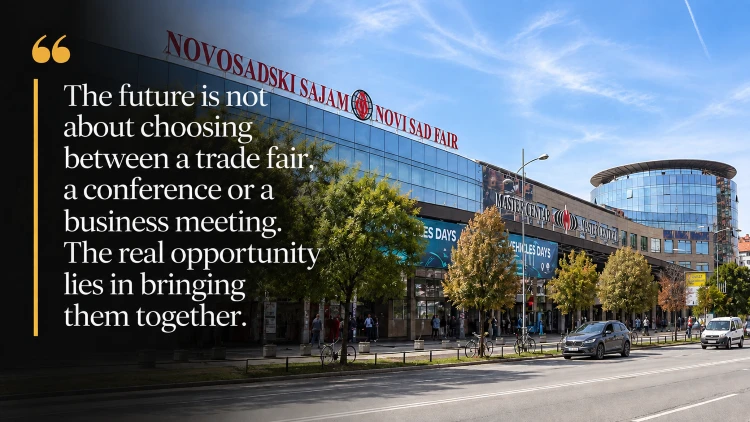
Our role is to provide a space and a platform where institutions, companies, ideas and opportunities can come together. If those encounters lead to new partnerships, projects and investments, then the Fair is doing exactly what it should be doing. That is why I believe the future is not about choosing between a trade fair, a conference or a business meeting. The real opportunity lies in bringing them together.
Read and watch other interviews here