
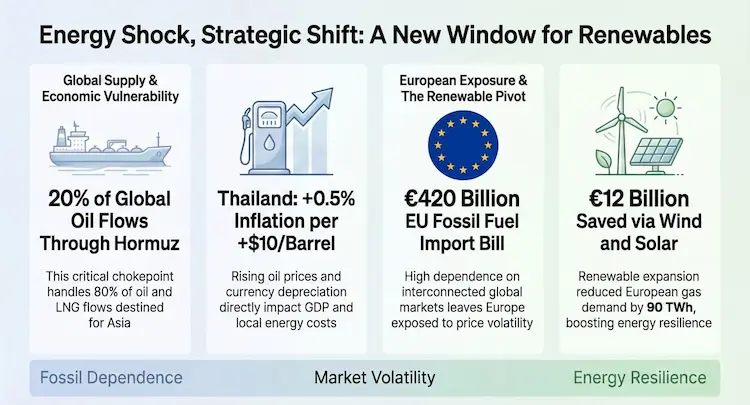
The latest escalation in the Middle East has once again exposed the structural fragility of global energy systems and raised urgent questions about energy security and renewable energy. Following large-scale strikes on Iranian facilities at the end of February, markets reacted immediately, with disruptions affecting prices, supply chains, and expectations across oil and gas markets. At the center of concern is the Strait of Hormuz, one of the world’s most critical energy chokepoints. According to the U.S. Energy Information Administration, roughly 20% of global petroleum liquids consumption passes through the strait, making any disruption immediate.
As tensions escalated, fuel shipments on both sides of the strait were disrupted, while Qatar’s LNG export infrastructure, the largest in the world, was forced to suspend operations. As a result, LNG prices in Asia rose to their highest levels since 2023. The risks are not limited to the region itself. As the International Energy Agency notes, disruptions in key transit routes can quickly affect global energy balances, particularly in gas and LNG markets.
Energy security and renewable energy: A global shock with an Asian epicenter
The immediate pressure point of the crisis lies in Asia. More than 80% of oil and LNG flows through the Strait of Hormuz are directed toward Asian markets, making the region structurally exposed to supply disruptions. This exposure has already translated into policy responses. Countries across Asia have begun assessing reserves and considering alternative supply options. According to Zero Carbon Analytics, Japan faces the highest risks due to its reliance on maritime imports, followed by South Korea, India, and China.
Recent infrastructure decisions add another layer to this picture. After the 2022 energy crisis, several Southeast Asian countries expanded LNG capacity. The Philippines and Vietnam launched their first import terminals in 2023, while Thailand increased LNG imports by around 40%. Across the region, total import capacity is expected to grow significantly in the coming year. These developments were intended to improve energy security. The current crisis suggests that they may also increase exposure to disruptions in global LNG markets.
LNG volatility and real-world consequences
LNG markets are often described as flexible; however, recent experience has shown how sensitive they are to price shifts and geopolitical events. During the 2022 energy crisis, cargoes were redirected toward Europe, contributing to shortages and power outages in countries such as Bangladesh and Pakistan. Even long-term contracts offer limited protection in such conditions. Bangladesh’s 15-year agreement with QatarEnergy, which entered into force in January 2026, has already been disrupted under force majeure conditions.
The economic impact is visible at the national level. Thailand, which imports around 80% of its crude oil, reported that rising oil prices contributed to a 0.15% decline in GDP. A $10 increase per barrel may push inflation up by around 0.5%, according to the National Economic and Social Development Council. As analysis by the Institute for Energy Economics and Financial Analysis shows, currency depreciation can further amplify these effects by increasing the local cost of energy imports.
From Asian disruption to European exposure
At first glance, Europe appears less directly exposed to the Strait of Hormuz than Asia. However, this is only partly true. Gas markets are interconnected, and supply disruptions in one region tend to affect prices elsewhere. This dynamic was clearly visible during the 2022 energy crisis and remains a defining feature of global gas markets.
This is where the current crisis becomes a European issue. Europe does not need to be directly affected by supply disruptions to feel their impact. Its reliance on imported fuels makes it highly sensitive to shifts in global markets and underlines the growing importance of renewable energy and energy security strategies.
Speaking at the Green Growth Summit in Brussels, Simon Stiell noted that the EU spent over €420 billion on fossil fuel imports in 2024. He warned that such dependence leaves economies, households, and businesses exposed to repeated cycles of price volatility and geopolitical disruption. Europe does not need to be directly affected by supply interruptions to feel their impact. Its reliance on imported fuels makes it sensitive to shifts in global markets.
Renewables reframed: from climate to security
In this context, the role of renewable energy is being reassessed. Increasingly, policymakers and analysts are linking energy security in Europe not only to supply diversification, but to long-term structural change. Analysis compiled by Green Central Banking shows that many experts see renewables, rather than LNG, as a key tool for reducing exposure to the consequences of the current crisis. The argument is increasingly framed in terms of risk. Renewable energy systems are not dependent on maritime routes or fuel imports, which reduces vulnerability to external shocks.
Recent European experience illustrates this point. After 2022, the expansion of wind and solar capacity helped reduce gas demand by around 90 TWh, contributing to estimated savings of €12 billion.Similar trends are emerging in Asia. In the Philippines, policy reforms, including renewable energy auctions and regulatory changes, have accelerated solar deployment and delayed some LNG projects.
Policy responses and market signals
Governments are responding on two levels. In the short term, countries such as Thailand and the Philippines are using subsidies, price controls, and other fiscal measures to limit the impact of rising energy costs. At the same time, longer-term policy signals are becoming clearer. For example, the United Kingdom has reaffirmed its plans to expand renewable energy, including support for small-scale solar installations for households.
These responses suggest a gradual shift in how energy security is understood, moving beyond supply diversification toward structural change.
Policy responses and market signals
Governments are responding on two levels. In the short term, countries such as Thailand and the Philippines are using subsidies, price controls, and other fiscal measures to limit the impact of rising energy costs. At the same time, longer-term policy signals are becoming clearer. For example, the United Kingdom has reaffirmed its plans to expand renewable energy, including support for small-scale solar installations for households.
These responses suggest a gradual shift in how energy security is understood, moving beyond supply diversification toward structural change.
A system in transition
The duration of the current conflict will determine the scale of its immediate impact. If disruptions persist and alternative supply routes cannot compensate for flows through the Strait of Hormuz, the consequences for global energy markets could be significant. At the same time, the broader direction is already visible. Repeated disruptions are highlighting the risks associated with dependence on imported fossil fuels.
For Europe, this creates a strategic question. As long as energy systems rely on external supplies, economic stability will remain sensitive to geopolitical developments. The transition to renewable energy, in this context, is not only about emissions reduction. It is also about reducing exposure to external risks and improving resilience. For Europe, energy security and renewable energy are no longer separate policy tracks, but part of the same strategic response to an increasingly volatile global system.