

This article about the China Transportation Digitalization is provided by our media partner 7ITSNEWS.
Standing at the threshold of 2026, contemplating transportation in 2036 holds significance far beyond predicting when autonomous driving will become widespread, how many AI agents will be embedded in “transportation brains,” or when drones will complete last-mile logistics. In the context of China transportation digitalization, the real challenge lies in this: when technology grants us near-supernatural ability to manipulate space, what kind of social structure will we build to match it? As Kevin Kelly pointed out in The Inevitable: Understanding the 12 Technological Forces That Will Shape Our Future, the future is defined by new platforms, not the linear expansion of today’s giants.
Over the next decade, transportation will no longer be a standalone industry; it will be integrated into other sectors. It will evolve into the “Spatial Intelligence Coordination Layer” underpinning the operation of Digital China. Its prospects will be collectively defined by three interconnected propositions.

Evolution of Goals: From Physical Movement to Spatiotemporal Synergy
The core thinking behind current transportation digitalization remains focused on “how to move people and goods from Point A to Point B more efficiently.” When autonomous driving and intelligent navigation theoretically push efficiency to its physical limits, what lies next as the source of value for transportation?
True disruption lies in redefining “Point A” and “Point B.” Current assumptions treat these as static points. Future systems will no longer view them as fixed geographical coordinates, but as “dynamic projections of value and demand in time and space.” The purpose of commuting won’t be “arriving at the company,” but “seamlessly accessing a work state.” The goal of logistics won’t be “moving cargo,” but “precise synchronization of supply chain rhythm.” Transportation will become deeply integrated with energy, information, and social networks, transforming into the “intelligent joint” that reorganizes urban functions and regulates societal rhythm.
This evolution carries a fundamental philosophical tension: global optimization demands near-omniscient monitoring, yet human civilization is rooted in free will and serendipitous discovery. What we ultimately need may be neither a highly centralized “transportation brain” monopolizing data, nor the complete marketization of personal data. Instead, we must pioneer a new ethic combining “framework regulation with flexible guidance.” This involves ensuring the system’s baseline through mandatory foundational safety protocols, then using well-designed, non-monetary incentives like “social contribution scores” to gently channel the autonomous choices of billions of individuals toward directions resonating with collective well-being—much like guiding the flow of water. The ambition behind this is to prove that hyper-efficiency and human-centric warmth are not a paradox.
Order Construction: Building the Next-Generation China Transportation Digitalization Foundation
In Western narratives, the future is often portrayed either as the “platform empires” of tech giants or a completely decentralized “digital utopia.” Our path might be a unique third way: drawing inspiration from the models of the “State Grid” and the “Stock Exchange” to construct a government-led, multi-stakeholder “National Unified Transportation Digital Operation Network (Nat-TransNet).” This network would fundamentally reshape the production relations of mobility and logistics, ushering in a new era of high-quality, intelligent transportation development through a series of viable, sustainable, and specific profit models.
Grid Attribute (Providing Foundational “Power”)
Unified Standards: Just as the grid provides stable 220V/50Hz electricity, it defines mandatory, unified data interfaces and communication protocols for all vehicles, roads, and orders. Any service provider can simply “plug in” via a standard interface to join and operate on the network.
Foundational Services: It supplies public transportation digital resources like real-time right-of-way status across the entire domain, high-precision map benchmarks, and authoritative identity authentication—the equivalent of the grid’s stable voltage.
Exchange Attribute (Organizing an Efficient “Market”)
Core Trading Objects: The core assets traded are “spatiotemporal resources” and “mobility services.” Priority access to roads, parking spots during specific time slots, or the commitment to transport a shipment—all can be standardized into digital products, traded and dispatched on a regulated marketplace.
Transparent Rules and Clearing: All transactions, from a single ride-hailing order to a 10,000-ton maritime shipment, occur under the network’s publicly transparent rules. The system provides automated, trusted clearing and settlement, eliminating commercial disputes.
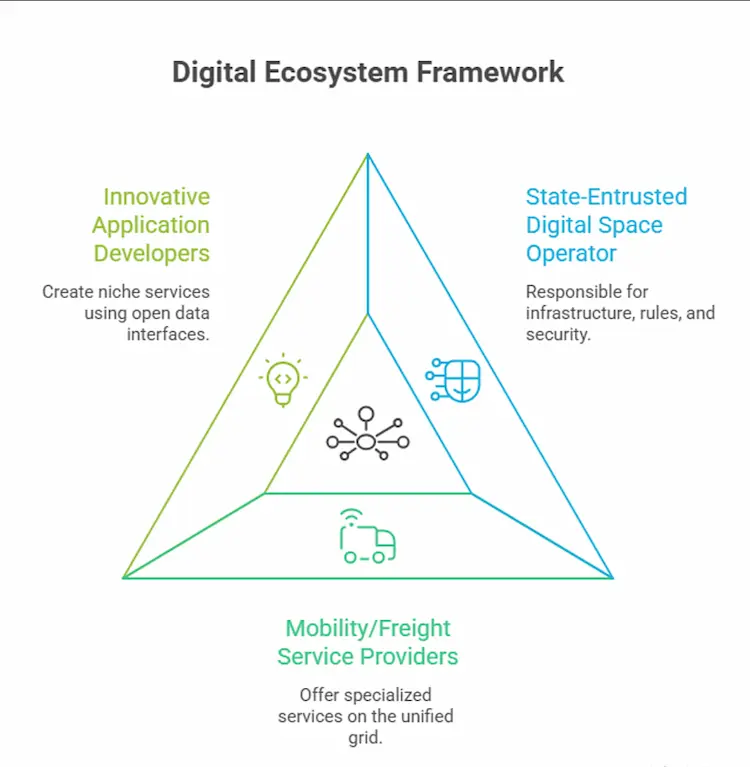
New Production Relations: Reshaping Roles and Fostering a Win-Win Ecosystem
Within this network, the roles of all participants will be reshaped:
- State-Entrusted Digital Space Operator: Playing the role analogous to the “State Grid Corporation,” responsible for the network’s physical and data infrastructure, core rule-making, and ensuring system security and fairness. It acts as a neutral “referee” and “foundational service provider,” not a participant in the specific competitive arena.
- Mobility/Freight Service Providers (Transformed Didi, Lalamove, etc.): Their role shifts from “platform masters” to “brand retailers” and “specialized contractors.” On the unified grid, they are free to develop distinctive “appliances” (service products). Within the unified exchange, they compete based on efficiency and service quality. They could be the “Dyson” offering premium, precise services, or the “Gree” ensuring essential public mobility.
- Innovative Application Developers (Countless SMEs): Leveraging open data interfaces and trading tools, they innovate in niche areas—think “mobile meeting rooms,” “pet-friendly dedicated rides,” or “mobile café service vehicles”—becoming the “vibrant cells” within the ecosystem.
Commercial Innovation: Reshaping the Value Ecosystem of Smart Transportation
Any grand vision requires solid, closed-loop commercial viability. Existing business models are essentially “traffic tolls” and “commission cuts,” inevitably leading to zero-sum games between platforms and governments (seeking public good), drivers (seeking fair income), and users (seeking low cost and high efficiency). Smart transportation demands a “revolution in production relations” that strikes at the core. The future profit model for transportation will shift from charging “tolls” to end-users (C-end) towards getting paid for the systemic value created for all parties involved.
Government Pays for “Governance Outcomes”: Fiscal spending shifts from “procuring hardware” to “purchasing service effectiveness.” For example, payment could be based on the quantifiable result of “a verifiable 15% reduction in commuting time within key zones.” This frees the government from complex project management, allowing it to focus on goal-setting and performance oversight.
Enterprises Pay for “Certainty” and “Insights”: A manufacturing giant might pay a premium for the guaranteed certainty of “precise 72-hour cross-provincial supply chain fulfillment.” A retail brand might subscribe annually for millions to access a “dynamic data map of urban commercial vitality” for precise site selection. Thus, transportation data transforms from a cost center into a core production factor driving upgrades across various industries.
Ecosystem Thrives on “Value Circulation”:” Novel digital assets facilitated by the state, like “transportation carbon inclusion credits,” would be circulated and traded among automakers, logistics companies, and insurers. The operator gains sustainable revenue by maintaining this value network. The clearing and settlement fees from a vast number of micro-transactions constitute the “lifeblood” ensuring the system’s stable operation.
Conclusion: Defining the Next Decade
Therefore, the true prospect of China’s transportation digitalization a decade from now is not the emergence of a globally dominant car manufacturer or algorithm company. Its ultimate achievement will be a “socio-technical coordination system” deeply rooted in China’s institutions and culture, capable of simultaneously managing scale and complexity. It will be a diverse yet orderly mobility service market, supported by a “unified national digital transportation infrastructure.” No single company will monopolize all data, mobility, or users. Through a meticulously designed system of “rules + incentives,” the government will conduct this symphony, enabling state-owned “anchors,” transformed platform “mainstays,” and innovative “sources of vitality” to play their parts in harmony. A company’s success will no longer depend solely on capital scale or market share, but on its intelligence, efficiency, and level of innovation in serving the public good.
This system will demonstrate that the greatest efficiency gains no longer come from faster engines, but from superior coordination rules. The most crucial infrastructure will no longer be concrete and steel, but trustworthy data circulation networks. The ultimate competitive edge will be designing a new operational paradigm for a complex society with billions of nodes and rapidly changing demands—a paradigm that achieves macro-level order while granting individuals a profound sense of freedom.
This is no longer just a competition within the transportation sector. It is a profound exploration of how to govern modern civilization itself. Ultimately, the trajectory of China transportation digitalization will define not only mobility systems, but also the institutional logic of coordination, efficiency, and human-centered technological progress.
Author: Huang Zhen
Source: A Decade Ahead: Where Will China’s Transportation Digitalization Head by 2036?| 7ITSNEWS| Huang Zhen
Read more about accelerating digital mobility investments here.
Read more about sustainable urbanization here.