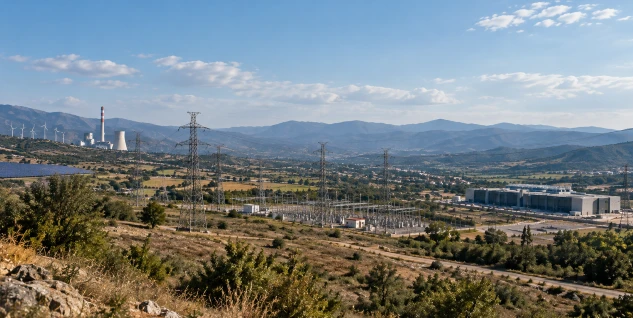

Air pollution in Serbian cities has become one of the most serious environmental and public health challenges in Southeast Europe. Accelerated urbanization, industrial activity, traffic-related air pollution, and the widespread use of solid fuels for household heating have significantly degraded urban air quality in Serbia. As a result, air pollution today affects not only environmental sustainability but also population health, economic productivity, and social equity across Serbian cities, particularly during winter smog episodes.
The contemporary development of society, accompanied by intensive resource use and energy consumption, has exceeded the self-regulatory capacity of natural systems. In the context of the Anthropocene, human activity has become the dominant driver of changes in atmospheric composition. This makes systematic environmental monitoring essential for understanding pollution sources, exposure pathways, and health effects of air pollution in urban environments.
What causes air pollution in Serbian cities?
Urban air pollution in Serbia is driven by a combination of structural and seasonal factors. The dominant sources include traffic emissions, industrial and energy facilities, and individual household heating. Each of these sources contributes differently to the chemical composition of urban air, producing a complex mixture of primary and secondary pollutants.
Traffic-related air pollution is a major source of nitrogen dioxide (NO₂), fine particulate matter (PM₂․₅), benzene, and black carbon, particularly along major road corridors in cities such as Belgrade and Novi Sad. Industrial and energy facilities contribute sulfur dioxide (SO₂), PM₁₀, and potentially toxic elements (PTEs), while household heating, especially the use of coal and wood, remains the leading cause of winter smog in Serbia.
How does air pollution in Serbian cities change the composition of PM₂․₅ and PM₁₀?
In relatively clean conditions, particulate matter contains mainly mineral and biogenic components. However, under polluted conditions, PM₂․₅ and PM₁₀ particles become carriers of toxic substances, including sulfates, nitrates, PTEs, polycyclic aromatic hydrocarbons (PAHs), and black carbon.
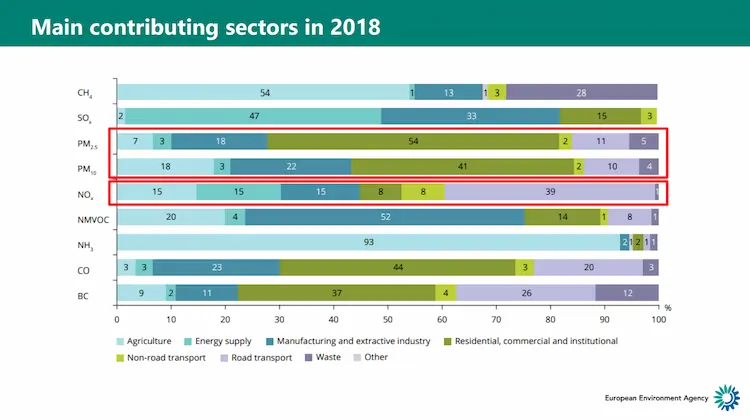
Sulfur dioxide emissions from coal combustion oxidize in the atmosphere and form sulfates that bind to fine particles. Nitrogen dioxide from traffic contributes to nitrate formation and ground-level ozone. This altered chemical composition significantly increases the toxicity of particulate matter and explains why PM₂․₅ pollution in Serbian cities poses particularly severe health risks.
Which Serbian cities suffer most from air pollution?
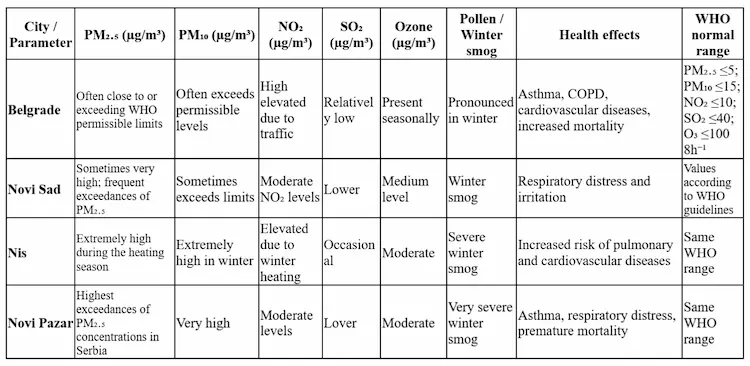
Monitoring data consistently show that urban air quality in Serbia varies by geography, socio-economic conditions, and dominant emission sources.
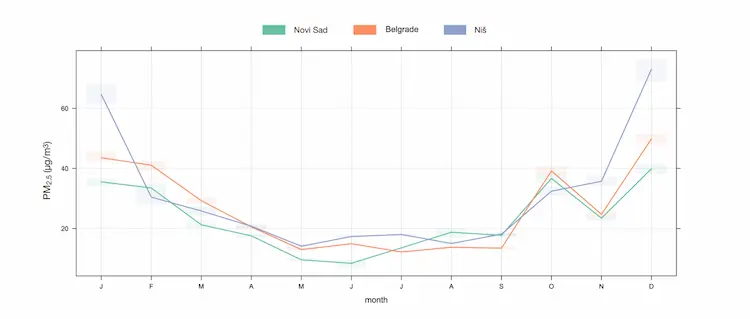
Source Trends in Air Quality and Health in the Republic of Serbia. 2022.
- Belgrade experiences high NO₂ concentrations along traffic corridors and elevated PM₂․₅ levels during the heating season. Summer episodes of ground-level ozone are also common.
- Novi Sad reflects the combined impacts of traffic and industry, with seasonal overlap between air pollution and pollen exposure.
- Niš, due to its basin-like topography, frequently experiences prolonged winter pollution episodes.
- Novi Pazar records some of the highest PM₂․₅ concentrations in Serbia, driven primarily by household heating and energy poverty.
Cities such as Valjevo, Užice, and Kragujevac are also regularly affected by winter smog in Serbia, with significant socio-economic consequences.
How does air pollution in Serbian cities affect human health?
The health effects of air pollution are well documented through epidemiological and monitoring studies. Fine particulate matter and nitrogen dioxide penetrate deep into the respiratory system, triggering inflammation and systemic effects.
Health impacts include:
- increased rates of cardiovascular diseases (heart attacks and strokes),
- higher incidence of asthma and chronic obstructive pulmonary disease (COPD),
- elevated lung cancer risk,
- premature mortality, particularly among vulnerable groups.
Children, older adults, and people with pre-existing conditions are disproportionately affected, reinforcing health inequalities in polluted urban areas.
More information about the effects of air pollution on health in general and on dementia risk can be read here and here.
Why are PM₂․₅ and NO₂ the most dangerous pollutants in Serbian cities?
Among all pollutants, PM₂․₅ and NO₂ consistently show the strongest association with adverse health outcomes. PM₂․₅ particles can enter the bloodstream, while NO₂ acts as a strong respiratory irritant and a marker of traffic-related air pollution.
Their combined presence intensifies health risks, especially during winter smog episodes when atmospheric dispersion is limited. Studies for Belgrade, Novi Sad, and Niš confirm that PM₂․₅ contributes more to total mortality than any other single air pollutant.
How can air pollution in Serbian cities be reduced sustainably?
Reducing air pollution in Serbian cities requires both short-term and long-term measures.
Short-term factors such as wind, precipitation, and the end of the heating season can temporarily improve air quality, but they do not address structural causes.
Long-term sustainable solutions include:
- replacing individual household heating with cleaner energy systems,
- addressing energy poverty through targeted subsidies,
- electrifying public transport and reducing car dependency,
- improving urban planning through green corridors and ventilation pathways,
- strengthening air quality monitoring systems at national and local levels.
Experiences from other European cities demonstrate that integrated policies can significantly improve urban air quality in Serbia over time.
More about solutions for reducing air pollution can be found here.
In conclusion, air pollution in Serbian cities represents a multidimensional challenge that extends beyond environmental degradation to public health, economic resilience, and urban governance. Persistent exposure to particulate matter, nitrogen dioxide, sulfur dioxide, ground-level ozone, and their interaction with biological agents such as pollen creates cumulative and long-term risks for urban populations. Only a systemic transformation of energy use, transport systems, and urban planning, supported by robust monitoring and socially just policies, can ensure cleaner air, healthier communities, and sustainable urban development across Serbia.