
The article about AI-powered intelligent transportation is provided by our media partner 7ITSNews.
The transportation sector, with its diverse scenarios and rich data resources, holds unique advantages as a key area for deepening the application of artificial intelligence. Today, AI-powered intelligent transportation is becoming central to how cities rethink mobility, efficiency, and public services.
Based on its urban development strategy, Changzhou has selected representative scenarios as breakthrough points to accelerate the implementation of “AI+” applications in transportation, using real-world needs to drive the integration of AI technologies into everyday mobility systems.
Urban public transportation, as a public service ensuring residents’ daily travel, plays a critical role in urban development and people’s livelihoods. This is where intelligent transportation systems move from concept to lived experience.
AI-driven public transport: the cloud bus model
“Try the ‘Cloud Bus’—it’s really convenient.” On December 26, 2025, the “Regional Cloud Bus” in Menghe Town marked its first full month of operation. Ms. Ding, a resident of Yinqiao Village, used the service 66 times for her daily commute.
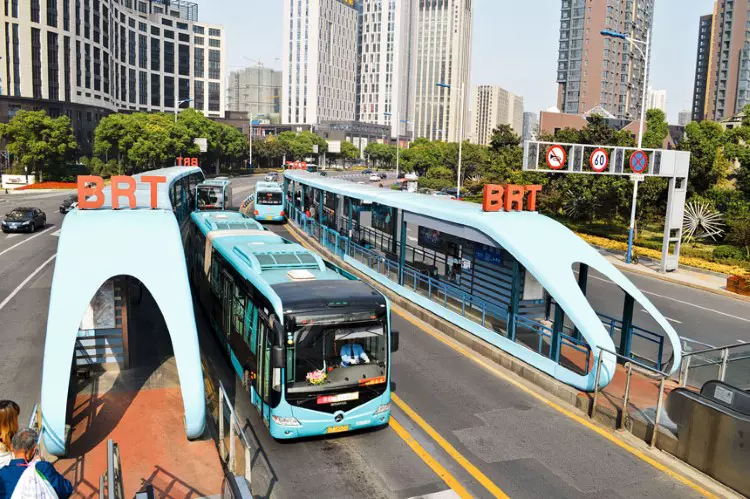
The “Regional Cloud Bus” breaks away from traditional fixed-route operations by integrating existing stops with flexible virtual ones, shifting “from lines to surfaces.” Small five-seater vehicles provide AI-driven public transport services based on real-time demand and optimal routing.
In its first month, the service completed 3,781 orders, transporting 5,574 passengers. Average waiting time dropped to 339.5 seconds, with the shortest wait just three seconds. Through intelligent ride pooling, the system reduced unnecessary mileage by 3,452.7 kilometers.
Behind this performance lies the “Public Transportation Digital Brain,” which integrates public transit data with large-scale online travel data to enable route optimization, passenger flow analysis, and intelligent dispatching. Supported by AI simulation tools, Changzhou Public Transportation was able to model outcomes before deployment, significantly reducing implementation risk.
By replacing fixed schedules with demand response and large buses with smaller vehicles, AI-powered intelligent transportation has reshaped traditional rural and suburban bus operations, offering a replicable model for towns and villages nationwide.
Smart mobility solutions beyond buses: tolling and system governance
In Changzhou, smart mobility solutions extend far beyond public transport. In late November 2024, the Wujing Economic Development Zone Toll Station introduced a new “Quasi-Free Flow + Cloud Tolling” model, becoming the first municipally managed expressway station to complete a full smart toll renovation.
Using AI-enabled vehicle recognition, cloud-edge collaboration, and pre-deduction transactions, the system reduced ETC transaction time from 350 milliseconds to under 30 milliseconds, with a success rate exceeding 99.9%. Traffic efficiency improved by approximately 80%.
For non-ETC vehicles, self-service card dispensers, payment robots, and AI-based license plate recognition shortened entry and exit times by 10–20%. A cloud-based management booth now allows staff to remotely handle special cases across multiple lanes, reducing on-site manual intervention by about 33%.
These applications demonstrate how AI-powered intelligent transportation supports not only efficiency, but also governance, safety, and service quality.
Toward a “Smooth Changzhou” transportation system
In September, the Municipal Transportation Bureau released the Implementation Plan for Demonstrating “Transportation + Artificial Intelligence” Scenarios in Changzhou (2025–2027), identifying ten pilot scenarios across highways, ports, railways, law enforcement, and public transport.
Early deployment and rapid implementation are now shaping a new governance model characterized by precision, efficiency, and intelligent collaboration. Looking ahead, Changzhou aims to foster a virtuous cycle of “scenario supply—technological innovation—industrial clustering,” further deepening the integration of artificial intelligence and transportation.
By advancing intelligent transportation systems and people-centered design, Changzhou continues to refine its “Smooth City” vision—ensuring that residents directly benefit from the evolution of smart mobility.
Source: AI Empowers Intelligent Transportation to Build a New “Smooth Changzhou” System | 7ITS NEWS
Read more about AI in cities here and about smart and sustainable transportation here and here