
Across the globe, cities are growing at unprecedented speed. According to the World Bank Group, by 2050, nearly 70% of the world’s population is expected to live in urban areas, presenting enormous challenges in mobility, energy, housing, and governance. To cope with these pressures, the concept of the “smart city” has emerged—an urban model that uses data and technology to create more sustainable and efficient systems. Among these technologies, AI in smart cities stands out as the most transformative. It enables cities not only to collect and process data but also to make predictions, optimize services, and design adaptive systems. This article examines the various ways artificial intelligence can be integrated into cities to support the achievement of smart city goals.
Urban mobility and transport
Congestion and pollution are two of the most visible urban problems. Traditional traffic management struggles to keep up with rising demand, but AI offers a smarter alternative. Predictive algorithms can analyze real-time data from cameras, sensors, and GPS devices to adjust traffic lights dynamically, reducing waiting times. Singapore is a leading example, where adaptive AI systems have helped cut traffic delays significantly.
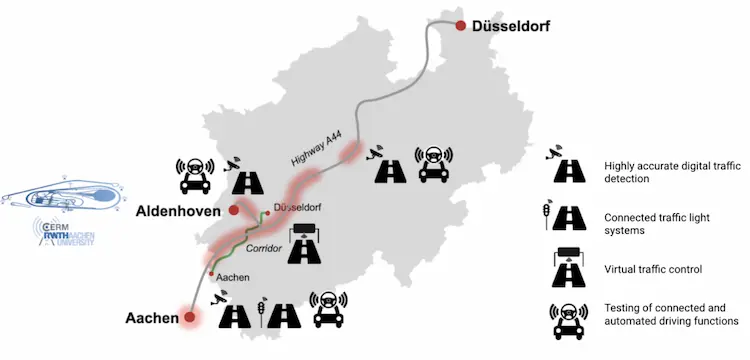
One of the most promising implementations is underway in the Aachen–Düsseldorf corridor in Western Germany. As part of the “Corridor of New Mobility,” researchers have equipped a 4.3 km urban stretch with over 100 lidar units and 200 high-resolution cameras. The system feeds live data into a digital twin that simulates road usage and traffic behavior, enabling proactive management. If congestion builds, the digital twin can simulate interventions—rerouting traffic, adjusting lights, or deploying warnings—before gridlock forms. Notably, the project is fully compliant with GDPR. All user data is anonymized, emphasizing that digital transformation in traffic data doesn’t have to come at the cost of privacy. Similarly, Barcelona’s Smart Mobility Plan has introduced adaptive traffic lights that respond to real-time conditions, aiming to reduce congestion and improve journey times.
Public transport also benefits. AI tools analyze passenger flows, ensuring buses or trains are dispatched where and when demand peaks. This avoids overcrowding and optimizes resources.
Energy efficiency and smart grids
Sustainability is a cornerstone of smart city strategies, and AI is critical in managing energy use. Smart grids powered by AI can forecast energy demand, balancing supply while integrating renewable sources like solar and wind more effectively. This reduces waste and helps stabilize the grid in real time.
On the building scale, AI can detect inefficiencies in heating, cooling, and lighting systems. Google’s DeepMind famously reduced energy used for data center cooling by 40% through AI optimization. Applied citywide, similar systems could cut urban carbon footprints dramatically. At a district level, AI simulations help design energy-positive neighborhoods, testing how different building orientations, insulation types, or solar panels will perform before construction begins.
Urban resilience and safety
Cities must also be resilient against disasters and emergencies. AI enables predictive risk management by analyzing vast amounts of satellite and climate data to forecast floods, wildfires, or earthquakes. For example, flood-prediction AI models are now used in parts of Southeast Asia, giving residents and authorities more time to prepare. In Jakarta, the city’s “JAKI” platform integrates AI flood forecasting with mobile alerts, providing residents with advance warning. Similarly, in India’s Pimpri-Chinchwad, a 2025 partnership with C-DAC introduced a flood early-warning system that delivers 72-hour neighborhood-level forecasts. Google has also scaled its global flood forecasting model, offering multi-day lead times across major river basins worldwide.
Emergency services also rely on AI for dynamic resource allocation. Intelligent dispatch systems can analyze incoming calls, traffic conditions, and hospital capacities to assign ambulances and firefighters more efficiently, cutting response times. In public safety, AI-based video analytics detect unusual activities in public spaces, such as abandoned packages or sudden crowd movement. While powerful, these technologies must be implemented carefully to balance safety with citizens’ right to privacy.
Citizen services and engagement
Beyond infrastructure, AI in smart cities reshapes how residents interact with their governments. Many municipalities deploy AI-powered chatbots to answer routine questions, such as waste collection schedules, parking permits, or healthcare information, saving time for both citizens and staff. Denver, USA, launched its “Sunny” AI assistant in 2024, helping residents book appointments, report issues, and access services 24/7. In Ranchi, India, a 2025 WhatsApp bot now allows residents to pay property and water taxes in Hindi or English, broadening access to digital services. Meanwhile, in Spain, more than 100 municipalities have partnered with 1MillionBot to deploy AI assistants for services ranging from event information to document requests.
AI can also improve inclusivity. Real-time translation and speech recognition tools help people from different language backgrounds access public services more easily. Some platforms allow residents to report issues like potholes or broken streetlights, which AI then categorizes and routes to the relevant department. By shortening response times, cities become more transparent and responsive.
Urban planning and predictive analytics
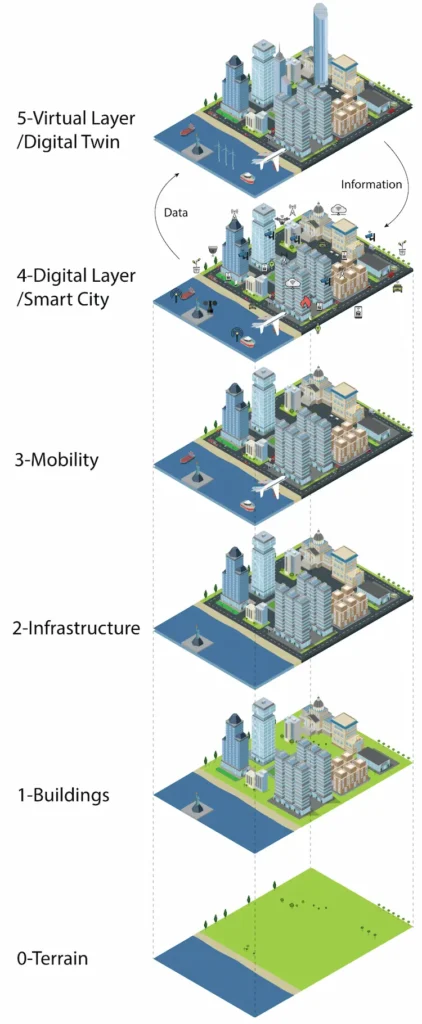
Urban planning is shifting from a static, once-in-a-decade process to a living, adaptive system supported by AI. Digital twins analyze demographic and mobility patterns to forecast future needs for housing, schools, or green spaces. One of the most promising tools within this approach is the digital twin—a virtual replica of a city where different scenarios can be tested. Helsinki, for instance, has built a city-scale digital twin to simulate policies for carbon neutrality. By modeling everything from new tram lines to zoning regulations, planners can predict impacts on mobility, emissions, and public health before implementing real changes. Singapore’s “Virtual Singapore” program, for instance, uses a dynamic 3D digital twin to simulate zoning changes, infrastructure upgrades, and energy policies before implementation. Similarly, Barcelona and Copenhagen apply AI combined with IoT data to optimize everything from transport corridors to energy efficiency in buildings.
Ai in smart cities: challenges and ethical considerations
While AI offers enormous potential, it also brings challenges that cities must address. Data privacy, algorithmic bias, and transparency remain key concerns. To address these, many cities are adopting best practices such as algorithm registers that make decision-making systems visible to the public, independent audits of training data to reduce bias, and strict compliance with regulations like the EU’s GDPR. Embedding these measures into urban AI strategies helps ensure accountability, strengthen citizen trust, and create a more ethical foundation for smart city innovation.
Artificial intelligence is rapidly becoming the backbone of smart city initiatives. It already helps optimize transport, manage energy, enhance resilience, engage citizens, and inform planning. Over the next five years, the role of AI in smart cities is likely to expand further as autonomous mobility corridors, positive-energy districts, and city-scale digital twins move from pilot projects to mainstream practice. Yet AI’s promise will only be fulfilled if paired with strong ethical frameworks and citizen trust. Cities that embrace AI not just as a technical tool but as a governance instrument will be best equipped to thrive in an era of rapid change.
About the author: Sila Eğridere, architect and smart city expert
Read more about AI in smart cities here and about urban intelligence for business here.