
Every winter, as cities around the world light up with festive cheer, municipal governments face a broader challenge than seasonal decoration: how to support residents in celebrating the holidays in ways that are joyful, conscious, and environmentally responsible. In an era where climate change and sustainable urban living are at the forefront, New Year’s and Christmas celebrations become a test of how urban systems, from waste management to public spaces, shape everyday sustainability choices. While individual decisions matter, cities play a crucial role in facilitating low-impact practices that reduce waste, limit carbon emissions, and minimize pressure on urban ecosystems, laying the foundation for sustainable holiday celebrations in cities.
In this article, we move beyond the narrow debate of real versus artificial Christmas trees to unpack the latest environmental research, explore the broader ecological footprint of holiday celebrations, from seasonal waste streams to energy use and fireworks, and highlight how smart, sustainability-oriented cities can actively help citizens celebrate while reducing their overall carbon footprint.
Real vs. artificial trees: the core debate
At first glance, deciding between a natural or artificial Christmas tree seems simple: choose the one with the smallest environmental footprint. But sustainability isn’t just about what you buy; it’s about how you use it, how long it lasts, how far it travels, and how it is disposed of.
Life cycle assessments of real vs. artificial trees
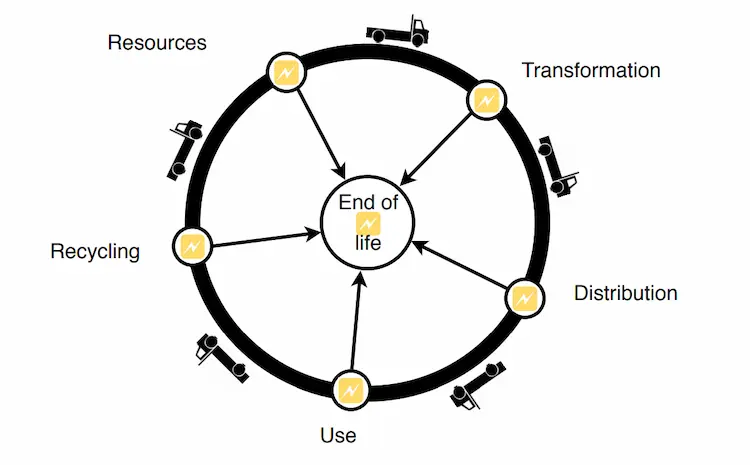
Life Cycle Assessments (LCAs) compare environmental impacts across a product’s entire life cycle, from production to disposal. Most studies show that artificial Christmas trees have higher upfront impacts because they are made from plastics and metals and are often transported over long distances. Real trees, while associated with impacts from cultivation, fertilizers, water use, and transport, can deliver environmental benefits while growing and can be recycled or composted at the end of their life. A Canadian study in Quebec, for example, found that in the key climate change category, a natural tree performs better than an artificial one when the artificial tree is used for an average of six years.
Research by the American Christmas Tree Association highlights that for natural trees, end-of-life choices and transport distance strongly influence overall impact. Importantly, the total energy used over a natural tree’s life cycle is 1.5 to 3.5 times lower than the electricity consumed by using 400 incandescent Christmas tree lights for just one holiday season.
For artificial trees, most environmental impact comes from manufacturing, which accounts for more than half of total impacts (51%–77%). Transportation from the store to the home is the next largest contributor, while use and disposal have a relatively small effect. Keeping an artificial tree for longer reduces its annual impact, but lighting often outweighs the tree itself.
Carbon footprints: how big is the difference?

Natural Christmas trees are not perfect solutions. They have a relatively low per-year footprint and can even be close to carbon-neutral when composted or mulched properly. Some estimates put an artificial tree’s lifetime emissions at around 48.3 kg for its entire life span, whereas a natural tree can be as low as 3,1 kg CO₂ per year, depending on disposal method.
Because of this, analysts suggest that artificial trees must spread their higher initial footprint over many years, sometimes 10 years or more, before becoming competitive from a carbon perspective. Importantly, while these footprints vary by geography and consumer behavior (e.g., driving to the store, disposal method, and lighting on the tree), most studies agree that no tree type is categorically perfect; sustainability depends on how the tree is produced, used, and disposed of.
Beyond the tree: the hidden impacts of holidays
While the tree debate is a useful conversation starter, the environmental footprint of holiday celebrations stretches far beyond pine needles and plastic materials.
Holiday waste increases sharply
Festive seasons generate massive amounts of waste. The USA studies show that household waste increases by more than 25% between Thanksgiving and New Year’s in some regions, adding millions of extra tons to landfills. Some estimate 31 percent of food loss at the retail and consumer levels.
This waste surge comes from wrapping paper, packaging, food leftovers, and discarded decorations, making waste reduction strategies essential for sustainable celebrations.
Air quality and fireworks
On New Year’s Eve, many cities worldwide experience serious air quality challenges. Fireworks, a cherished tradition in many cultures, release particulate matter and toxic metals into the air. Fine particulate matter (PM10 and PM2.5) can spike dramatically, even if fireworks account for a small percentage of annual emissions. For example, Chinese researchers found that fireworks resulted in five times the normal amount of PM and dangerous chemical pollutants in the air, like nitrogen dioxide (NO2) and sulfur dioxide (SO2).
These pollutants can exacerbate respiratory illnesses, linger in the atmosphere for hours or days, and contribute to long-term health effects if exposure is repeated over the years.
Holiday lighting and energy use
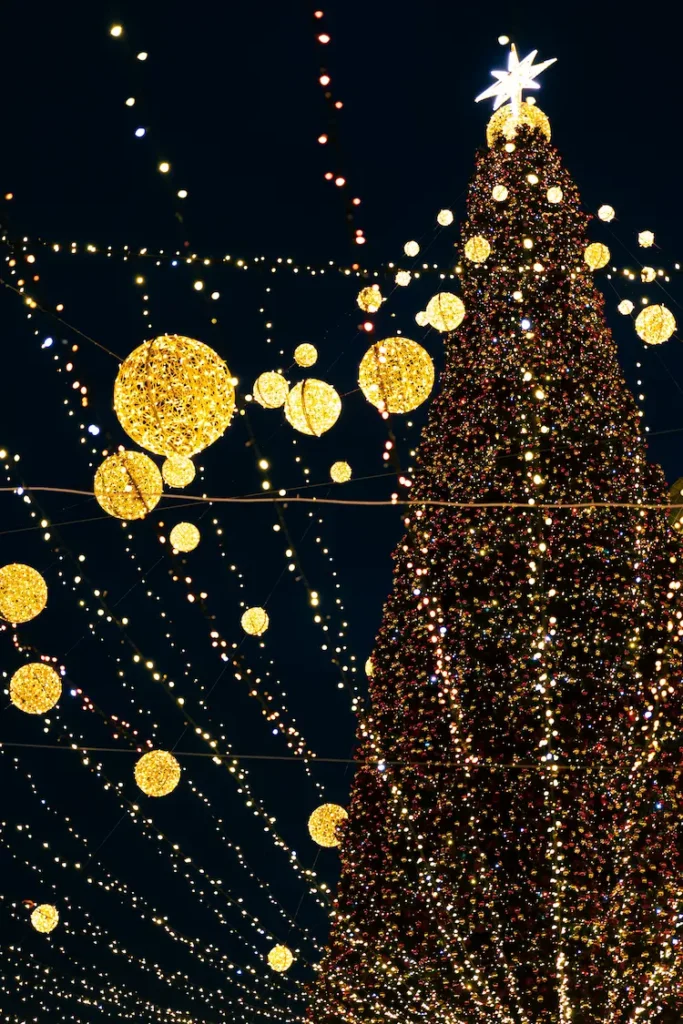
Globally, the electricity demand from Christmas lighting is so extensive that NASA satellite imagery has recorded some regions of the Earth becoming up to 50% brighter during the holiday season.
According to data from EDF Energy, older incandescent lights consume significantly more power and quickly increase both household energy bills and associated CO₂ emissions. Beyond electricity use, EDF also notes that the environmental footprint of holiday lighting includes manufacturing and disposal, making longer use, reuse, and efficient technologies especially important.
Smart сities сan help
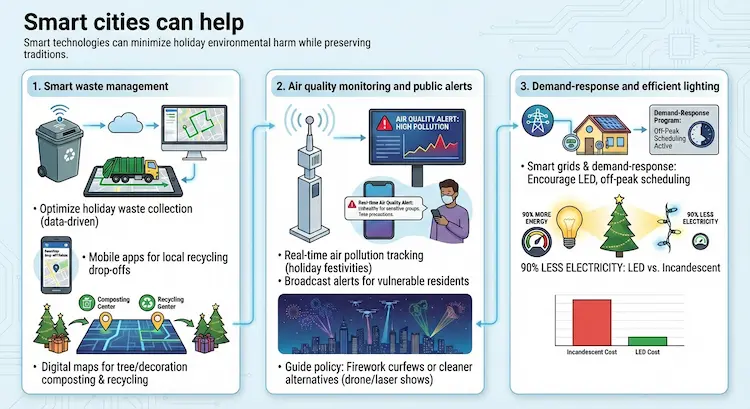
One of the most exciting frontiers in sustainable cities is how smart technologies can minimize environmental harm during holidays while preserving cultural traditions.
1. Smart waste management
Cities can optimize holiday waste collection using data-driven routing and scheduling, ensuring that trees and packaging are picked up efficiently. Integrating mobile apps that inform residents about local recycling drop-off points encourages proper disposal. Many smart cities already implement digital maps of composting and recycling centers, making it easier for residents to drop off used trees and decorations.
2. Air quality monitoring and public alerts
Smart urban sensors can track air pollution during New Year’s festivities and broadcast real-time alerts. These systems help residents with respiratory vulnerabilities take precautions, and can guide city policy on firework curfews or cleaner alternatives like coordinated drone shows or laser displays.
3. Demand-response and efficient lighting
Smart grids and demand-response programs allow cities to encourage LED use, schedule off-peak lighting, and optimize energy loads during high-demand periods. LED Christmas lights use up to 90% less electricity than traditional incandescent bulbs, while delivering the same visual effect. When used for an average festive season, around six hours a day over several weeks, the electricity cost of a set of LED lights is typically reduced.
Practical tips for sustainable holiday celebrations
Whether you live in a rural community or a bustling metropolis, there are multiple ways to enjoy a greener New Year.
Choose (and use) your tree wisely
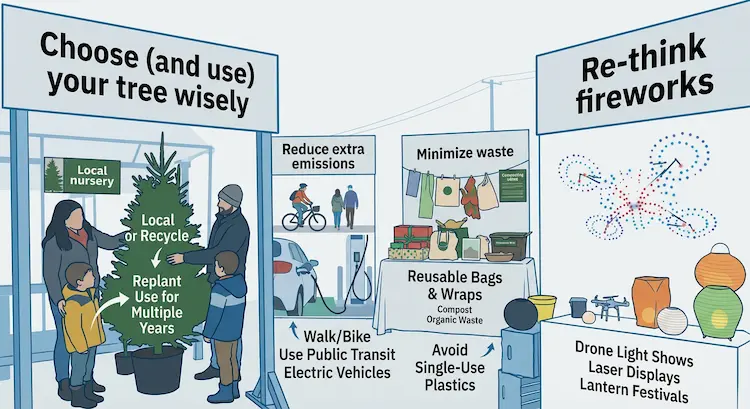
- If you choose an artificial tree, keep it for as many years as possible, ideally more than a decade, to mitigate its upfront footprint.
- For natural trees, select locally grown trees when possible.
- After the holidays, make sure natural trees are composted or mulched instead of sent to landfills, where decomposition can release methane.
Reduce extra emissions
- Carpool or use public transit when picking up your tree.
- Choose LED lights with timers.
- Donate or reuse decorations rather than buying new.
Minimize waste
- Wrap gifts in reusable or recyclable materials.
- Compost food scraps.
- Participate in or organize community recycling events.
Re-think fireworks
Support cities exploring eco-friendly alternatives to smoke-producing fireworks, like coordinated drone or light displays that celebrate without harming air quality.
The real vs. artificial tree debate illustrates a larger truth about sustainability: context matters.
- A well-used artificial tree can be environmentally responsible.
- A thoughtfully sourced and properly recycled real tree can offer ecological benefits.
- The biggest impacts often arise from travel, waste, energy use, and broader consumer behavior.
This is why sustainable holiday celebrations in cities depend not on a single “right” choice, but on how urban systems guide millions of small decisions. Smart cities have a unique opportunity to guide residents toward greener traditions, from smart waste systems to air quality monitoring and energy management platforms. With thoughtful policies and technology, the joy of New Year celebrations can go hand-in-hand with environmental stewardship.
Read more about smart solutions for city here.