
As cities across Europe accelerate digital transformation, a critical question is emerging: how can AI in urban governance strengthen, rather than weaken, democracy, trust, and human experience in urban life?
In this New Polis interview, we speak with Svetlana Tešić, Co-Founder of the Alliance of European Mayors and a strong advocate for human-centric digital transformation in cities. With a background spanning telecommunications, business development, and international collaboration, she now focuses on how artificial intelligence, digital identity, and citizen participation are reshaping urban governance across Europe.
In the conversation, Svetlana explores how cities can move from simply adopting technology to actively shaping it from building public trust in AI systems to creating new models of collaboration between municipalities. She reflects on the growing role of cities as laboratories of democratic innovation, where digital transformation must remain deeply connected to human needs, social equity, and civic trust.
Personal Perspective: Why Cities Matter Today
You’re working with cities, innovation, and public-sector leadership. What first drew you personally to the idea that cities, rather than nations or corporations, are where real change happens?
My professional roots are in the telecom industry, where I spent more than 20 years building expertise in technology, communication, and systems that connect people. But at a certain point, I decided to allocate my personal potential toward something with greater societal relevance, something aligned with the kind of future I wanted to contribute to. That’s when cities emerged as both a focus and an inspiration.
Cities are where life unfolds. It’s where we live, learn, create, and care, all in close proximity. They reflect who we are as societies, but also who we want to become. With 80% of the world’s population projected to live in urban areas in the coming decades, the pressure is real – but so is the opportunity. Cities may be facing massive challenges, but they also concentrate diversity, talent, and the drive for transformation. This is why for me cities are true laboratories of change, deeply human, incredibly complex, and full of potential to create more sustainable, livable, and lovable places for all of us.
Over the past few years, your focus has increasingly shifted toward AI and urban governance. What made this topic especially urgent for you?
The AI industry moved fast, and suddenly cities found themselves part of the game whether they were ready or not. Technology evolved exponentially, often shaped by private-sector logic, and the systems being deployed became increasingly complex. Cities, which are deeply human institutions with very different operational rhythms and responsibilities, weren’t necessarily prepared to navigate this shift, yet they’re where these technologies now land and affect daily life most directly.
What made this urgent for me was the realization that if cities don’t step into the AI conversation with clarity and courage, they risk becoming passive users of tools they didn’t shape, rather than active stewards of digital transformation. At Mayors of Europe, we help cities understand what others have already tested and we offer access to collective knowledge, so they don’t have to start from scratch. Cities should not compete over who digitizes faster, but rather collaborate on how to deploy technology in ways that protect rights, strengthen communities, and build trust.
AI in Urban Governance: Challenges, Opportunities and Risks
European cities today are under pressure to be more efficient, more digital, and more accountable at the same time. From your perspective, what are the most difficult governance challenges cities are facing right now?
Today’s citizens expect public services to function with the same ease, speed, and reliability as their favorite banking or delivery apps. That’s a high bar for local governments, especially when working with outdated systems, limited budgets, and complex procurement rules. The result is a constant pressure to catch up, to be digitally fluent and immediately responsive, even when internal capacity may not yet be there.
One major governance challenge is exactly that: the pace of digital innovation often outstrips what city administrations can realistically deliver. Many municipalities still lack the technical teams, data infrastructure, or long-term strategies to assess and manage digital tools responsibly.
Another issue is fragmentation. Departments work in silos, while tech requires horizontal integration. At the same time, cities often rely on external vendors offering closed, “black box” solutions, which makes it harder to build sovereignty over their own digital ecosystems.
And finally, there’s the matter of trust. If digital transformation isn’t inclusive, transparent, and well communicated, it risks eroding public confidence. The real challenge isn’t just digitizing services, it’s governing technology in a way that reinforces democratic legitimacy at the local level.
Artificial intelligence is often presented as a solution to urban complexity. In your view, where does AI genuinely improve city management and where should local governments be more careful or even slow down?
I’m glad to see that more and more cities are approaching AI with a mindset of public service, not just operational efficiency. AI has already proven where it can help, replacing outdated bureaucratic systems, automating repetitive tasks, and making services more responsive. We’ve featured several examples on our AI & the City page, such as Copenhagen’s AI-powered heating optimization system, which reduced emissions and energy waste, and Helsinki’s use of AI agents to streamline resident interactions and improve access to digital services.
What excites me even more is how AI can expand the reach and quality of citizen participation. From analyzing open-ended resident feedback at scale to creating more intuitive digital interfaces for public engagement, technology can help cities hear from more voices. It only works when we make sure technology is inclusive and designed to lower barriers rather than raise them.
We should stay open to experimentation and bold enough to redesign how cities operate. Technology is a tool, but how we use it reflects our priorities.
Cities, with their diversity and proximity to everyday life, can lead the way in using AI not only to optimize but to evolve urban life in more sustainable, inclusive, and human-centered directions.
People now frequently speak about human-centric governance. What does this actually mean when algorithms and data-driven systems start influencing urban decisions?
For me, human-centric governance means never losing sight of the people behind the data – their lived realities, aspirations, and vulnerabilities, ensuring that technology supports dignity, fairness, and trust at every step.
As cities adopt data-driven tools, human-centricity becomes a commitment to context: knowing why something is being automated, for whom, and with what guardrails. It means asking whether a digital solution truly adds value to a resident’s experience, or whether it creates new layers of exclusion.
A great example is the city of Bologna, which has invested in long-term civic participation infrastructure and institutionalized co-creation processes. Because those mechanisms already exist, it is much easier now to introduce digital tools that enhance rather than replace public dialogue. When civic trust is already in place, technology can scale what works.
Citizens, Trust and Collaboration in the Age of AI
Trust is a recurring concern when cities introduce AI into public services. What practical steps can local governments take to ensure citizens feel included rather than controlled?
Trust doesn’t come from simply explaining how technology works, it comes from showing that people matter in the process. When cities treat transparency and participation not as formalities but as foundations of service design, they create space for genuine connection.
Amsterdam and Helsinki have both taken important steps in this direction, publishing public algorithm registers that allow residents to understand what kinds of automated systems are in use, how they work, and why. This kind of openness helps shift the narrative from control to collaboration.
Trust also grows when residents are invited into conversations early and not just consulted at the end, but engaged from the start to help define challenges, shape responses, and understand what’s at stake. And we see that a lot across European cities happening.
Ultimately, trust builds over time. It’s less about a perfect system and more about ongoing relationships grounded in clarity, care, and accountability.
Many cities experiment with AI in isolation. Why is cooperation between cities so important in this field, and what kinds of shared learning do you see emerging across Europe?
When cities work in isolation, they often face the same hurdles, from data fragmentation to ethical uncertainty, without knowing that others have already tackled similar issues. But when cities collaborate, that learning becomes collective. One city’s pilot can save another’s resources, avoid duplication, and raise the overall quality of solutions being deployed.
Across Europe, we’re seeing more peer-to-peer knowledge exchange emerge, not in theory, but in very practical terms. Cities are sharing procurement templates, testing methodologies, and governance frameworks. For example, discussions around algorithm transparency or citizen engagement strategies gain depth and speed when they’re shared across municipal borders. This is what our platform, Mayors of Europe, helps facilitate, making sure valuable experiences don’t stay locked inside local silos.
What’s also encouraging is that collaboration happens across different levels: large capitals and smaller cities, tech-advanced administrations and those just starting their AI journey. This diversity brings a richer set of lessons and reminds us that no single city has all the answers, but together, we get much closer and faster.
Citizen participation is often limited to consultation or feedback. How can cities move toward more meaningful involvement of residents in shaping how AI is used in urban life?
At Mayors of Europe, we are deeply committed to this topic. In partnership with the Better Politics Foundation, we recently produced a documentary spotlighting the cities of Stockholm, Poznań, and Bologna, showing how citizen participation, when meaningfully enabled, strengthens democratic resilience. The film captures real-world practices where civic input is not just welcomed but structurally supported.
At the same time, the fact that platforms like GoVocal have existed for over a decade and are already working with hunderds of cities demonstrates both the demand and growing awareness that governments must create direct, ongoing channels for public involvement. This kind of infrastructure becomes even more essential as cities begin to apply AI in decision-making.
Cities, Leadership and the Future of Human-Centric AI Governance
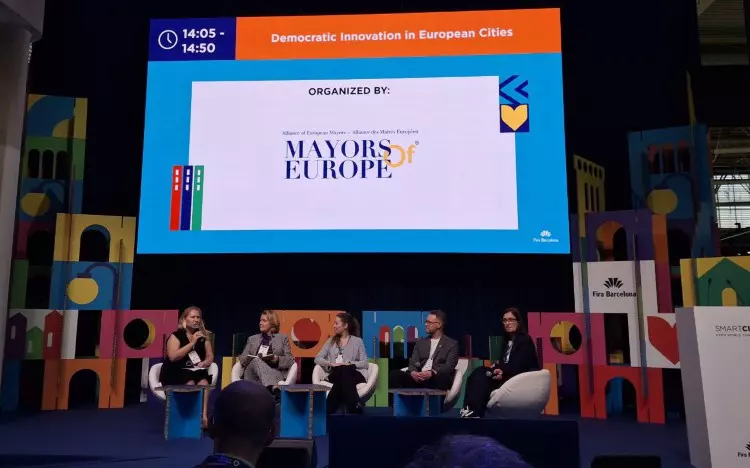
Mayors of Europe brings together more than 300 municipalities across the continent. How does the platform help cities turn shared ideas about sustainability, digital rights, and innovation into real policies and everyday practices?
Mayors of Europe is a collaborative leadership platform and above all, a force multiplier.
We don’t just amplify stories, we amplify capacity. Cities come to us not for blueprints, but for access: to real peers, tested ideas, and policy paths that have already been walked.
Whether it’s a mid-sized city leading on AI ethics or a small town pioneering zero-waste strategies, we help bring their work to light. Our interviews, case studies, and convenings are all curated to turn shared ideas into applied knowledge.
But we also go further. When a city in Portugal needs to learn from a Finnish municipality already piloting inclusive tech strategies, we help make that connection. This kind of trusted exchange isn’t abstract, it’s human, practical, and immediate. That’s how we help cities move from ambition to action.
Looking ahead, what keeps you personally motivated in this work and what would make you feel that cities are moving in the right direction when it comes to AI and governance?
What keeps me going is the people behind the cities, the committed, curious, often overworked leaders who still believe they can shape better places for all of us living in those cities. When I see a mayor experimenting with new participation tools, or a city team wrestling with AI policy not because it’s trendy but because it matters, that’s what gives this work meaning.
I’m motivated by the possibility of building coalitions across borders, sectors, and ideologies. The moment we stop acting like we need to compete for visibility and start collaborating for impact, that’s when cities begin to lead the way forward.
What makes me feel we’re on the right path is when technology is used not to replace care, but to extend it. When AI helps reduce inequities instead of deepening them. When local governments openly talk about mistakes, share lessons, and stay open to growth.
If we can keep building ecosystems that are transparent, participatory, and rooted in dignity, then I believe we’ll see real transformation. That’s the city-making I want to be part of.
Read and watch other interviews here