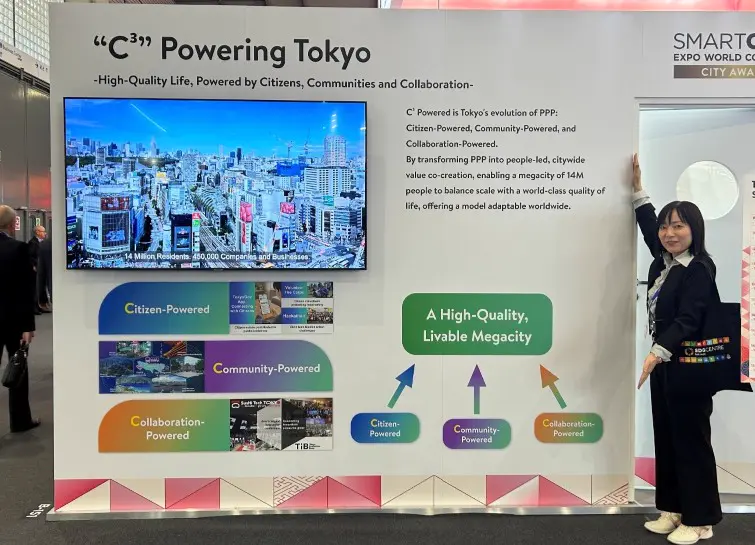
At Smart City Expo World Congress 2026 in Barcelona, Tokyo received the prestigious City Award in recognition of its innovative approach to Tokyo smart city development, known as C³ Powering Tokyo. Built around citizens, communities and collaboration, this model reflects an ambitious vision of urban transformation in one of the world’s largest metropolitan areas, where technological innovation must respond to the diverse needs of millions of residents. But what does this vision mean in practice? How can digital technologies improve everyday life, strengthen disaster resilience and help address the challenges of an ageing society? And what can other cities learn from Tokyo’s experience?
New Polis spoke with Haruyo Fukuda, Director of Smart City Strategy at the Digital Services Bureau of the Tokyo Metropolitan Government, about the city’s smart initiatives, the role of Japanese traditions and local communities, and the future of people-centred urban innovation.
Tokyo Smart City Vision: Putting People First
First of all, congratulations on Tokyo receiving the City Award at Smart City Expo World Congress 2026 in Barcelona. The award recognised Tokyo’s “C³ Powering Tokyo” approach, which places citizens, communities and collaboration at the heart of urban transformation. What makes this approach distinctive, and what do you consider its most important achievements so far?
We are truly honored that Tokyo has been recognized with this prestigious City Award.
It is people who drive cities forward. Through the power of its citizens, communities, and collaboration, which we call C-cubed, Tokyo has shown that a megacity can also be a city that offers a high quality of life.
What distinguishes Tokyo’s approach is the way these principles are translated into practice.
Citizen-Powered: Even in the digital age, Tokyo remains committed to the principle of citizen-centered governance. One example is the TokyoGov App, developed under the concept of “the metropolitan government in your pocket,” offering government services via smartphones. With more than seven million downloads, it allows residents to access services, stay connected, and share their views anytime, anywhere. We listen to those voices and reflect them in our policies. As a result, we can deliver better and more responsive services.
Community-Powered: Tokyo’s growth is driven by its diverse communities. The digitally enabled urban infrastructure forms a constellation of connected areas.
Collaboration-Powered: Today’s challenges are too complex for any single nation or city to solve alone. That is why cities at the forefront must share what works and learn from one another.
Tokyo hosts SusHi Tech Tokyo, Asia’s largest innovation conference. It is built around the concept of “Sustainable High City Tech,” using cutting-edge technologies to create sustainable cities. In addition, through city networks and international exchanges, we share knowledge, innovation and solutions to common challenges with diverse partners.
Tokyo is one of the world’s largest metropolitan areas, with around 14 million residents in the metropolitan prefecture. What are the greatest challenges of developing a smart city on such a scale? Does Tokyo’s size make digital transformation more difficult, or does it also create unique opportunities?
Locally driven initiatives sustain Tokyo’s growth. Area management bodies align businesses, residents, and government, while neighborhood associations strengthen vibrancy and disaster resilience. From central Tokyo to Tama and islands over 1,000 km away, regions are linked by transport and digital infrastructure into a constellation of areas.
In addition, GovTechTokyo, established by the Tokyo Metropolitan Government in 2023, plays a key role in advancing digital transformation (DX) across Tokyo. Its digital specialists work with the Bureau of Digital Services to provide hands-on technical support, working closely with each municipality to solve the challenges it faces, while also promoting the sharing of digital tools and systems. Through these efforts, GovTechTokyo responds to the specific needs of each municipality, solves common challenges across municipal boundaries, and accelerates DX throughout Tokyo.
Technology and everyday life
Smart city strategies often focus on infrastructure, data and technological innovation. But for residents, what matters most is how these developments affect their everyday lives. Could you share two or three examples of smart solutions that have made a tangible difference for people living in Tokyo?
For example, the Tokyo Metropolitan Government’s Official App, TokyoGov App, was developed under the concept of “the metropolitan government in your pocket.” Using the power of digital technology, it connects each resident with the government, allowing them to share their views anytime and enjoy a tangible sense of greater convenience. Downloaded more than seven million times, the app serves as a touchpoint through which residents can also access information on daily life, such as disaster preparedness and childcare, in one place. In addition, residents have submitted 570,000 comments on the Metropolitan Government’s projects through the App. We listen carefully to this feedback and use it to deliver services that bring greater satisfaction to the residents.
Japan is known for its ageing society, while Tokyo also faces changing demographic needs. How are digital technologies helping older residents maintain their independence and access essential services? And how does Tokyo ensure that digital transformation does not leave behind people who are less comfortable with technology?
We place importance on leaving no one behind. In Metropolitan schools, we have created an environment where generative AI can be used safely, and 160,000 students and teachers are using AI tools. In addition, 10,000 citizen volunteers are supporting seniors in using digital technology.
Japanese traditions and urban innovation
Japan has a distinctive culture of urban life, combining technological sophistication with strong traditions of community, public responsibility and attention to detail. How do these cultural characteristics influence Tokyo’s approach to becoming a smart city? Are there aspects of Japanese urban culture that you believe other cities could learn from?
At the root of the C³ Powering Tokyo model are traditions that have been passed down for centuries. In the Edo period, citizens took on firefighting themselves, in the spirit of helping one another. And each community has nurtured its own diverse and distinctive local culture.
The spirit of Edo’s citizen-led firefighters lives on today in our 27,000 Volunteer Fire Corps members, who protect the safety of their communities.
Tokyo’s award-winning C³ Powering Tokyo model highlights the role of citizens and local communities in urban development. How does this approach work in practice? Could you share an example of a smart city initiative that was shaped by the needs or suggestions of local residents?
A good example is TokyoGov App I mentioned earlier. At hackathons, civic tech groupsuse open data and AI to tackle urban challenges.
One example is a team called Aliss, which won the Governor’s Cup (Grand Prize) at the Tokyo Governor’s Cup Open Data Hackathon 2025. Many people feel uneasy at night because they do not know which routes are safe. To address this, the team developed YORUMICHI, a service that combines open data such as nighttime light levels and crime information to suggest safer routes for walking at night. The service is now publicly available online.
Resilience and the challenges of innovation
Tokyo faces significant natural disaster risks, including earthquakes and extreme weather. How are digital technologies, real-time data and smart infrastructure helping the city improve disaster preparedness and protect its residents?
When it comes to connectivity, we are combining optical fiber links, mobile internet links, and satellite communication links in the most appropriate ways. Our aim is a “Connected Tokyo,” that stays connected anytime, anywhere, and under any circumstances.
We are also working to secure means of communication during disasters, including deploying mobile satellite communication equipment and satellite-based OpenRoaming-enabled Wi-Fi.
In addition, the Tokyo Digital Twin Project combines 3D city models with geospatial data. Its Digital Twin 3D Viewer visualizes information relevant to disaster preparedness, such as river water levels, estimated inundation areas and evacuation sites.
Not every smart city initiative delivers the expected results. Has Tokyo encountered projects that proved more difficult to implement than anticipated? What have been the main obstacles, and what lessons have you learned from these experiences?
Tokyo’s smart city initiatives are co-created with diverse stakeholders, including Tokyo residents, over 450,000 businesses, among them more than 10,000 startups, and over 140 universities.
In each area, area management organizations and resident groups are building on the culture and character that their communities have nurtured, and rolling out initiatives and services that fit the area.
In promoting the wider adoption of smart city services, we must always consider whether they deliver benefits that Tokyo residents can actually experience. We have learned that each stage, from pilot projects to implementation and then to scaling, presents its own challenges, and that collaboration among a wide range of stakeholders is essential to overcoming them.
Lessons for other cities and the future
Looking ahead to 2030 and beyond, what changes would you most like Tokyo’s residents to experience as a result of the city’s digital transformation? And which elements of Tokyo’s experience could be adapted by smaller cities with more limited resources, including cities in Southeast Europe?
The age of AI is here, and it is set to transform our cities. However, no matter how far technology advances, the sources of Tokyo’s strength – our citizens, our communities, and our spirit of collaboration – will remain unchanged. In fact, AI can make each of us far more capable and make the C-cubed model even more powerful.
Through AI transformation (AX), we will further evolve C-cubed Powering Tokyo.
Tokyo’s community-based approaches may be adaptable to other cities, regardless of their size. Across Tokyo, the continued efforts of local communities support the city’s growth. Through area management, where businesses, residents, government, and academia share a common vision for the future, communities are enhancing the value of their neighborhoods while contributing to both the vitality and safety of the city.
Tokyo will continue to advance its smart city initiatives together with cities worldwide, powered by C³. As one step forward, Tokyo is launching the new SusHi Tech City Award. It will recognize cities that are driving AX and working with their citizens and communities to build a sustainable society. Applications open later this month, and the winning cities will be honored at SusHi Tech Tokyo 2027 next May. We hope that cities from around the world will apply.