
Artificial intelligence may be digital, but the infrastructure behind it is decidedly physical. The expansion of AI data centre infrastructure requires servers and chips, but also electricity, substations, transmission lines, cooling, land and fibre. As computing demand grows, these requirements are beginning to influence where new data centres can realistically be developed.
The scale is already significant. According to the International Energy Agency, data centres consumed around 415 TWh of electricity worldwide in 2024, about 1.5% of global electricity consumption. In its base case, the IEA expects consumption to more than double to around 945 TWh by 2030. Electricity consumption by accelerated servers, mainly driven by AI, is projected to grow about 30% annually through 2030, compared with about 9% for conventional servers.
This creates a longer infrastructure chain in which power and grid access are becoming increasingly important parts of the location decision.
Digital speed meets the grid
Data centres and electricity networks operate on very different development cycles. The IEA’s Electricity 2026 report estimates that new data centres can be built in one to three years, while new grid infrastructure can take five to 15 years to plan, permit and complete.
The mismatch is becoming harder to ignore. More than 2,500 GW of renewable, storage and large load projects are currently stalled in grid connection queues worldwide, according to the IEA. The agency estimates that around 20% of planned data-centre projects could face delays if grid constraints are not addressed. For developers, this changes the site-selection question. Finding land, customers and fibre is not enough if the electricity connection arrives years after the building could be ready.
Europe offers a good illustration. CBRE’s Q2 2026 data show how quickly AI demand is entering the market: AI focused colocation capacity signings reached 420 MW in the first half of 2026, compared with 89 MW in the same period of 2025.
AI data centre infrastructure is moving beyond the traditional hubs
Frankfurt, London, Amsterdam, Paris and Dublin, the familiar FLAP-D markets, still dominate Europe’s data-centre landscape. According to JLL’s EMEA Data Centre Mid-Year 2026 report, five markets had around 3.8GW of live capacity in the first half of 2026, with a further 1.4GW under construction and 2GW planned.
But the advantages of these mature markets come at a price. JLL estimates that powered land in FLAP-D reached €2.26 million per MW in 2026, up 82% from €1.24 million in 2021. Primary markets command around 2.3 times the powered land cost of secondary markets and around four times the cost of tertiary markets.
Power availability can be an even greater problem. A well-connected site close to customers has limited value for a large AI project if a sufficiently large grid connection cannot be secured within the investment timetable. This does not mean that Europe’s traditional data-centre hubs are losing their role. JLL describes the shift as a broadening of the market rather than a relocation away from the core.
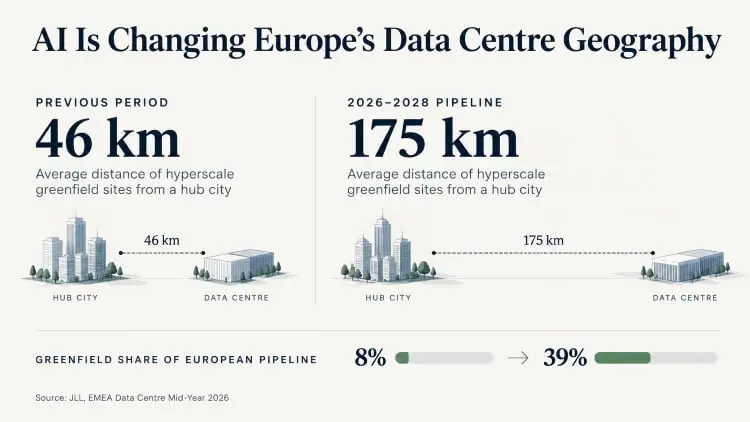
Greenfield sites have risen from just 8% to 39% of the European pipeline for 2026–2028, according to JLL. Hyperscale projects in the greenfield pipeline are now located on average 175 kilometres from a hub city, compared with 46 kilometres previously.
That is a striking geographical shift. For traditional data centres, the logic often started with customers and networks:
Customer → Network → City → Data Centre
Large AI facilities can put the priorities in a different order:
Power → Grid → Land → Connectivity → Data Centre
Latency-sensitive services will still need metropolitan locations, and the established hubs retain advantages in connectivity, cloud infrastructure, customers and skills. But AI training workloads can be less sensitive to distance. For projects of 100 MW or more, access to power and scalable land can outweigh proximity to a major city. That is one reason why AI data centres in Europe are starting to appear in places that would once have seemed unlikely candidates.
The implication is important for emerging markets. AI training workloads can tolerate greater distance from major metropolitan centres than latency sensitive workloads, provided that power and other infrastructure can be delivered at the required scale. JLL specifically identifies AI training requirements of 100 MW and above as less latency sensitive and increasingly associated with locations where power is available.
Greece: from lignite to AI
Greece offers a particular example of how an energy landscape can become part of a new data centre proposition. Athens is already developing as a regional digital and connectivity hub. In March 2026, Enterprise Greece highlighted the country’s expanding cloud infrastructure, submarine cable connections and growing interest from hyperscale and colocation operators when presenting Greece at Data Centre World in London.
But one of the country’s most ambitious projects is not in Athens. It is in Western Macedonia, for decades the centre of Greece’s lignite industry. In April 2025, PPC Group announced a €5.75 billion transformation plan for the region. Among its plans was a 300 MW data centre at the Agios Dimitrios power station, with the possibility of eventually expanding to 1 GW. The proposal reached its next level of advancement in September 2026. PPC and Amazon Web Services executed a Memorandum of Understanding laying down the blueprint and essential terms of the project. As per the proposed structure, AWS will lease the built-up data center for 15 years, with PPC providing the land, buildings, and energy infrastructure for the same.
The project remains subject to further agreements, due diligence, grid connection and regulatory approvals. The MoU therefore does not make the project a completed investment, but it represents a substantially more concrete development pathway than the earlier proposal.
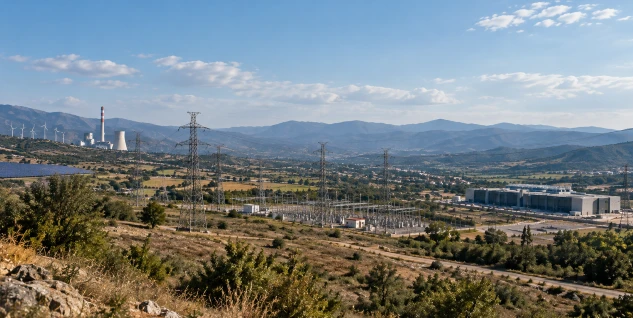
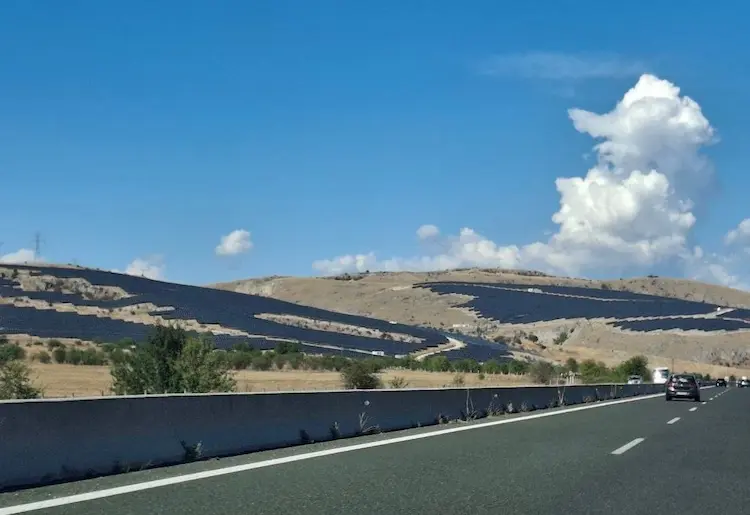
The location is what makes the case particularly interesting. Western Macedonia is already undergoing a large-scale energy transformation. In April 2026, PPC reported the completion of 2.13 GW of photovoltaic projects in the region and Northern Greece. Battery systems at Ptolemaida and Meliti add 98 MW / 196 MWh of storage, while another 50 MW / 200 MWh battery project is under construction near Amyntaio. PPC expects the Western Macedonia solar clusters to produce around 3,150 GWh of electricity annually.
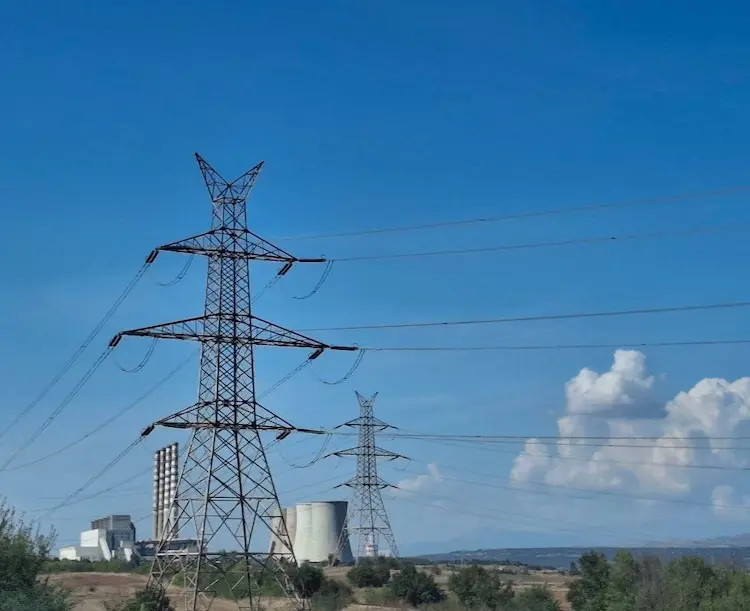
The proposed data centre is therefore entering a landscape that already contains former power-generation sites, high-voltage infrastructure, renewable generation, storage and large areas of industrial land. That reverses the conventional development logic. Instead of choosing a metropolitan data-centre location and then trying to bring enough electricity to it, an investor can start with a place where energy infrastructure and land already exist. A former lignite region may find a second life as part of Europe’s AI economy.
What does this mean for Southeast Europe?
Greece is currently the region’s strongest example, but it is not the only Southeast European market with assets relevant to AI data centre infrastructure. Bulgaria has considerable generation capacity. The country’s transmission system operator ESO reported 18,668 MW of installed capacity in 2025, including 1,382 MW of battery storage. Sofia also has an established commercial data centre and interconnection ecosystem, giving Bulgaria both a large power system and an existing digital infrastructure base.
Serbia has been expanding its public digital infrastructure. In April 2026, new modules and a second supercomputer were commissioned at the State Data Centre in Kragujevac. According to Serbia’s Office for IT and eGovernment, the additional modules brought the facility’s total energy capacity to 14 MW.
None of these figures proves that Bulgaria or Serbia is ready for the next hyperscale AI campus. Installed generation at national level is not the same thing as 100 MW of firm capacity available at a particular site.
That distinction is important when discussing data centre investment in Europe, and particularly in emerging markets. The relevant question is whether several conditions can be brought together at the same location: sufficient power, a viable grid connection, suitable land, resilient connectivity, cooling and a development process that can deliver them within the required timetable.
For an investor, the decisive questions quickly become local. How much additional load can a particular substation take? When can it be connected? What reinforcement will be needed? Can the site expand? How many independent fibre routes are available? Is water available for the chosen cooling system? How long will permitting take?
A national energy surplus can attract attention. It does not, by itself, make a site investable.
The next digital map may follow the grid
For much of the internet era, data centres followed cities, customers and telecommunications networks. AI is adding another powerful variable to that geography: access to electricity at scale. The old hubs are not disappearing. Frankfurt, London, Amsterdam, Paris and Dublin will remain central to Europe’s digital economy. But the growth of AI workloads is creating additional demand for sites where large amounts of power and land can be secured.
Agios Dimitrios captures that change unusually well. A site associated for decades with lignite power generation is now being considered for a 300 MW data centre for AWS, potentially expandable to 1 GW, while the surrounding region is developing new solar and storage capacity. For Southeast Europe, the opportunity is therefore less about creating another Frankfurt or London than about identifying locations where energy, grid capacity, land and connectivity can be assembled into a viable digital infrastructure project.
The next important location on Europe’s digital map may not be the biggest city. It may simply be the place that can provide the next 100 MW of reliable power on time.