

The article about smart city projects is provided by our media partner 7ITSNews.
A county-level smart city project in Guizhou saw 6 of 7 sub-projects idle shortly after completion, wasting over 80 million yuan. Issues include blind planning, policy lags and data silos, highlighting urgent needs for better grassroots project management and asset revitalization.
During a recent investigation in a county in Guizhou Province, China, a reporter from “Ban Yue Tan” discovered that a smart city project, which had received over 80 million yuan (approx. US$11 million) in investment, fell into disrepair shortly after its completion, with hardware deteriorating and software ceasing to function. Further investigation revealed that such cases are not uncommon. As digital transformation accelerates, smart city construction is rapidly advancing across China. However, problems such as “prioritizing construction over tangible results” and “emphasizing form over application” are beginning to surface. In some cities, these projects are “idle upon completion” or “wasted upon launch.”
While this case comes from China, the underlying challenges are far from unique. Across the world, governments are investing heavily in smart city projects as part of broader urban digital transformation strategies. Yet many digital infrastructure projects struggle to move beyond the construction phase, raising important questions about governance capacity, interoperability, long-term funding, and the ability of institutions to turn technology investments into lasting public value.
Industry insiders suggest that county-level smart city projects face even higher idle rates, where substantial fiscal and social capital investments fail to deliver expected returns, a prominent governance issue at the grassroots level. Urgent priorities include clarifying creditor-debtor relationships, revitalizing assets, enhancing government project management capabilities, and preventing resource waste.
Grand launch, silent shutdown
This smart city project, a key initiative launched in 2016 by a county in Guizhou, originally comprised eight sub-projects: smart safety, smart urban management, smart communities, precision poverty alleviation, smart tourism, a public information sharing platform, a big data experience hall, and smart agriculture (the last of which was never developed). Of the seven that were actually developed, six have been discontinued or left idle.
At the county’s smart city big data center, a “butler-style” service counter is cluttered with debris. The big data experience hall remains locked, its interior cleared out. A comprehensive management center sits open, coated in dust. Nearly a dozen mini-programs linked to the project have been deactivated, with one online service platform having been suspended since December 25, 2023.
According to documents provided by local authorities, of the seven sub-projects actually developed, six are either suspended or idle. Systems for precision poverty alleviation, smart urban management, smart communities, and smart tourism, all launched by the end of 2017, were subsequently decommissioned. Their operational lifespans ranged from as little as six months to a maximum of one and a half years. Sub-project data has not been updated since suspension, leaving the public information sharing platform and big data experience hall unused.
The project, originally budgeted at 120 million yuan, had an audited construction cost of just over 80 million yuan, financed through a Public-Private Partnership (PPP) model. To date, approximately 40 million yuan has been paid, leaving over 40 million yuan in outstanding debt. The private partner filed a lawsuit in the first half of 2025 to recover the owed amount.
Beyond the financial losses, the case raises a broader question: why do smart city projects continue to encounter similar problems despite years of technological progress and growing public investment? The answer may lie not only in technology itself, but also in the quality of smart city governance, institutional coordination, and the ability of local administrations to manage increasingly complex digital systems after they are built.
Why smart city projects fail: planning gaps, redundant systems and data silos
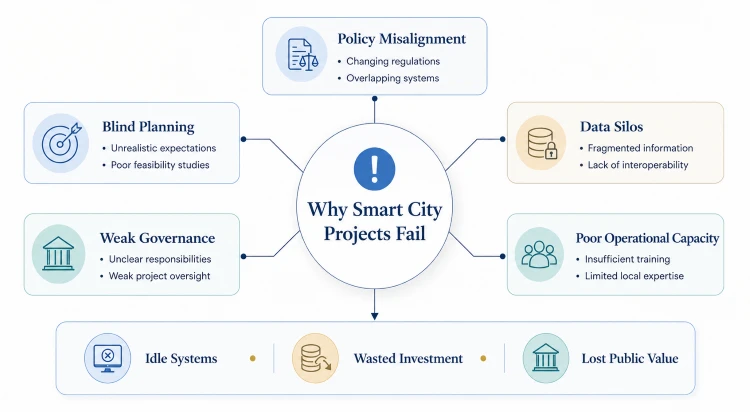
Authorities attribute the project’s failure to unscientific planning, subsequent operational and management lags, changing external policies that reduced demand, and persistent departmental silos.
Blind planning and unmet expectations
Unlike traditional construction projects, smart city initiatives rely heavily on software and electronic equipment, making cost assessment difficult. Inadequate institutional frameworks for procurement, contracting, and performance evaluation create regulatory blind spots. A local official admitted that the project suffered from insufficient feasibility studies and inaccurate PPP policy research. For instance, the smart urban management system, once launched, only addressed city appearance and was never expanded to other urban management functions, leaving most of its components unused beyond some cameras repurposed for the public security “Skynet” project. Industry insiders note that blind planning is a common issue, with some counties copying models from first-tier cities or pursuing overly advanced technology without considering local operational capacity, leading to systems that no one knows how to use.
Lagging policy awareness and redundant construction
A county official explained that shortly after the smart tourism sub-project went online, the province launched a unified smart system that vertically covered its functions, rendering the county’s project obsolete. Consequently, the private partner’s anticipated revenue from system maintenance and data services evaporated. Similar situations are widespread, as national and provincial-level unified systems for smart governance, culture, tourism, and emergency response are increasingly introduced, displacing locally built predecessors that cannot integrate or whose functions are duplicated. A lack of coordinated planning often leads to multiple overlapping platforms and sunk costs.
Data silos undermining smart initiatives
Interviewees point to persistent “information islands,” where data is not shared across public security, civil affairs, urban management, and tourism departments, and port access is restricted. Some higher-level vertical systems operate in a closed manner, refusing to grant data interfaces to grassroots units. In the county in question, the smart community system was never used after failing to secure an open port from a higher-level vertical department. The precision poverty alleviation system likewise faced data integration issues at the national and provincial levels. A local official noted that because systems and electronics are updated so frequently, revitalizing idle systems would require further capital investment, risking even greater waste of state assets.
Similar challenges have been reported in a number of digital infrastructure projects worldwide, where fragmented data management and limited interoperability have undermined the effectiveness of otherwise promising smart city initiatives.
Tailoring smart city construction to local conditions
No matter how impressive the façade, smart city construction must not stray from its core mission of serving the people. The goal is not to embellish paper credentials but to provide real, practical, user-friendly benefits.
Since the project has yet to be fully accepted and its debt issues are now in litigation, grassroots officials recommend expediting the process, completing asset transfers, re-evaluating asset values through third-party assessments, and disposing of assets via auction or leasing to improve utilization.
For existing idle projects, comprehensive inspections and classified efforts should be made to revitalize resources, maximize asset benefits, and track proceeds to minimize waste. Social capital should be guided to participate in upgrading idle projects, adjusting operational models and optimizing functions based on grassroots needs to generate tangible returns. To address departmental silos, clear data-sharing responsibilities, unified standards, and opened ports are essential to break information barriers.
The predicament of this county’s smart city project serves as a cautionary tale. Experts and grassroots officials urge that future initiatives must embrace a correct view of performance, adhere to pragmatism, adapt to local conditions, live within means, and direct limited funds and resources where they are most needed. A systems-thinking approach is required to facilitate cross-departmental and cross-level data integration, ensuring collaborative efficiency. Finally, information technology training for grassroots cadres must be strengthened to improve system operation and management, avoiding the trap of “prioritizing construction over tangible results.”
More broadly, the experience of this county suggests that the success or failure of smart city projects is rarely determined by technology alone. Digital platforms, sensors, and data systems create value only when they are supported by effective governance, institutional coordination, sustainable funding, and a clear understanding of local needs. As cities continue to pursue urban digital transformation, the key challenge may not be how to build smarter systems, but how to ensure they remain useful long after the ribbon-cutting ceremony is over.
Authors: Ou Dongqu, Jiang Cheng, Yang Xin