
The issuance of the latest World Meteorological Organization (WMO) Global Annual to Decadal Climate Update for the 2026–2035 period serves as an empirically backed analysis of the direction in which the world’s climate is heading. Featuring an analysis of complex multi-model initialized forecasts from 13 different institutes, with a total of 250 ensemble members, the update paints a dire picture of the timeline within which urgent action is required to avoid dangerous manipulation of atmospheric conditions. In light of the fact that the last three years, 2023-2025, have been the hottest on record, humanity is faced with a direct and structural environmental question: Is the Earth getting hotter?
The statistical updates provided by the WMO confirm that we are no longer facing hypothetical long-term shifts, but a rapidly accelerating baseline. Global mean temperatures are projected to persist at or near record-breaking levels for the five-year block of 2026–2030. This review highlights key points, explores regional and polar changes, and discusses their implications for the professionals who deal with infrastructural challenges and sustainable energy generation.
The 2026–2030 baseline: breaking through the 1.5°C safety zone
The near-term forecasts detailed within the WMO update present highly precise and disconcerting mathematical ranges for global near-surface warming. Climatologists project that the annually averaged global mean near-surface temperature for each individual year between 2026 and 2030 will sit between 1.3°C and 1.9°C higher than the pre-industrial baseline average of 1850–1900.
When evaluated as a multi-year block, the escalating probability of breaching vital safety metrics highlights a clear, upward trend:
- The 1.5°C Single-Year Threshold: The probability that the global mean near-surface temperature will exceed 1.5°C above the pre-industrial baseline for at least one individual year between 2026 and 2030 has surged to a near-certain 91%.
- The 1.5°C Five-Year Average: Crucially, the update reveals a 75% probability that the entire five-year mean for the 2026–2030 period will itself exceed 1.5°C above pre-industrial levels.
While the WMO notes that these figures represent temporary annual exceedances rather than a permanent multi-decadal breach of the long-term limits defined by the Paris Agreement, the frequency of these temporary events is accelerating rapidly. Conversely, the model indicates that it remains exceptionally unlikely (less than 1% chance) that any individual year will breach the extreme threshold of 2.0°C of warming within this immediate five-year window. Nevertheless, the probability that at least one year in the 2026–2030 timeframe will surpass the current historical record set in 2024 stands at 86%, while there is a 91% chance that the 2026–2030 five-year average will be hotter than the preceding 2021–2025 span.
Polar transformations and long-term decadal deviations (2026–2035)
As thermal energy continues to accumulate within the biosphere, the geographical distribution of warming exhibits intense, localized variations, with the polar regions experiencing the most severe impacts.
Severe arctic amplification
The most alarming regional projection centers on the upper latitudes of the Northern Hemisphere. Over the next five extended winter seasons (running from November to March), the near-surface temperature in the Arctic is predicted to climb an astonishing 2.8°C above the 1991–2020 average. This local anomaly is more than three and a half times larger than the projected global mean temperature anomaly over the same period. This severe warming feeds directly into structural changes in northern ecosystems, with decadal projections for March 2026–2035 suggesting further stark reductions in Arctic sea-ice concentration, particularly across the Barents Sea, the Bering Sea, and the Sea of Okhotsk.
Deep decadal anomalies vs. historical projections
When looking out across the full ten-year window (2026–2035), multi-model initialised decadal predictions track closely with long-term climate projections, but they identify several highly vulnerable land and ocean zones where warming will outpace baseline models. Specifically, the WMO highlights significantly warmer-than-projected anomalies over the Amazon basin, North Africa, northern Scandinavia, and the Greenland Sea. Additionally, the report indicates a preference for persistent El Niño conditions in the Niño 3.4 region relative to the wider tropics, with these conditions peaking noticeably in 2027 and 2028.
Macro-environmental shifts: is the Earth getting hotter?
The convergence of these diverse datasets forces industrial, municipal, and political stakeholders to move past theoretical climate scenarios and directly confront a singular operational reality: Is the Earth getting hotter? The empirical framework presented by the WMO shows an unequivocal upward shift across every core climate vector.
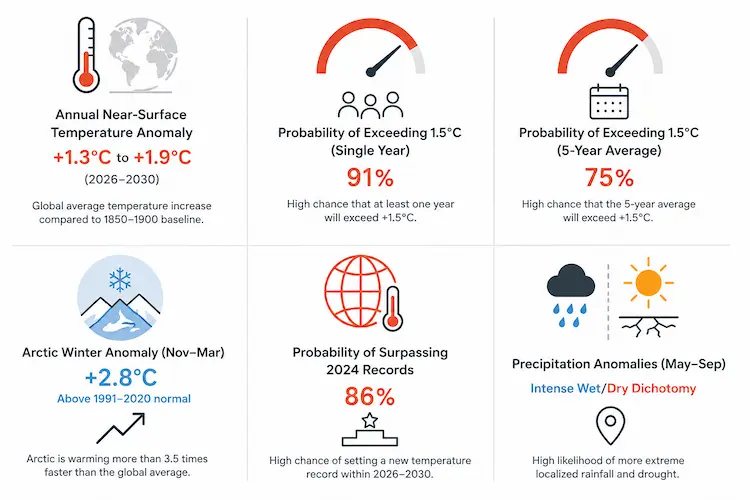
These figures demonstrate that the global climate is moving out of its historical stability zone, resulting in erratic, localized precipitation shifts. Between May and September (2026–2030), wet anomalies are projected to intensify across the African Sahel, northern Europe, Alaska, and Siberia, while severe dry anomalies are expected to settle over the Amazon.
Strategic imperatives for modern urban planners
For municipal authorities and urban planners, the WMO update serves as an operational mandate to completely re-engineer urban spaces. Because cities amplify heat via the Urban Heat Island (UHI) effect, a global baseline increase of up to 1.9°C can translate into highly dangerous localized microclimates.
- Thermal infrastructure management: Given the risk of new annual temperature records at the likelihood rate of 86%, city planners need to adopt robust heat-mitigation measures. This includes upgrading municipal construction codes to enforce the use of cool roofs, green facades, and highly reflective road surfaces. In addition, urban forests and green-blue infrastructure should be incorporated into urban designs to mitigate extreme temperatures.
- Hydrological resilience and rainfall adaptation: An increase in extreme rainfall events in northern Europe, Alaska, and Siberia implies that traditional urban stormwater systems will experience repeated system failures. It will be necessary to introduce the concept of “Sponge Cities,” which involves using permeable surfaces, rain gardens, and underground storage ponds to absorb excessive amounts of rainwater.
- Regional stability and infrastructure restoration: In regions that have been characterized by dry conditions in the past, such as in the South East European Virtual Climate Change Centre (SEEVCCC), the WMO report reveals an unlikely development in 2026-2030. It forecasts an unusually high amount of precipitation in these regions, necessitating the establishment of dual-purpose water infrastructure.
Engineering adjustments for the renewable energy sector
The accelerating climate change detailed by the WMO presents unique operational challenges and resource variations for the renewable energy sector, requiring immediate adjustments to asset management and deployment models.
- Solar PV thermal degradation risk: Solar photovoltaic panels suffer from an efficiency decrease in power production as temperatures increase in the operational environment. Renewable energy engineers have to take into account the temperature anomaly of +1.3°C to +1.9°C when modeling their investments, as well as enhance solar parks with cooling mechanisms to preserve efficiency.
Read more about solar power in cities here and here.
- Hydropower vulnerability in drought zones: Given the warning from the WMO about dry anomalies for the coming decade in the Amazon basin region, energy strategy experts should diversify local electricity sources by combining current hydropower capacities with powerful wind and solar systems to ensure constant energy generation in the absence of water flow in rivers.
- Wind resource optimization and atmospheric changes: The anomaly of +2.8°C in winter in the Arctic area, along with other warm anomalies in the Greenland Sea and northern Scandinavia, can change thermal regimes and traditional patterns of winds in the atmosphere. Therefore, renewable energy companies should use new decadal climate data for optimizing wind farm positioning.
The data compiled within the WMO Global Annual to Decadal Climate Update for 2026–2035 removes any remaining ambiguity regarding our planetary trajectory. When evaluating the core physical indicators of the Earth’s atmosphere, the fundamental question arises: Is the Earth getting hotter? The empirical data provides a clear, affirmative response. With a 91% probability of an individual year breaching the 1.5°C threshold and a 75% chance of the entire five-year average doing the same, our historical climate baselines have officially shifted.
This report, therefore, must become the cornerstone upon which urban planners can base all future efforts related to safeguarding cities, and on which engineers of renewable energy can base all efforts related to future power grid systems. Adaptation to this new situation necessitates a departure from old engineering records and the creation of flexible infrastructure that will allow us to adapt to the changes we have created. This specific emphasis contained in the numbers from the WMO indicates the urgency of this need.