

Urbanization, climate change, and rising inequality place unprecedented pressure on cities and regions, calling for a fundamental redefinition of “development”. In this context, urban data governance in Europe emerges as a decisive lever, turning raw data into shared public assets that align policies, technologies, and organizations within mission-driven ecosystems, explicitly addressing fragmented infrastructures, siloed data, and uneven urban–rural capacities that hinder systemic sustainability. The goal is to move beyond “intelligent” cities merely informed by data toward truly “smart” communities, where integrated socio-technical systems actively shape the urban fabric.
Strategic datasets for mission-oriented urban data governance
European cities generate vast data streams from IoT sensors and mobility networks, as well as citizen apps and open portals, often amounting to petabytes annually across EU urban areas. Raw data have limited value unless contextualized and aligned with mission-oriented strategies that address global objectives, such as the UN’s Agenda 2030. This shift is from early “data dumping” to purpose-driven High-Value Datasets in geospatial, mobility, and environmental domains, as outlined in the 2023 EU Regulation.
Guided by the EU Leipzig Charter, which frames integrated and place-based urban development, cities are experimenting with ways to leverage multi-level data for integrated policymaking and coordination across administrations, while also opening space for citizen participation across governance tiers. Sustainable urban development in this context requires approaches that mobilize both governments and communities, embedding environmental, social, and economic considerations into policy to produce systemic, long-term outcomes and strengthen resilience, enabling institutions and citizens to anticipate and adapt to emerging challenges.
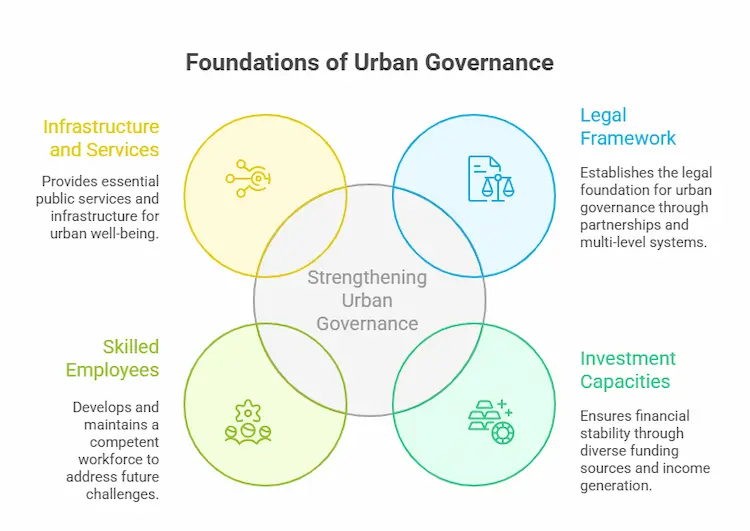
Unlocking urban potential through regulated european data spaces
Europe’s regulatory framework underpins secure, ethical, and rights-based data ecosystems. The GDPR protects privacy; the Data Governance Act enables secure sharing; the Data Act clarifies access to industrial and IoT data; the AI Act ensures accountable deployment; and cybersecurity regulations protect critical infrastructure. Together, these rules treat data as a shared strategic asset while safeguarding democratic values and digital sovereignty.
Building on this foundation, EU “data spaces” aim to create secure, cross-sector ecosystems that enable integrated policymaking and scalable innovation. One example, the Data Space for Smart and Sustainable Cities and Communities initiative (DS4SSCC), pilots federated, place-based ecosystems aligned with Europe’s Green Deal and Digital Decade, with €15M funding 10–12 city-led pilots by 2026, despite only about half of HVDs being fully open due to privacy and security hurdles. These spaces aim to provide cities with locally governed yet shareable data to accelerate both the green and digital transitions.
Federated data platforms for interoperable urban ecosystems
Urban platforms evolve into federated ecosystems where data producers retain ownership while sharing securely. Designed to minimize vendor lock-in and enable cross-sector coordination, they mostly rely on interoperability mechanisms and open standards respectively promoted by networks such as Open & Agile Smart Cities (OASC) and the FIWARE Foundation (400+ cities). Building on the initial Local Digital Twin Toolbox work on standards and procurement, the new European Digital Infrastructure Consortium (EDIC) now integrates this agenda with Member States, promoting interoperability at scale on a continent largely shaped by intermediary cities. From this model emerge next-generation urban digital twins, AI-driven virtual replicas of cities that support scenario modeling, risk assessment, and policy experimentation, where citizens also engage directly via digital interfaces, and AI systems can capture preferences and feedback to refine strategies and ethically build trust.
Pioneering European cities such as Helsinki, Amsterdam, Vienna, or Rotterdam are advancing interoperable platforms, but it is Rennes that has emerged as the historical metropolitan reference for data governance and data sovereignty, while Flanders plays a similar role at the regional scale. Unlike Barcelona’s earlier centralized CityOS model, which recentered control even as it escaped proprietary lock-in, the capital city of Brittany (France) deliberately shifted toward a federative approach: its EU-funded RUDI platform structures a multi-stakeholder ecosystem and, together with the ongoing State-funded City Orchestra initiative, channels roughly €20 million of cumulative investment over a decade into climate, IoT, and planning use cases, now directly informing the strategic DS4SSCC blueprint.
Scaling urban data governance through multi-level governance
Europe’s investments in data spaces, federated platforms, and local digital twins enable cities, fully engaged through the Living in EU platform (120+ cities), to co-create and operationalize interoperable digital ecosystems and citizen-centered governance, backed by Horizon Europe’s €120M/year for 100 Climate-Neutral Cities tracking 100+ NetZeroCities indicators (GHG, equity, economic impact, etc.). Pilots show how cities can strategically use data to support structural change; the next step is scaling these demonstrators from local pilots to continent-wide deployment.
Effective data governance goes beyond technical implementation. It requires continuous learning, adaptation, and coordination across governance levels. Europe’s model blends top-down with bottom-up approaches, testing and refining policies from decarbonization to well-being, as affirmed by Eurocities’10 Data Principles and by Joint Research Centre work on multilevel, subsidiarity-based approaches to digital and data governance. This adaptive framework strengthens resilience, drives innovation, and anchors impact in local contexts, while keeping scalability at the core of the European urban digital agenda.
The political and systemic challenges of urban data governance in Europe
At its core, data governance is political. It shapes power, builds trust, and defines collective action. Europe anchors this in subsidiarity and accountability, while the UN’s Decade of Action calls for robust methodologies and consolidated frameworks. Yet risks remain: technocratic drift from biased or incomplete datasets, uneven capacities across territories, vendor-driven governance capture, and potential national recentralization requiring adaptive metrics, regulatory sandboxes, and genuine civic deliberation. These tensions show that progress is neither linear nor assured, as structural asymmetries and fragmented institutional landscapes continue to hinder systemic deployment.
The coming decade will serve as a decisive stress test: only ecosystems capable of aligning interoperability, distributed governance, and regulatory absorption will scale beyond pilots. At a broader level, the proliferation of EU initiatives highlights the need for clearer alignment and gradual rationalization, with cumulative investment in urban data and digital governance programmes, mostly recent, likely reaching several hundred million euros, making urban data governance in Europe a defining factor of the continent’s urban future.
About the author: Stéphane Péan, is a global strategist with European experience and international activities, notably across Asia, advising corporations, institutions and cities on digital governance and resilient, people-centered urban ecosystems.
Read more about urban data here.