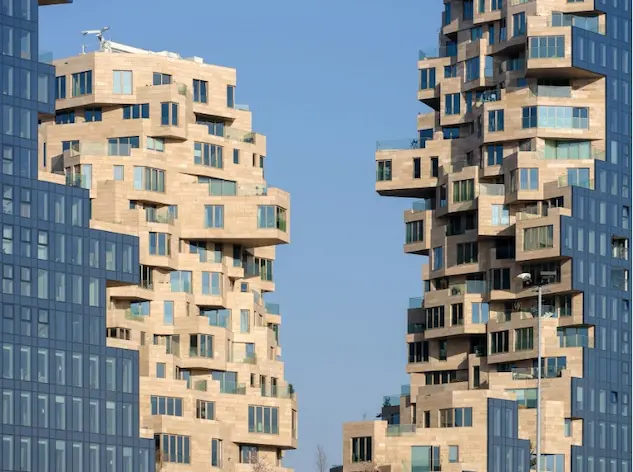

From Beijing’s collective-land rental housing to Vienna’s social housing and Tokyo’s compact living, youth-oriented models are reshaping the future of affordable urban housing solutions.
Across major cities worldwide, younger residents are finding it increasingly difficult to secure stable, affordable housing even when employed full-time and living modestly. Skyrocketing rents, constrained supply, and competition from investors have left newcomers and early-career professionals squeezed out of traditional housing markets. In response, cities are experimenting with new models designed to retain talent, support “new urban citizens,” and rebuild housing systems around flexibility rather than ownership. These emerging approaches are redefining what affordable urban housing solutions can look like in the 21st century.
A global lens on affordability: what the data shows
A broader statistical perspective reinforces how complex today’s global housing affordability challenges have become. A new cross-country dataset developed by IMF economists Nina Biljanovska, Chenxu Fu and Deniz Igan (2024) introduces a mortgage-based Housing Affordability Index (HAI), offering a more robust way to compare affordable urban housing solutions across countries. Their analysis of 40 OECD economies reveals that housing affordability actually improved between the late 1990s and the mid-2010s largely because declining mortgage rates and favourable macroeconomic conditions reduced borrowing costs. Yet the picture is far from uniform: affordability diverges sharply between advanced economies (average HAI of 118) and emerging markets (average HAI of 85), highlighting the importance of mortgage market development. More recent data underscores renewed pressure on households, as the post-pandemic surge in house prices and the global monetary tightening cycle have already begun reversing earlier gains. These findings remind policymakers that even well-designed urban housing policy trends must account for volatility in financial conditions – and that affordability improvements can be fragile when mortgage costs rise faster than incomes.
Figure 1. Changes in the housing affordability index and its time-varying components.
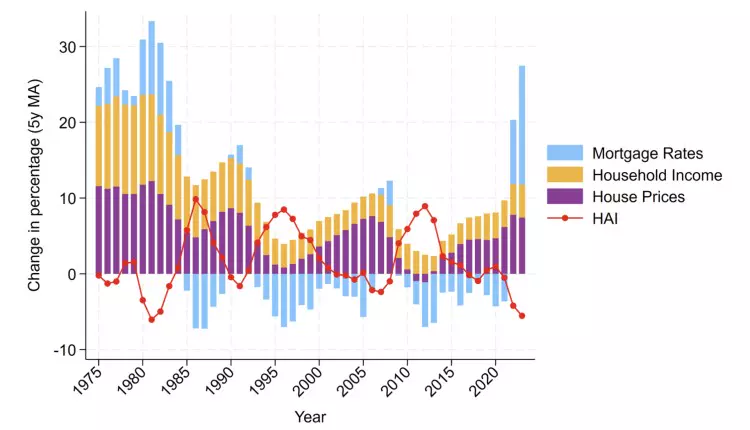
Source: A new dataset on housing affordability
One of the most intriguing examples comes from Beijing, where a bold policy shift has enabled the creation of innovative rental housing communities on collectively owned land, a resource unique to China’s urbanization story. The Beijing Chengshousi Collective Land Rental Housing project illustrates how unconventional land governance can unlock thousands of affordable homes for young workers while revitalizing urban villages absorbed by metropolitan growth. It is increasingly cited as part of a broader global movement toward next-generation rental communities.
A housing model of affordable urban housing solutions growing out of urban change
As Beijing expanded over the past decades, many surrounding villages became engulfed by the city. Their collective ownership of land remained legally intact, even after urban designation, but usage was heavily restricted. Informal rental blocks proliferated, meeting high demand from young workers priced out of formal housing and illustrating the scale of global housing affordability challenges.
This changed in 2017, when China launched a pilot programme in 13 cities allowing collective land to be used legally for rental housing for the first time. It opened a new channel for supplying affordable urban housing solutions without competing for scarce urban land.
Beijing’s Chengshousi project became one of the emblematic early examples.
Inside Beijing’s new youth-focused rental communities
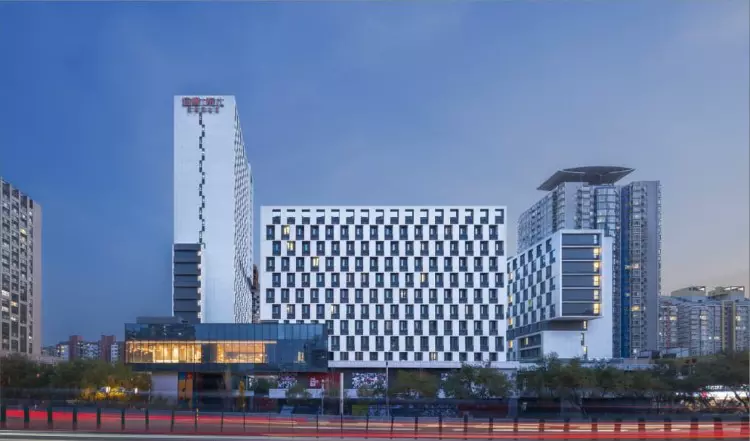
The Chengshousi development includes four blocks and 961 apartments with 70% consisting of compact studios of 15–20 m² and 30% designed for specific tenant groups such as remote workers, female residents, pet owners or fitness enthusiasts. An “active edge” at street level hosts cafés, shops and community services, while the shared core offers a gym, co-working spaces and a micro-cinema. It opened a new channel for supplying affordable urban housing solutions without competing for scarce urban land.
Although the formal age range is broad (18–45), government guidelines identify “new urban citizens”, recent graduates and young professionals, as priority beneficiaries.
Corporate leasing plays a growing role: around 200 units were rented by employers for staff, and the overall vacancy rate remains extremely low at about 3%.
Why developers enter the market even under financial pressure
Vanke, one of China’s largest developers, was chosen to operate the project due to its long-term experience in innovative rental housing and mature digital management platforms. Even amid the company’s recent financial difficulties, youth-oriented rentals remain strategically attractive: they offer stable occupancy and predictable returns over a long-term horizon, unlike speculative apartment sales.
Beijing’s broader affordable housing strategy
The Chengshousi project helped shape Beijing’s 14th Five-Year Plan for Housing Security (2021–2025), which calls for the creation of 400,000 affordable rental units across three formats: family rental apartments, employer-provided dormitories, and large-scale collective-land rental communities. This integrated strategy has strengthened Beijing’s position as a leader in developing affordable urban housing solutions.
Since Chengshousi, at least five additional Vanke projects have opened, including complexes with 1,700 and 3,200 studios, while China Resources, a major state-linked enterprise, operates similar developments at scale.
Global examples reinforcing the trend
Cities worldwide are testing new rental and mixed-tenure models to support young residents, retain talent and adapt to shifting housing needs. Though approaches vary, they share common principles: stable affordability, efficient land use, and community-oriented design. Taken together, they form a global laboratory for urban housing policy trends.
Vienna: long-term affordability through public land. More than 60% of residents live in subsidized or municipally supported housing. Vienna’s model shows how public land control can sustain affordable urban housing solutions for younger and lower-income residents.
Helsinki: mixed-tenure districts for social balance. Helsinki requires at least 25% of new housing in development areas to be affordable rentals, integrating them into market-rate neighborhoods and creating next-generation rental communities that avoid segregation.
Tokyo: compact living with shared amenities. Tokyo’s micro-apartments (14–20 m²) and co-living models demonstrate how design innovation can support youth housing models in high-density megacities while maintaining affordability.
Singapore: a structured rental pathway for young singles. Singapore supplements its ownership-focused housing system with short-term public rental flats for early-career residents, reinforcing its standing as a city that actively addresses global housing affordability challenges.
New York City: pilot programs for micro-housing. New York’s Carmel Place introduced 25–35 m² micro-units with communal facilities, informing urban housing policy trends in North America.
What cities can learn from Beijing
Beijing’s approach offers several instructive lessons for cities worldwide:
1. Alternative land sources can dramatically expand rental supply
Opening collective land to urban rental development created a new supply channel in one of the world’s most constrained property markets.
2. Youth-oriented design increases housing effectiveness
Affordable studios, shared amenities and themed units reflect the lifestyles and budgets of early-career workers, contributing to scalable affordable urban housing solutions.
3.Professional management builds trust and long-term viability
Digital leasing systems, standardized operations and predictable pricing outperform informal rental markets.
4. Blending corporate and individual leasing stabilizes communities
Company-leased units offer steady occupancy, while individual rentals ensure diversity and social engagement.
5. Housing is now part of cities’talent strategies.
Cities that create next-generation rental communities are better positioned to attract young professionals essential to the innovation economy.
Looking ahead
As global cities confront mounting shortages of accessible, affordable housing, Beijing’s rental innovations, alongside examples from Vienna, Helsinki, Tokyo, Singapore and New York, provide a compelling blueprint. The emerging theme is clear: the future of urban living will depend less on ownership and more on flexible, community-oriented, professionally managed rental ecosystems grounded in affordable urban housing solutions.
The next generation may not prioritize buying a home early in life, but they seek stability, dignity, mobility and opportunity. Cities that recognize these needs, and adapt accordingly, will be the ones that thrive.
Read more about sustainable urbanization here.