
How are the world’s “smartest cities” actually ranked? This article examines smart city ranking methodology, from indicator selection to weighting and normalization. Understanding how the numbers are built changes how we interpret the Top 10 cities of 2025.
Read MoreSmart City Ranking Methodology: Beyond the Top 10 Cities of 2025 (II)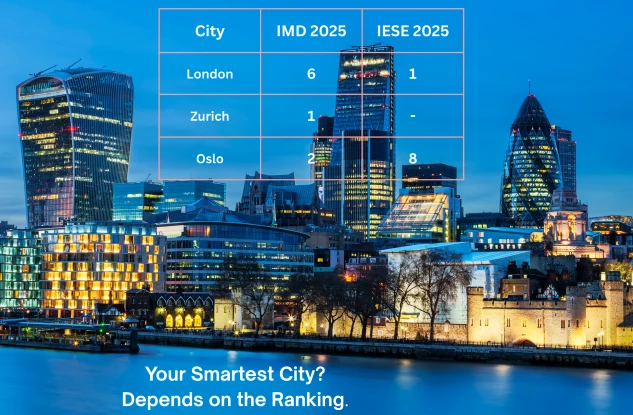
Who is the smartest city in the world? It depends on the ranking. This article examines how leading smart city indexes define and measure “smartness” and why their results diverge
Read MoreSmart City Rankings Methodology: Beyond the Top 10 Cities of 2025 (I)
Winter urban heat islands are often seen as a seasonal advantage, making cities slightly warmer during cold months. However, growing evidence shows they can worsen air pollution, accelerate infrastructure damage, and create hidden public health risks. This article explores real-world case studies and explains why winter UHIs are becoming a critical issue for sustainable and smart cities.
Read MoreWhen Warmth Becomes a Trap: The Hidden Costs of Winter Urban Heat Islands
The Smart Engineering for Urban Development conference in Belgrade brought together experts from Serbia and Nordic countries to discuss how Western Balkan cities can move beyond isolated smart city projects toward systemic urban transformation. The discussions highlighted that sustainable and smart urban development depends not only on technology, but on governance, planning, financing and cross-sector cooperation.
Read MoreSmart Cities Need Systems, Not Just Technology: Lessons from “Smart Engineering for Urban Development”
In this interview, Svetlana Tešić shares her expert perspective on AI in urban governance and the growing role of cities in shaping digital transformation. She discusses citizen trust, collaboration between municipalities, and the importance of human-centric approaches to technology. The conversation explores how European cities can use AI responsibly while strengthening democratic governance and public participation.
Read MoreAI in Urban Governance and the Future of Human-Centric Cities: Interview with Svetlana Tešić
The extraordinary snowfalls of early 2026 once again exposed structural weaknesses in urban winter maintenance systems. Gender-sensitive snow clearance, first implemented in Swedish cities, demonstrates how rethinking snow removal priorities can improve safety, equity, and cost efficiency in climate-stressed cities.
Read MoreGender-Sensitive Snow Clearance: Why Winter Maintenance Is a Question of Urban Accessibility
New York is moving toward an all-electric buildings law that could end gas-powered systems in new construction. The proposal has sparked legal challenges and concerns over costs and grid readiness. The outcome may influence building electrification policies far beyond the state.
Read MoreNew York Moves Toward an All-Electric Buildings Law Amid Court Battles and Grid Concerns
This article examines air pollution in Serbian cities with a focus on changes in pollutant composition, dominant emission sources, and associated health risks. Using examples from major urban centers, it highlights how particulate matter, nitrogen dioxide, sulfur dioxide, and ground-level ozone interact to create complex urban air pollution patterns. The paper also outlines policy-relevant pathways for restoring urban air quality through energy transition, sustainable transport, and integrated environmental monitoring.
Read MoreAir Pollution in Serbian Cities: Sources, Health Risks, and Ways to Improve Urban Air Quality
In this interview, Milica Raičković discusses how noise and air pollution affect public health and urban quality of life across Serbia and the Western Balkans. Drawing on insights from a major regional conference, she explains why systematic monitoring, interdisciplinary planning, and data-driven decision-making are essential for healthier cities.
Read MoreHow Noise and Air Pollution Shape Healthier Cities: Interview with Milica Raičković
This article examines how urban data governance in Europe is reshaping city development through regulatory frameworks, federated platforms, and mission-oriented data spaces. It explores how European cities leverage data to align climate, social, and digital objectives while addressing fragmentation, governance complexity, and uneven territorial capacities. The analysis highlights both the systemic potential and political challenges of scaling these models across Europe.
Read MoreHow Urban Data Governance in Europe Is Shaping the Future of Cities