
In February 2026, the Sustainable Development Solutions Network (SDSN) released the Europe Sustainable Development Report 2026, one of the most comprehensive assessments of how European countries are progressing toward the UN Sustainable Development Goals (SDGs).
At a time when the European Union is navigating the energy transition, geopolitical uncertainty and growing climate risks, the report offers an important snapshot of where the continent stands today. In this short overview, we examine several key findings from the Europe Sustainable Development Report 2026 and consider what they reveal about the current state of sustainable development in Europe, particularly from the perspective of cities and regional development.
Leaders and lagging regions in the SDG Index for Europe
According to the latest SDG Index for Europe, Finland, Sweden and Denmark once again lead the ranking, with scores of 80.8, 78.7 and 78.1 respectively. The European Union as a whole averages 72.4 points, confirming its position among the world’s strongest performers in sustainable development.
At the same time, the Europe Sustainable Development Report 2026 highlights a clear regional divide. Northern Europe reaches an average SDG score of 79.7, while Central and Eastern Europe averages 69.8, and candidate countries remain further behind at 61.0.
The Western Balkans illustrate this gap particularly clearly. Serbia scores 65.3, North Macedonia 63.7, and Albania 62.4 in the 2026 SDG Index. These figures reflect the structural challenges facing countries that are still converging toward EU environmental and economic standards.
For policymakers, the regional imbalance highlighted in the Europe Sustainable Development Report 2026 raises an important question: how can the European sustainability transition move forward without leaving entire regions behind?
Table 1. 2026 SDG Index for Europe
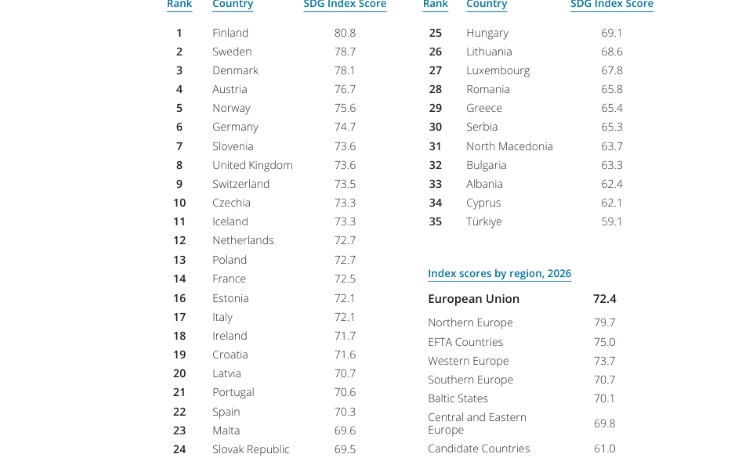
Source: Europe Sustainable Development Report 2026
Persistent challenges across key sustainability goals
Despite relatively strong overall performance, the report stresses that every European country still faces at least two major challenges across the 17 SDGs. The most persistent difficulties appear in sustainable agriculture, responsible consumption and production, climate action and biodiversity protection.
Some of these challenges reflect deeper structural trends within the European economy. According to modelling cited in the Europe Sustainable Development Report 2026, agricultural emissions remain largely stagnant, while energy emissions decline only gradually under existing policy frameworks.
Regional environmental pressures add another layer of complexity. In Southern Europe, water stress and irrigation deficits are becoming increasingly visible, yet many national climate and energy plans still lack enforceable targets for water demand management. These dynamics illustrate how environmental pressures are shaping sustainable development in Europe in ways that vary significantly across regions.
Cities and the implementation challenge in the Europe Sustainable Development Report 2026
Another important message of the Europe Sustainable Development Report 2026 concerns the growing role of cities and regions in implementing sustainability policies.
Across Europe, urban governments are increasingly preparing Voluntary Local Reviews (VLRs), sustainability reports aligned with the UN SDGs that translate global targets into local policy frameworks.
Cities in countries such as Germany, Finland and Spain have already begun using these frameworks to coordinate climate policy, public transport planning, housing strategies and social inclusion initiatives.
This trend reflects a broader reality of the European sustainability transition. Many of the decisions that ultimately determine progress toward the SDGs are made at the urban level. Infrastructure planning, building regulations, transport systems and energy networks are all largely managed by local authorities, making cities key actors in the implementation of sustainable development strategies.
Sustainable development in Europe in a changing global context
The report appears at a moment when global sustainability governance is facing increasing pressure. Worldwide, less than 20% of SDG targets are currently on track to be achieved by 2030, a reminder that the global sustainability agenda is entering a critical phase.
At the same time, international negotiations in 2025 produced several new initiatives aimed at strengthening financing for sustainable development, including the Seville Commitment and new climate measures affecting the global shipping sector.
Within this broader context, Europe continues to play an important role as a testing ground for policies that attempt to reconcile climate action, economic transformation and social cohesion.
Toward a systemic European sustainability transition
The central conclusion of the Europe Sustainable Development Report 2026 is that sustainable development cannot be achieved through isolated policy measures. Instead, Europe will need stronger coordination between climate policy, agriculture, water management, infrastructure planning and industrial strategy.
Experts recommend creating integrated policy platforms linking national climate plans with agricultural and water policies, while strengthening financing mechanisms for renewable energy, hydrogen infrastructure and climate adaptation.
Only such a systemic approach, the report concludes, can deliver a pathway toward climate neutrality that is economically viable, environmentally sustainable and socially equitable across Europe.
For European cities and regions, the coming decade will therefore be decisive. The policy frameworks largely exist. The main challenge now lies in translating ambitious sustainability strategies into practical implementation across very different economic and geographic contexts.