
Across the Western Balkans, urban development is still largely shaped by fragmented initiatives rather than long-term sustainability strategies. Cities are gradually modernizing infrastructure and introducing smart solutions, but progress on climate resilience, pollution reduction and integrated urban planning remains uneven. Smart projects are often implemented as isolated efforts instead of being part of coordinated long-term transformation.
Against this backdrop, the conference Smart Engineering for Urban Development, held on February 12 in Belgrade, marked the final event of the Nordic Smart and Green Cities – Building Partnerships in the Western Balkans initiative. The initiative was launched by the Embassy of Denmark in Belgrade, the Royal Norwegian Embassy in Belgrade, the Embassy of Sweden in Serbia and the Embassy of Finland in Serbia, with support from the Nordic Council of Ministers. The conference itself was organized in partnership with the Chamber of Commerce and Industry of Serbia and the Nordic Business Alliance.
The event brought together representatives of governments, international financial institutions, private sector companies and urban development experts from Serbia and the Nordic region to discuss how cities in the Western Balkans can move from individual smart city projects toward system-level urban transformation.
From technology to systems thinking
The program included opening remarks by Swedish Ambassador Charlotte Sammelin and Mihailo Vesović, Vice President of the Serbian Chamber of Commerce, followed by expert presentations and two panel discussions featuring domestic and international speakers.
One of the central case studies presented was Stockholm Royal Seaport. The presentation was delivered by Christina Salmhofer, Sustainability Strategist at the City of Stockholm, who outlined how sustainability principles are implemented in large-scale urban development.
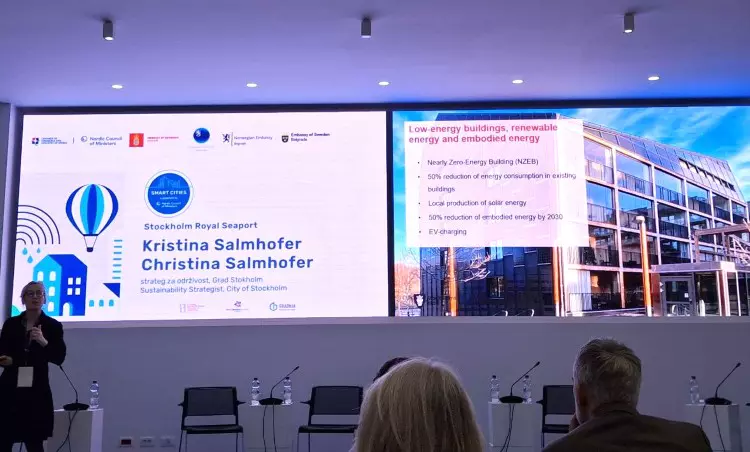
A key idea surfaced repeatedly throughout the day and could already be traced to this part of the program. A smart city is not defined by technology itself. Technology is a tool. A smart city is fundamentally a system built on systemic thinking, long-term planning, continuous dialogue and participation of stakeholders, including citizens, combined with effective implementation mechanisms.
This systemic perspective shaped much of the Nordic contribution. Swedish architect Klas Groth presented the SymbioCity concept as an integrated planning model linking energy, mobility, environment, infrastructure and social systems. Paul Dixelius, SymbioCity Project Manager at the Swedish Association of Local Authorities and Regions, highlighted the role of local governments and cross-sector cooperation in urban transformation. Finnish architect Bratislav Toskovic added another dimension, presenting approaches based on circular intelligence in urban development.
The conference also focused on the practical application of Nordic experience in Serbia. Duško Suvajac, Chief Representative at MD Ventures, presented examples of how Swedish approaches to lifecycle value and building data management are being applied in construction projects in Novi Sad.
Local context and financing challenges
The Serbian contribution provided important local context. Speakers discussed ongoing projects and institutional realities shaping smart and sustainable city development in the country. Serbian participants included Iva Petrović (Nordic Business Alliance), Dragana Korica (Executive Director of the Serbia Green Building Council), Miodrag Gluščević (Head of Department for Urban Development, Environmental Protection and Utilities at the Standing Conference of Towns and Municipalities), Jovana Cvetković (Director for Development, Technical Operations and Innovation at MPC Properties), Petar Kolognat (Business Development Director at CTP Serbia), Katarina Gajić (Director of Design and Construction at Delta Real Estate), and others.
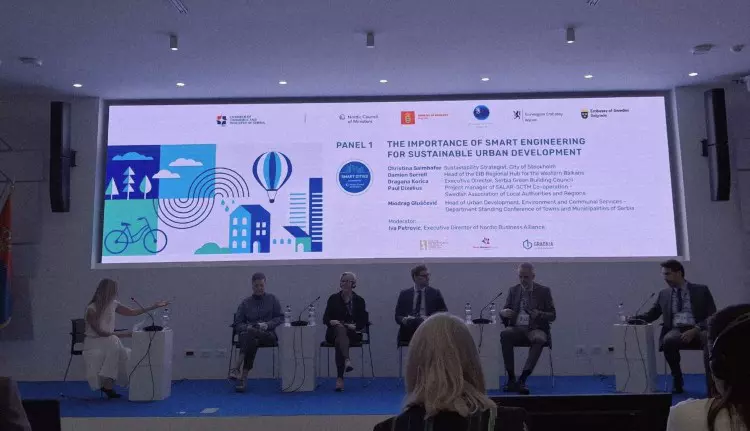
Financing was another key topic. Damien Sorrell, Head of the EIB Regional Hub for the Western Balkans, spoke about financing frameworks and underlined the importance of project maturity, governance capacity and long-term strategic planning for attracting international capital.
What emerged from the conference was a clear move away from a technology-centric view of smart cities. The discussions pointed toward a more mature understanding: cities become smart not when they deploy more digital tools, but when they develop the institutional, strategic and social capacity to use them effectively. Partnerships, knowledge transfer and stakeholder engagement are becoming decisive factors for cities aiming to achieve measurable sustainability outcomes.
Read about other conferences and exhibitions here