
The article about Europe wildfires is provided by our media partner Ecoportal.
In 2025, Europe crossed a dangerous fire threshold that can no longer be treated as an exception or a temporary anomaly. According to the European Forest Institute policy brief Integrated Fire Management: Empowering Action for a Fire-Resilient Europe, more than one million hectares of land burned across European Union countries last year. The scale of Europe wildfires has doubled compared to 2024, marking the worst recorded result since 2006, when the European Forest Fire Information System (EFFIS) was established. These figures are not just abstract statistics. They are a clear signal that Europe is facing a deep structural shift in wildfire risk, with Europe wildfire risk now rising across multiple regions at the same time.
Fires are no longer an exception, but the new normal
The EFI document explains that wildfires are no longer isolated natural disasters or emergency events. Instead, extreme fires are becoming more frequent due to a combination of climate change and land-use changes, particularly the abandonment of rural areas. These processes increase the connectivity of flammable material across landscapes and extend the fire season, which now often runs from early spring to late autumn. As a result, wildfire risk in Europe is expanding geographically and becoming less predictable.
Particularly worrying is the rapid rise in fire risk in regions that until recently were considered low-risk, including parts of Central and Northern Europe. At the same time, an increasing number of scientific studies suggest that mortality linked to fires, especially through smoke exposure, is likely underestimated by up to 93 percent. In other words, the real human and public health costs of Europe wildfires are significantly higher than currently recorded.
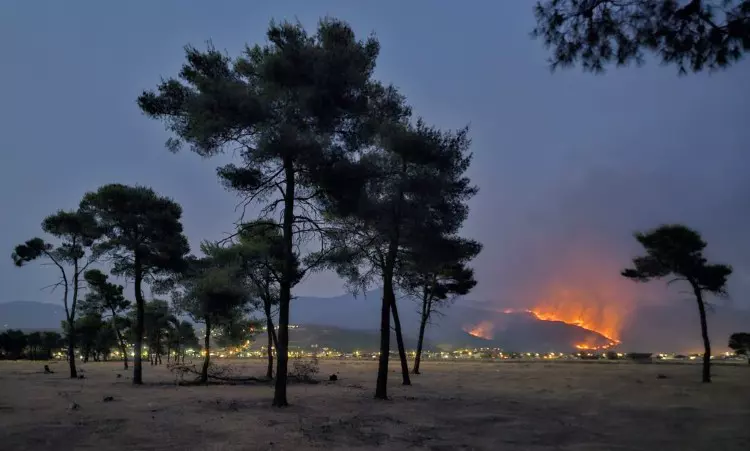
One of the many fires in the vicinity of Podgorica (Montenegro) during August 2025. Photo: Jasmin Murić
The “firefighting trap”: why suppression alone does not work
The EFI Policy Brief clearly states that the dominant approach so far, relying almost exclusively on fire suppression, has proven insufficient. Moreover, such practice leads to what the authors describe as the “firefighting trap”. Short-term success in extinguishing every fire prevents the natural burning of biomass. Over time, this leads to fuel accumulation in forests and increases the risk of future fires that are far more destructive, particularly where active landscape management is missing.
For this reason, the document calls for a shift toward integrated fire management. Integrated fire management is increasingly seen as a core tool for wildfire prevention in Europe, because it treats fire as a matter of land management and social systems, not only as an emergency situation. The approach integrates three closely connected pillars: fire management, which includes prevention, suppression and the controlled use of fire; fire ecology, which focuses on understanding the role of fire in ecosystems; and broader governance, which includes socio-economic and cultural aspects of society’s relationship with fire, as well as its negative impacts on communities.
Resilience starts with citizens and local communities
The authors stress that resilience cannot begin without informed and empowered citizens. Before landscapes can change, society’s relationship with fire must change. In this context, participatory bottom-up models can help close knowledge gaps and strengthen local social capital, allowing communities to manage defensible spaces around settlements themselves. Strengthening wildfire resilience at community level is becoming a central part of long-term wildfire risk reduction in Europe.
The document also highlights the need for a broader public understanding of why planned, controlled vegetation burning can play a crucial role in preventing catastrophic fires. At the same time, nature-based solutions are recognized as an important tool for maintaining long-term ecological stability and preserving forest microclimates.
What the EU should do: policies, funding and knowledge
In a dedicated part of the document, EFI sets out recommendations for decision-makers at the European level. Among the key priorities is the need for innovation in governance and financing, including closer alignment of sectoral policies such as the Common Agricultural Policy, Cohesion Policy and the LIFE Programme, so that measures like afforestation do not unintentionally increase fire risk. The document also calls for the development of a unified policy framework that would bridge the gap between disaster risk management and environmental protection, bringing together social, ecological and risk-related perspectives. Such coordination is becoming central to the future of EU wildfire policy.
Another important proposal is the creation of an easily accessible fire management fund intended for local communities, practitioners and other actors outside uniformed emergency services. At the same time, EFI stresses the need to integrate ecological knowledge more deeply into nature protection systems. This includes developing clear guidelines for fuel management inside protected areas, including sites within the Natura 2000 network, in order to prevent the complete destruction of habitats during large-scale fires. The document also calls for explicit recognition that prescribed burning and certain forestry practices are not exceptional measures, but necessary tools for achieving long-term conservation goals.
National and local levels: landscape as the first line of defense
At national and regional levels, the document calls for enabling the use of prescribed burning in places where it is currently limited by administrative or legal barriers. It also stresses the importance of adapting sustainable forest management practices to reduce fire risk and of investing in landscape mosaics based on agroforestry and silvopastoral systems in high-risk areas. Through grazing and systematic removal of biomass, such landscapes can naturally slow the spread of fire and reduce fuel loads over time, supporting long-term wildfire prevention in Europe.
Special attention is given to prevention and preparedness in wildland–urban interface zones. Managing low vegetation within a 10 to 30 metre zone around homes, combined with clear communication strategies and public education, can significantly reduce risk and improve safety.
After fires occur, the document stresses that recovery should focus on strengthening socio-ecological resilience and territorial equality. The goal is to ensure that recovery contributes to long-term development and improves preparedness for future disturbances.
Conclusion
The document’s conclusion is clear. Reducing the impacts of wildfires in Europe requires moving beyond a purely reactive approach. Integrated fire management makes it possible to treat fire as a comprehensive issue of spatial and social governance. Without systemic change, Europe wildfire risk will continue to grow under climate change, threatening ecosystems, public health and long-term economic stability. Only an integrated approach can protect citizens, preserve ecosystems and serve as a foundation for a resilient, climate-neutral Europe.
Source: EFI: Evropa se više ne smije oslanjati samo na gašenje požara – ecoportal.me
Read about sustainable and smart technologies against fires in cities here